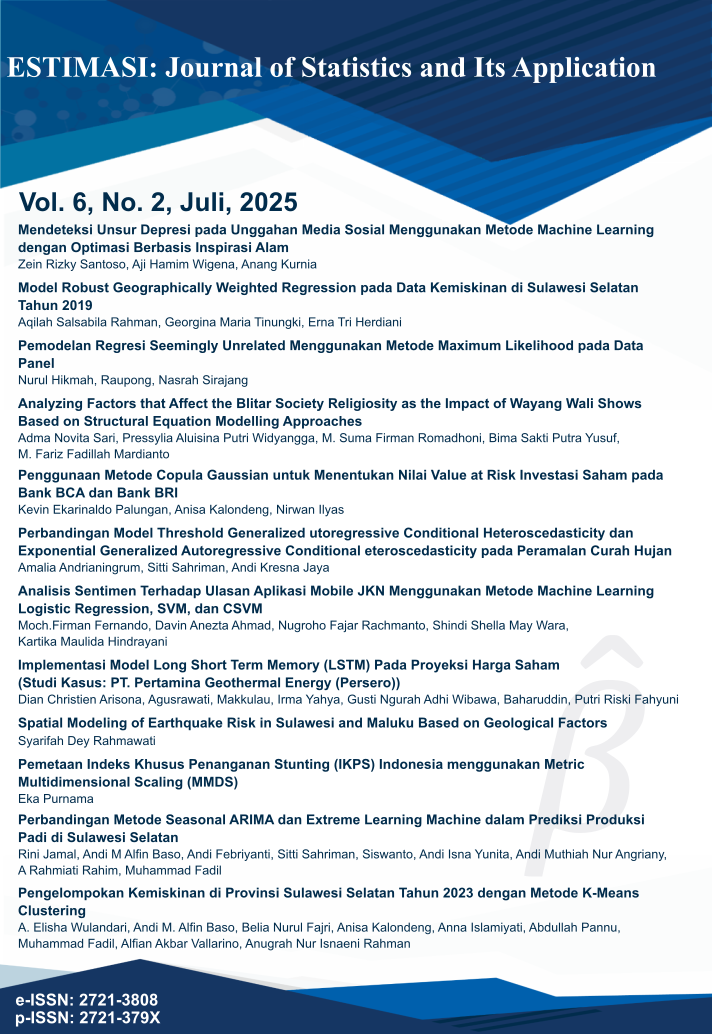
Model Robust Geographically Weighted Regression pada Data Kemiskinan di Sulawesi Selatan Tahun 2019
DOI:
https://doi.org/10.20956/ejsa.v6i2.18046Keywords:
Adaptive Kernel Bisquare, Geographically Weighted Regression, Least Absolute Deviation, Poverty, RobustAbstract
Geographically Weighted Regression (GWR) is a method of spatial analysis that can be used to perform analysis by assigning weights based on the geographical distance of each observation location and the assumption of having spatial heterogenity. The result of this analysis is an equation model whose parameter values apply only to each observation location and are different from other observation locations. However, when there are outliers at the observation location, a more robust estimation method is needed. One of the robust methods that can be applied to the GWR model is the Least Absolute Deviation method. In this study, model estimation was carried out on the factors that affect poverty in South Sulawesi in 2019 using Robust Geographically Weighted Regression (RGWR) with the Least Absolute Deviation (LAD) method. Determination of weighting is done by using the adaptive kernel bisquare weighting function. The results obtained are RGWR models which are different and apply only to each district/city in South Sulawesi. In addition, it was also found that the RGWR model with the LAD method was the best model for data that experienced spatial heterogenity and contained outliers.
References
Dewi, P. L. A. Pemodelan Faktor-Faktor Penyebab Kecelakaan Lalu Lintas Berdasarkan Metode Geographically Weighted Regression di Jawa Timur. Skripsi, Institut Teknologi Sepuluh Nopember, 2016.
Montgomery, D. C. & Peck, E. A. Introduction to Linear Regression Analysis, 2nd edition. New York: John Wiley & Sons, Inc, 1992.
Gujarati, D. Dasar-dasar Ekonometrika, Edisi ketiga, jilid 1. Julius A. Mulyadi, S.E, penerjemah. Jakarta: Erlangga. Terjemahan dari: Essentials of Econometrics, 2007.
Erda, G. Pendugaan Model Regresi Terboboti Geografis dan Temporal Kekar Menggunakan Penduga-M. Tesis. Institut Pertanian Bogor, 2018.
Fotheringham, dkk. Geographically Weighted Regression : The Analysis of Spatially Varying Relationships. John Wiley and Sons, 2002.
Djuraidah, dkk. Pemodelan Regresi Terboboti Kekar dengan Simpangan Mutlak Terkecil dan Penduga-M (Studi Kasus: PDRB Kabupaten/Kota Pulau Jawa Tahun 2015). Tesis. Institut Pertanian Bogor, 2019.
Sari, R. A. Perbandingan Beberapa Metode Kekar pada Pendugaan Parameter Regresi Linier Sederhana untuk Data yang Mengandung Pencilan. Skripsi. Institut Pertanian Bogor, 2016.
Wulandari, dkk. Robust Geographically Weighted Regression Modelingusing Least Absolute Deviation and M-Estimator. International Journal of Scientific Research in Science, Engineering and Technology, 6(1), 238-245, 2019.
Huang, dkk. Geographically and Temporally Weighted Regression For Modeling Spatio-Temporal Variation In House Prices. International Journal of Geographical Information Science, 24(3), 383-401, 2010.
Wheeler, D. C., Fischer, M., Nijkamp, P. Geographically Weighted Regression. Handbook of Regional Science, Berlin, Heidelberg: Springer, 2014.
Downloads
Published
Issue
Section
License
Copyright
It is the author's responsibility to ensure that his or her submitted work does not infringe any existing copyright. Authors should obtain permission to reproduce or adapt copyrighted material and provide evidence of approval upon submitting the final version of a manuscript.