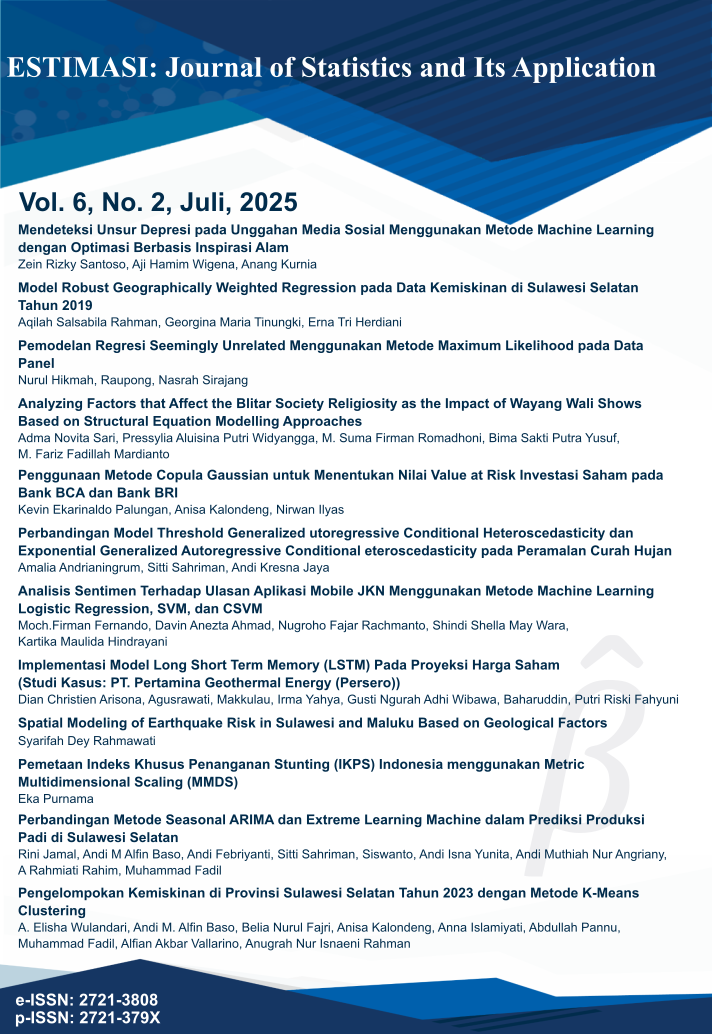
Pemodelan Regresi Seemingly Unrelated Menggunakan Metode Maximum Likelihood pada Data Panel
DOI:
https://doi.org/10.20956/ejsa.v6i2.34463Keywords:
Linear Regression, Maximum Likelihood Estimation, Seemingly Unrelated Regression, PCA, Human Development IndexAbstract
This study aims to model and predict the Human Development Index (HDI) values in South Sulawesi Province for the period 2014–2022 using a multiple linear regression approach with the Maximum Likelihood Estimation (MLE) method. Multiple linear regression analysis often encounters multicollinearity issues among independent variables; therefore, Principal Component Analysis (PCA) is employed as a dimensionality reduction technique to eliminate correlations among explanatory variables. In addition, due to the potential correlation of residuals among equations in a multivariate model, the Seemingly Unrelated Regression (SUR) approach is used, which is also estimated using the MLE method. The data utilized in this study is panel data, which offers advantages in obtaining more comprehensive and accurate information regarding the relationships between the analyzed variables. The estimation results of the SUR model indicate that variables such as Life Expectancy (UHH), Mean Years of Schooling (RLS), Expected Years of Schooling (HLS), and Adjusted Per Capita Expenditure have a significant influence on HDI across all districts/cities in South Sulawesi. One of the estimated equations from the SUR model is y22t=81.44+0.670KU122 which illustrates the relationship between the principal component and HDI in a specific region.
References
Sari, A. Q., Sukestiyarno, Y. L., & Agoestanto, A. Batasan Prasyarat Uji Normalitas dan Uji Homogenitas pada Model Regresi Linear. Unnes Journal of Mathematics, 6(2), 168–177, 2017.
Zellner, A. An Efficient Method of Estimating Seemingly Unrelated Regressions and Tests for Aggregation Bias. Journal of the American Statistical Association, 57(298), 348–368, 1962.
Wooldridge, J. M. Introductory Econometrics. A Modern Approach (Fifth Edition). South-Western, 2012.
Ratnasari, N., Kencana, I., & Gandhiadi, G. K. Aplikasi Regresi Data Panel dengan Pendekatan Fixed Effect Model (studi kasus: PT PLN Gianyar). E-jurnal matematika, 3(1), 1–7, 2014.
Ghozi, S., & Hermansyah, H. Analisis Regresi Data Panel Profitabilitas Bank Pembangunan Daerah (BPD) di Indonesia. Jurnal Matematika, 8(1), 1–12, 2018.
Baltagi, B. H. (2005). Econometric Analysis of Panel Data (Third edition). John Wiley & Sons, Ltd, 2005.
Syamsudin, R., & Wachidah, L. Pengujian Asumsi Homokedastisitas Regresi Linear Berganda Menggunakan RCEV Test Studentized Residual pada Data Pendapatan Asli Daerah (PAD) Kabupaten/Kota Jawa Barat Tahun 2018. Prosiding Statistika. 6(2). 9-16, 2020.
Gujarati, D. N., & Porter, D. C. Basic Econometrics (Fifth Edition). McGraw-Hill, 2009.
Sari, N., Yasin, H., & Prahutama, A. Geographically Weighted Regression Principal Component Analysis (GWRPCA) Pada Pemodelan Pendapatan Asli Daerah Di Jawa Tengah. Jurnal Gaussian, 5(4)717-726, 2016.
Abdi, H., & Williams, L. J. Principal Component Analysis. Wiley Interdisciplinary Reviews: Computational Statistics, 2(4), 433–459, 2010.
Moon, H. R., & Perron, B. Seemingly Unrelated Regressions. The new palgrave dictionary of economics, 1(9), 2006.
Hidayat, M. J., Hadi, A. F., & Anggraeni, D. Analisis Regresi Data panel Terhadap Indeks Pembangunan Manusia (IPM) Jawa Timur 2006-2015 (Panel Data Regression Analysis of the East Java Human Development Index (HDI) 2006-2015). Dalam Majalah Ilmiah Matematika dan Statistika, 18, 2018.
Fitria, S. F. Analisis Regresi Data Panel Pengaruh PDRB, Indeks Pembangunan Manusia, dan Tingkat Pengangguran Terbuka terhadap Jumlah Kemiskinan di Kabupaten/Kota di Jawa Barat pada Tahun 2013-2020. Jurnal Riset Matematika, 1(2), 119–128, 2021.
Downloads
Published
Issue
Section
License
Copyright
It is the author's responsibility to ensure that his or her submitted work does not infringe any existing copyright. Authors should obtain permission to reproduce or adapt copyrighted material and provide evidence of approval upon submitting the final version of a manuscript.