Keywords
poliheuristic theory
rational choice theory
United Kingdom
Germany
Russia-Ukraine conflict
How to Cite
Abstract
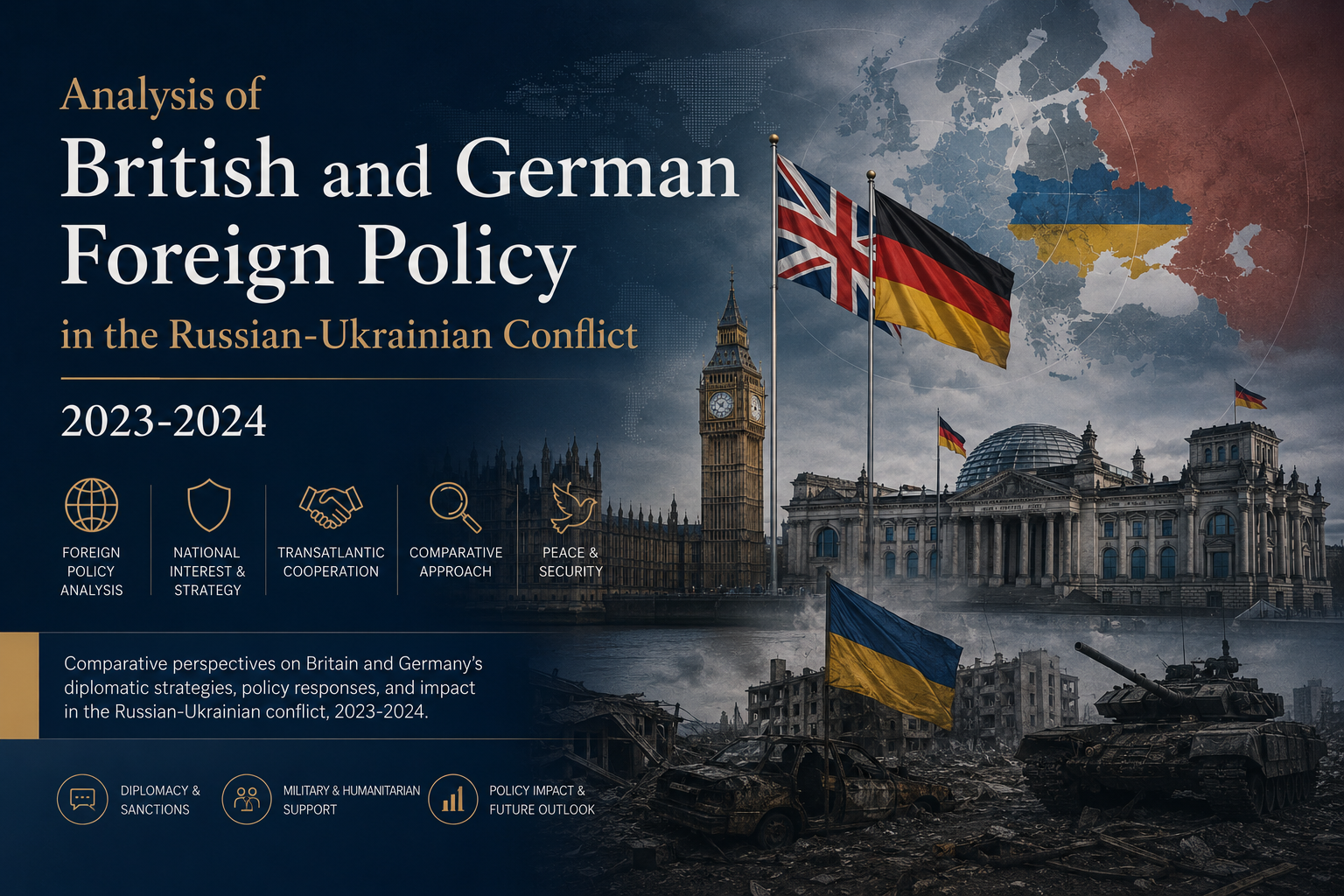
Russia's full-scale invasion of Ukraine on February 24, 2022, reshaped European security and prompted divergent responses among Western powers. This study examines the foreign policy responses of the United Kingdom and Germany to the Russia-Ukraine conflict during 2023-2024, asking: what factors account for the differences in their approaches despite a shared commitment to supporting Ukraine? Employing Poliheuristic Theory and Rational Choice Theory, the study analyses how decision-makers in both countries evaluated policy alternatives across political, economic, security, and international dimensions. The findings reveal stark contrasts in decision-making processes and outcomes. The UK adopted a proactive, assertive stance, rapidly delivering military assistance, implementing broad economic sanctions, and maintaining consistent political support for Ukraine. British policy was driven by NATO alignment, post-Brexit strategic repositioning, and domestic political incentives favouring decisive action. Germany, by contrast, followed a cautious and incremental path, constrained by deep energy dependence on Russia, longstanding economic ties, and a diplomatic foreign policy culture. While Chancellor Scholz's Zeitenwende declaration signalled a historic shift in German defence policy, implementation was slowed by domestic political divisions and competing strategic priorities. The poliheuristic analysis shows that both states employed non-compensatory elimination strategies, rejecting options threatening core national interests, before optimising remaining alternatives based on strategic benefit and domestic political costs. The study concludes that foreign policy responses to security crises are fundamentally shaped by historical context, structural dependencies, domestic politics, and leadership style. While both nations ultimately supported Ukraine, their pathways differed significantly. These findings underscore that analysing decision-making processes, not merely outcomes, is essential for understanding how democratic states navigate shared security threats under competing constraints.

This work is licensed under a Creative Commons Attribution 4.0 International License.
Copyright (c) 2026 Hasanuddin Journal of Strategic and International Studies (HJSIS)