Keywords
South China Sea
neoclassical realism
comparative security
Indonesia
How to Cite
Abstract
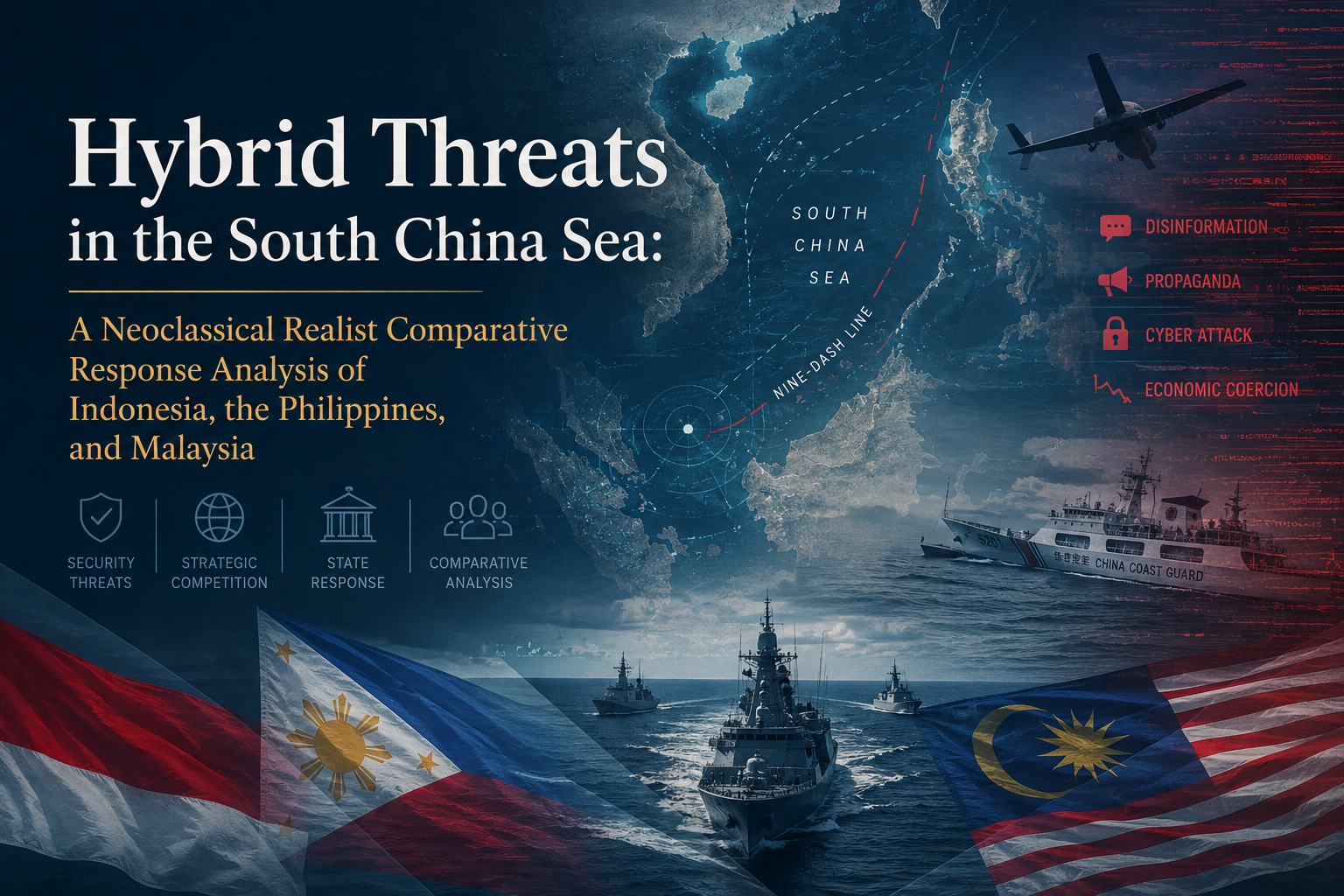
This article examines why Indonesia, the Philippines, and Malaysia respond differently to broadly similar hybrid threats from China in the South China Sea. It adopts a qualitative, most-similar-systems design and applies a neoclassical realist framework in which hybrid pressure is treated as a common systemic stimulus filtered through three domestic dimensions: elite perception, institutional capacity and integration, and state-society relations. The analysis shows that the Philippines has shifted toward denial, backed by formal alliance ties and a deliberate strategy of public transparency; Indonesia relies on diversification, combining legal firmness with diplomatic and operational choices that avoid overdependence on any single partner; and Malaysia maintains soft balancing oriented around the protection of offshore economic interests. These divergent outcomes cannot be explained by material asymmetry alone. By applying a neoclassical realist framework to these three cases, this article links hybrid coercion at sea to the domestic filters that turn similar external pressure into distinct policy paths.

This work is licensed under a Creative Commons Attribution 4.0 International License.
Copyright (c) 2026 Hasanuddin Journal of Strategic and International Studies (HJSIS)