Recommendations for the “One Village, One Product” Strategy and Coffee Marketing Efficiency in Gowa Regency
DOI:
https://doi.org/10.24259/jhm.v17i1.44324Keywords:
arabica coffee, marketing efficiency, OVOP, agroforestry, rural developmentAbstract
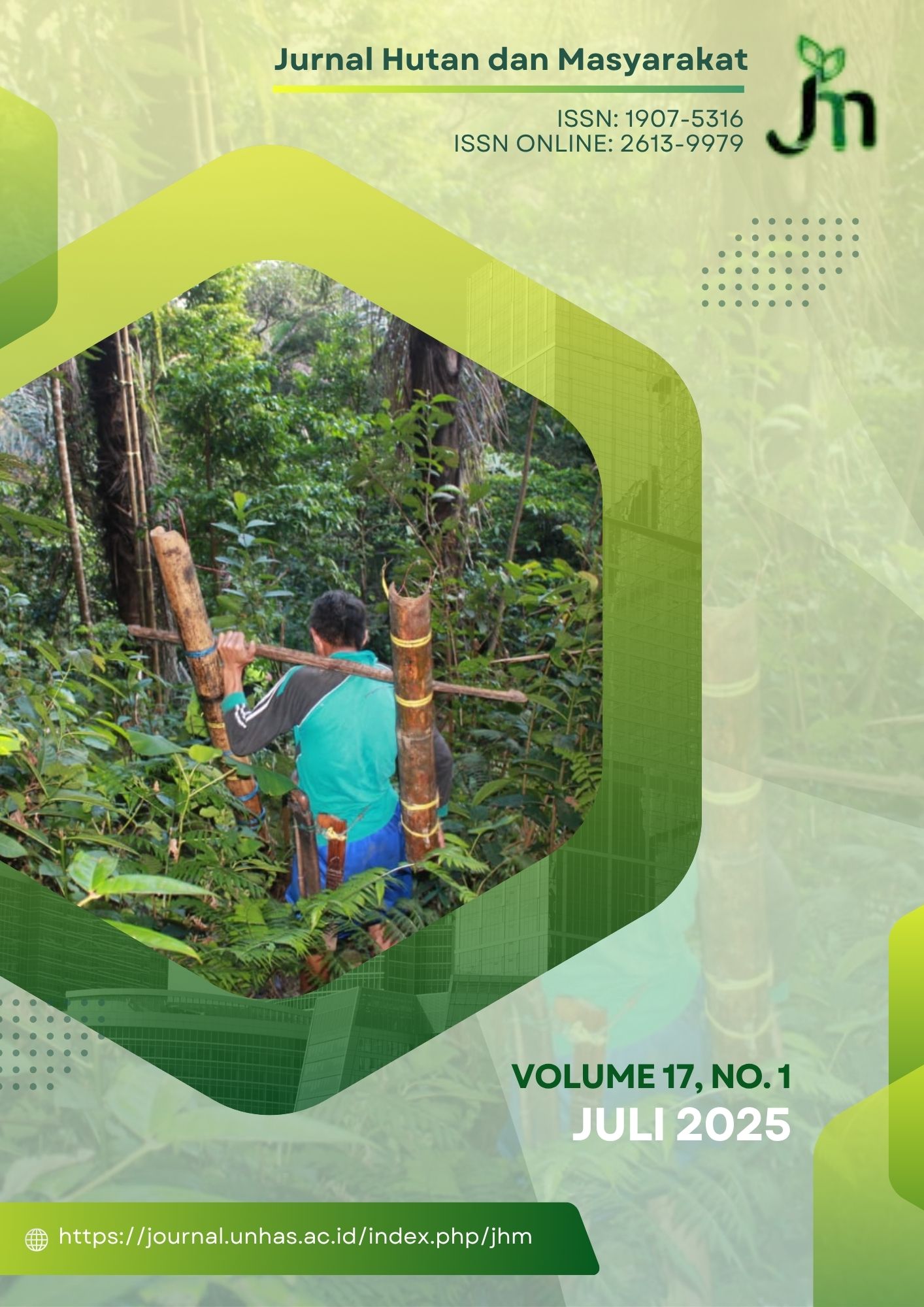
The One Village One Product (OVOP) concept seeks to raise farmers’ income by promoting regionally distinctive commodities. In Topidi Village, South Sulawesi, coffee is widely cultivated and well suited for agroforestry systems, offering high market potential. However, farmer profits are reduced by inefficient marketing channels involving many intermediaries. This study analyzed marketing institutions and the efficiency of Arabica coffee marketing using Marketing Margin, Farmer’s Share, and Profit to Cost Ratio methods. Data from four marketing outlets showed that Outlet IV, where farmers sell directly to end users, achieved the highest marketing efficiency at 44 percent for ground coffee and the highest profit. Adopting the OVOP concept for coffee could help position it as a leading regional commodity by integrating production across areas with similar landscapes, thus strengthening local industry and boosting household incomes.
References
Asmarantaka RW. (2014). Pemasaran Agribisnis (Agrimarketing). Bogor: IPB Pr.
Cerda R, Avelino J, Harvey CA, Gary C, Tixier P, Allinne. (2020). Coffee agroforestry systems capable of reducing disease-induced yield and economic losses while providing multiple ecosystem services. Crop Protection. 134 (2020). DOI: https://doi.org/10.1016/j.cropro.2020.105149
Hajad V, Ikhsan, Herizal, Latif IR, Marefanda N. (2023). Poverty and the Curse of Natural Resources in Indonesia. Journal of Contemporary Governance and Public Policy, 4(1), 41-58. Doi: https://doi.org/10.46507/jcgpp.v4i1.92
Hartatri DFS, Neilson J. (2021). Livelihood strategies of smallholder coffee farmers: case study in Simalungun, North Sumatera. E3S Web of Conferences. 306 (02061): 1 – 9. DOI: https://doi.org/10.1051/e3sconf/202130602051.
Hasannudin DAL, DAL, Nurrochmat DR, Ekayani M. (2022a). Agroforestry management systems through landscape-life scape integration: A case study in Gowa, Indonesia. Biodiversitas 23: 1864-1874. DOI: 10.13057/biodiv/d230420
Hasannudin DAL, DAL, Nurrochmat DR, Ekayani M. (2022b). Pengelolaan Sistem Agroforestry Melalui Integrasi Landscape-Life Scape: Studi Kasus di Kelurahan Bontolerung pada Wilayah Kerja KPHP Unit XIV Jeneberang 1. Thesis. IPB University.
Huang Z, Tan M. (2023). Spatial differences of specialty agriculture development in the mountainous areas of China “one village, one product” as an example. Heliyon 9 (2023) e18391. DOI: https://doi.org/10.1016/j.heliyon.2023.e18391
International Coffee Organization 2020. http://www.ico.org/
Kanako Mukai & Ryo Fujikura. (2015) One village one product: evaluations and lessons learnt from OVOP aid projects, Development in Practice. 25(3): 389-400, DOI: 10.1080/09614524.2015.1020763
Milford AB, Lien G, Reed M. (2021). Different sales channels for different farmers: Local and mainstream marketing of organic fruits and vegetables in Norway. Journal of Rural Studies. 88(2021): 279 – 288. DOI: https://doi.org/10.1016/j.jrurstud.2021.08.018
Natsuda, K., Igusa, K., Wiboonpongse, A., & Thoburn, J. (2012). One Village One Product – rural development strategy in Asia: the case of OTOP in Thailand. Canadian Journal of Development Studies/Revue Canadienne D’études Du Développement, 33(3), 369–385. doi:10.1080/02255189.2012.715
Noble V. (2018). Mobilities of the One-Product policy from Japan to Thailand: a critical policy study of OVOP and OTOP. erritory, Politics, Governance. 7 (4): 455 – 473. DOI: 10.1080/21622671.2018.1511463
Nugroho A. (2014). The Impact of Food Safety Standard on Indonesia’s Coffee Exports. Procedia Environmental Sciences 20 (2014): 425 – 433. Doi:10.1016/j.proenv.2014.03.054
Paul C, Weber M, Knoke T. (2017). Agroforestry versus farm mosaic systems Comparing land-use efficiency, economic returns and risks under climate change effects. Science of the Total Environment. 587-588: 22 – 35.
Permana NS, Masnenah E, Dasipah E, Haeriah Y, Najmudin A, Fatoni A, Gantini T. (2020). Analysis of Arabica Coffee Marketing Efficiency. IOP Conf. Ser.: Earth Environ. Sci. 466 (012026). DOI: doi:10.1088/1755-1315/466/1/012026
Seid G, Kebebew Z. (2022). Homegarden and coffee agroforestry systems plant species diversity and composition in Yayu Biosphere Reserve, southwest Ethiopia. Heliyon. 8(4): e09281. DOI: https://doi.org/10.1016/j.heliyon.2022.e09281
Tamirat N, Tadele S. (2023). Determinants of technical efficiency of coffee production in Jimma Zone, Southwest Ethiopia. Heliyon 9(4). DOI: https://doi.org/10.1016/j.heliyon.2023.e15030
Toledo V, Moguel P. (2012). Coffee and sustainability: the multiple values of traditional shaded coffee. Journal of sustainable agriculture. 36: 353 – 377. DOI: 10.1080/10440046.2011.583719
Undang-Undang Republik Indonesia Nomor 6 Tahun 2014 Tentang Desa.
Veidal A, Flaten O. (2011). Why do farm entrepreneurs sell at farmers’s markets? Insights from Norway. 199. The Handbook of Research on Entrepreneurships in Agriculture and Rural Development.
Widodo PB, Yulianto ME, Ariyanto HD, Paramita V. (2023). Efficacy of natural and full washed post-harvest processing variations on arabica coffee characteristics. Materialstoday: Proceedings. 87 (2): 79 – 85. Doi: https://doi.org/10.1016/j.matpr.2023.02.376
Xujin P. Li J. 2013. The analysis of peasant households’collective brand maintenance behavior in the “one village, one product” programof China. Information technology and quantitative management. 12(2013): 770 – 780. Doi: doi: 10.1016/j.procs.2013.05.099
Yang Q, Zhang D. (2021). The influence of agricultural industrial policy on non-grain procution of cultivated land: a case study of the “one village, one product” strategy impelemented in Guanzhong Plain of China. Land use Policy. 108(105579): 1 – 9. DOI: https://doi.org/10.1016/j.landusepol.2021.105579
Zhang Z, Ren G. (2014). Assesment and revelation of environmental impact on “one Village One product” strategy. J. Northwest AF Univ. (Soc. Sci.Ed). 14 (03).
Downloads
Published
Issue
Section
License
Copyright (c) 2025 Dian Ayu Lestari Hasannudin, Supratman, Syamsu Alam, Makkarennu, Baginda Hamzah

This work is licensed under a Creative Commons Attribution-ShareAlike 4.0 International License.