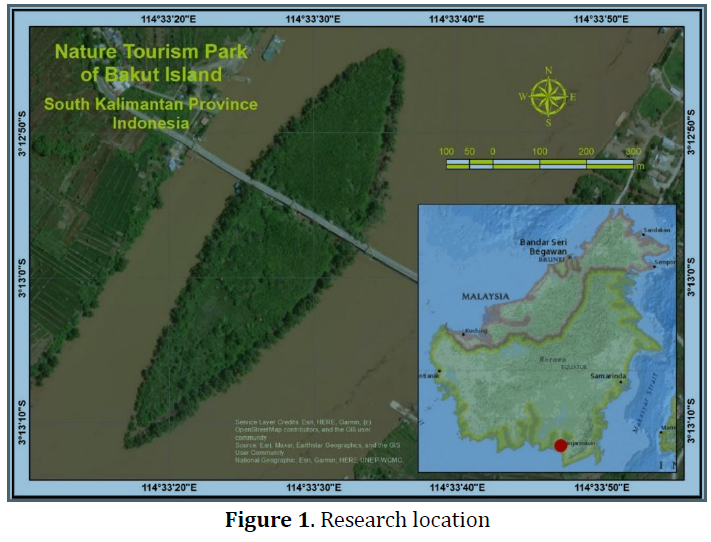
Analysis of the Carrying Capacity of Proboscis Monkey Habitat on Bakut Island, South Kalimantan, Based on Leaf Area Index
DOI:
https://doi.org/10.24259/jpkwallacea.v14i2.35993Keywords:
wildlife habitat, proboscis monkey, carrying capacity, remote sensing, geospatialAbstract
Bakut Island is one of the conservation forest areas in South Kalimantan. This island is the habitat of proboscis monkeys, and the proboscis monkey population is increasing from year to year. Therefore, it is estimated that one day the proboscis monkey habitat on Bakut Island will be over capacity. This study aims to estimate how long the population of proboscis monkeys on Bakut Island Nature Tourism Park can survive there by examining the amount of food the island's vegetation can produce. Proboscis monkey feed itself is estimated using the Leaf Area Index (LAI). LAI was extracted using UAV imaging and NICFI multitemporal imagery. Meanwhile, the carrying capacity of the proboscis monkey habitat is assessed using the quantity of consumption of the proboscis monkey population relative to food availability. Simulations of the carrying capacity of proboscis monkey habitat into the future were carried out using projections of the future proboscis monkey population and LAI growth. The entire computational process of simulating habitat carrying capacity is carried out using the Python language. The results of the analysis show that Bakut Island is only able to support proboscis monkey habitat until 2038. In that year, the proboscis monkey population on Bakut Island is projected to number 1,290 individuals. After 2038, the predicted amount of feed needed by the proboscis monkey population will exceed the feed available on Bakut Island. The limitation of this research is that it only uses one parameter to assess the carrying capacity of proboscis monkey habitat, namely food availability. There are still other parameters that have not been accommodated, including the home range and trees for nests.
References
Atmoko, T., Toulec, T., Lhota, S., & Darman. (2024). Population status of proboscis monkeys in Balikpapan Bay and their potential survival challenges in Nusantara, the proposed new capital city of Indonesia. Environmental Monitoring and Assessment, 196(2), 107. https://doi.org/10.1007/s10661-023-12252-z.
Azizah, N.A., Fithria, A., Rudy, G.S., Kanti, R., Rahman, H.A., & Imam, R. (2024). Analysis of vegetation composition and structure in the Bakut Island Tourism Park Area Anjir Muara District Barito Kuala Regency South Kalimantan. Jurnal Sylva Scienteae, 7(1). 47-54. https://doi.org/10.20527/jss.v7i1.11730.
Balolia, K. L., & Fitzgerald, P. L. (2024). Male proboscis monkey cranionasal size and shape is associated with visual and acoustic signalling. Scientific Reports, 14(1), 10715. https://doi.org/10.1038/s41598-024-60665-8
Boonratana, R., Cheyne, S.M., Traeholt, C., Nijiman, V., & Supriatna, J. (2021). Nasalis larvatus (amended version of 2020 assessment). The IUCN Red List of Threatened Species 2021. https://dx.doi.org/10.2305/IUCN.UK.2021-1.RLTS.T14352A195372486.en.
Choudhury, B.J., Ahmed, N.U., Idso, S.B., Reginato, R.J., & Daughtry, C.S.T. (1994). Relations between evaporation coefficients and vegetation indexes studied by model simulations. Remote Sensing of Environment, 50(1), 1-17. https://doi.org/10.1016/0034-4257(94)90090-6.
Curran, L.M., Trigg, S.N., McDonald, A.K., Astini, D., Hardiono, Y.M., Siregar, P. Caniago, I., & Kasischke, E. (2004). Lowland forest loss in protected areas of Indonesian Borneo. Science, 303(5660), 1000-1003. https://doi.org/10.1126/science.1091714.
Feilen, K.L., & Marshall, A.J. (2020). Responses to spatial and temporal variation in food availability on the feeding ecology of proboscis monkeys (Nasalis larvatus) in West Kalimantan, indonesia. Folia Primatologica, 91(4), 399-416. https://doi.org/10.1159/000504362.
Hunter, J.D. (2007). Matplotlib: A 2D Graphics Environment. Computing in Science & Engineering, 9(3), 90-95. https://doi.org/10.1109/MCSE.2007.55.
Jayasukma, P.A., Basir, Abdi, F., Rina, K., Aida, A.N., Rahman, H.A., & Imam, R. (2022). Nutrition of proboscis monkeys (Nasalis larvatus) feed sources at Bakut Island Nature Park. Russian Journal of Agricultural and Sosio-Economic Sciences, 131(11), 281-286. https://doi.org/10.18551/rjoas.2022-11.29.
Lisnaini, L., Fithria, A., & Rudi, G.S. (2020). Characteristic of night sleeping trees of proboscis monkes (Nasalis larvatus) in Bakut Island Nature Tourism Park, South Kalimantan. Jurnal Sylva Scienteae, 3(4), 657-666. https://doi.org/10.20527/jss.v3i4.2349.
MacQueen, J.B. (1967). Some Methods for Classification and Analysis of Multivariate Observations, Proceedings of 5th Berkeley Symposium on Mathematical Statistics and Probability, Berkeley, University of California Press, 1, 281-297. http://projecteuclid.org/euclid.bsmsp/1200512992.
Matsuda, I. (2022). Following the trail of the elusive proboscis monkey in Borneo. Ecological Research, 37(5), 562–567. https://doi.org/10.1111/1440-1703.12343.
Matsuda, I., Tuuga, A., & Higashi, S. (2009). Ranging behavior of proboscis monkeys in a riverine forest with special reference to ranging in Inland forest. International Journal of Primatology, 30(2), 313-325. https://doi.org/10.1007/s10764-009-9344-3.
Mazlan, N., Seelan, J.S.S., Chong, Y.L., Bernard, H., Azman, W.N.S.W., Silang, S., Zaini, M.K. & Khan, F.A.A. (2024). Unravelling the metagenomic landscape of gut microbiota in endangered proboscis monkey across
Fithria. et al. / Jurnal Penelitian Kehutanan Wallacea, 14(2): 71-82
Jurnal Penelitian Kehutanan Wallacea, 2025, 2 I 82
malaysian borneo: conservation and ecological insight. Research Square, pp 1-24. https://doi.org/10.21203/rs.3.rs-4487731/v1.
Naparin, M., & Helmi, M. (2023). The Effects of Biodiversity Knowledge on Environmental Awareness and Pro-Environmental Behavior Towards Proboscis Monkey Conservation in the Area of PT. Antang Gunung Meratus. Revista de Gestão Social e Ambiental, 17(5), e03433. https://doi.org/10.24857/rgsa.v17n5-016.
Rezeki A., Zainudin, Ong, E.J., Lee, C.C.C., & Roberts, T. (2020). Population study of proboscis monkey (Nasalis larvatus) on the Islands of Pulau Bakut and Pulau Curiak in South Kalimantan, Indonesia. Proceedings of the International Conference on Environmental Science and Applications (ICESA’20). Virtual Conference – September 7-8, 2020., Paper No. 124. http://dx.doi.org/10.11159/icesa20.124.
Rouse, J.W., Haas, R.H., Schell, J.A., & Deering, D. W. (1973). Monitoring vegetation systems in the Great Plains with ERTS. Third ERTS Symposium, NASA SP-351 I, 309-317. https://ntrs.nasa.gov/api/citations/19740022614/downloads/19740022614.pdf.
Saidah, S., Marsono, D., & Achmad, S. (2002). Studi vegetasi habitat alternatif bekantan (Nasalis larvatus) di Barito Kuala, Kalimantan Selatan. Agrosains, 15 (1), 18-29. https://search.informit.org/doi/10.3316/pdii-a.pdip090359.
Sakti, A. D., Adillah, K. P., Santoso, C., Faruqi, I. Al, Hendrawan, V. S. A., Sofan, P., Rustam, Fauzi, A. I., Setiawan, Y., Utami, I., Zain, A. F. M., & Kamal, M. (2024). Modeling Proboscis monkey conservation sites on Borneo using ensemble machine learning. Global Ecology and Conservation, 54, e03101. https://doi.org/10.1016/j.gecco.2024.e03101
Schmidt, A., Ellsworth, L. M., Boisen, G. A., Novita, N., Malik, A., Gangga, A., Albar, I., Dwi Nurhayati, A., Putra Ritonga, R., Asyhari, A., & Kauffman, J. B. (2024). Fire frequency, intensity, and burn severity in Kalimantan’s threatened Peatland areas over two Decades. Frontiers in Forests and Global Change, 7. https://doi.org/10.3389/ffgc.2024.1221797.
Thiry, V., Boom, A. F., Stark, D. J., Hardy, O. J., Beudels-Jamar, R. C., Vercauteren Drubbel, R., Alsisto, S., Vercauteren, M., & Goossens, B. (2025). Using DNA metabarcoding and direct behavioural observations to identify the diet of proboscis monkeys (Nasalis larvatus) in the Kinabatangan Floodplain, Sabah. PLOS ONE, 20(1), e0316752. https://doi.org/10.1371/journal.pone.0316752
Thorp, K.P., Wang, G., West, A.L., Moran, A.S., Bronson, K.F., White, J.W., & Mon, J. (2012). Estimating crop biophysical properties from remote sensing data by inverting linked radiative transfer and ecophysiological models. Remote Sensing of Environment, 124, 224-233. https://doi.org/10.1016/j.rse.2012.05.013.
Toulec, T., Lhota, S., Scott, K., Putera, A. K. S., Kustiawan, W., & Nijman, V. (2022). A decade of proboscis monkey ( Nasalis larvatus ) population monitoring in Balikpapan Bay: Confronting predictions with empirical data. American Journal of Primatology, 84(2). https://doi.org/10.1002/ajp.23357.
Van Rossum, G., & Drake, F.L. (2009). Python 3 Reference Manual. Scotts Valley, CA: CreateSpace. https://dl.acm.org/doi/book/10.5555/1593511.
Wardatutthoyyibah, W., Pudyatmoko, S., Subrata, S.A., & Imron, M.A. (2018). The sufficiency of existed protected areas in conserving the habitat of proboscis monkey (Nasalis larvatus). Biodiversitas Journal of Biological Diversity, 20(1), 1–10. https://doi.org/10.13057/biodiv/d200101.