Genetic Diversity and Kinship Relationships Among Black Mangrove Populations (Rhizophora mucronata) in West Sulawesi Based on Morphological Markers
DOI:
https://doi.org/10.24259/jpkwallacea.v14i2.36617Keywords:
Genetic Variability, Heterozygosity, Mangroves, Morphological, Rhizophora muronataAbstract
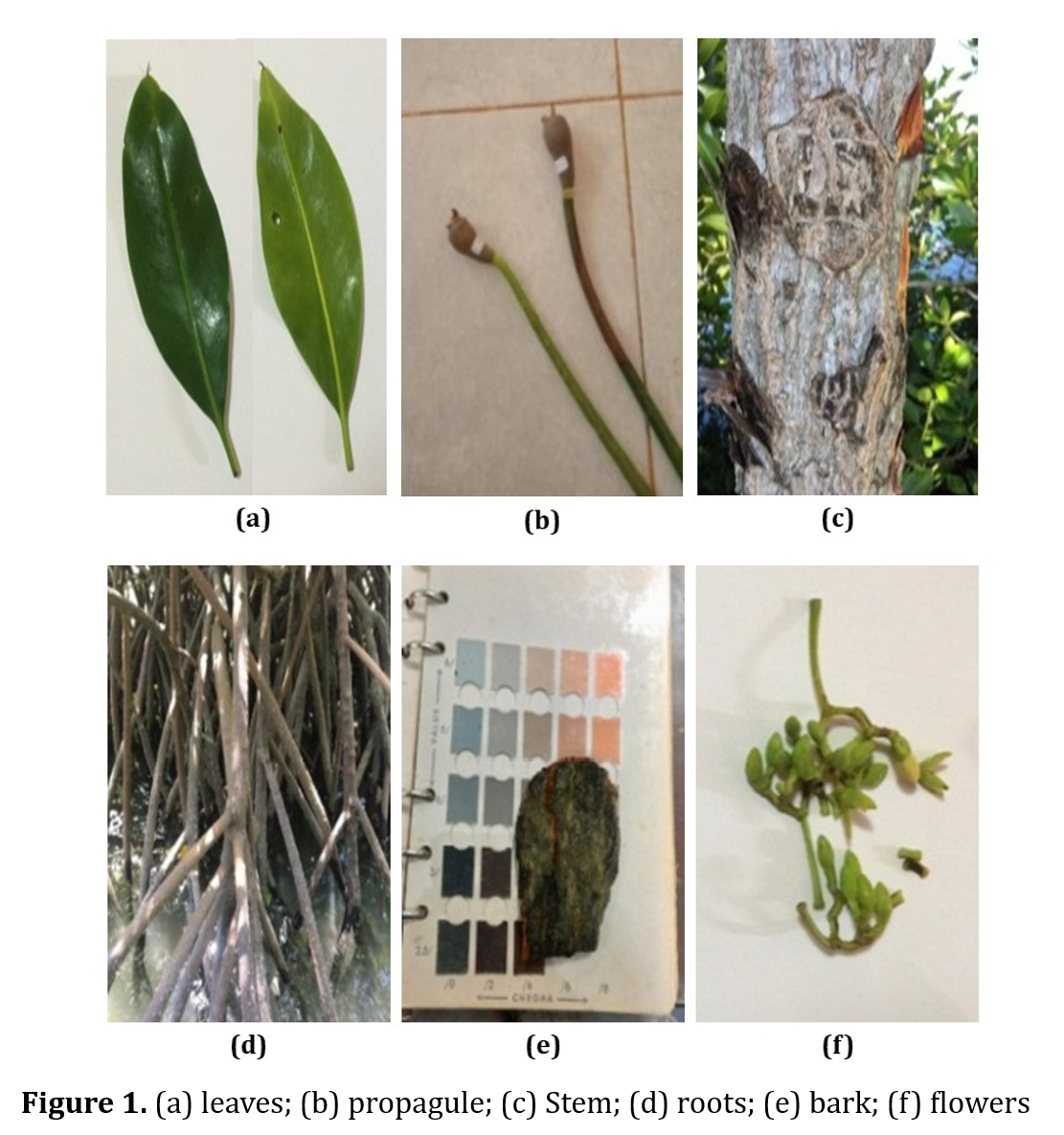
Rhizophora mucronata is a black mangrove with the most productive ecosystem that has benefits many people. But in reality, because of their business, some people often neglect preserving mangrove ecosystems and habitats. This study was conducted to analyze the level of genetic diversity and the relationship between R. mucronata in West Sulawesi based on morphological markers that will be used in future restoration efforts of black mangroves around the coast. This study used ten trees from three origins: Polewali Regency Mandar, Majene, and Mamuju. Then, several parts of the tree are used for this study, namely leaves, trunks, bark, roots, flowers, and propagules. However, the observed characteristics are leaf shape, stem shape, and color samples such as bark color, stem color, root color, color propagule (fruit and hypocotyl), and leaf color with a qualitative and quantitative approach. The results of this study show that black mangroves in Polewali Mandar, Majene, and Mamuju show high-value genetic diversity. The genetic distance between Polewali Mandar and Mamuju shows a high value of 0.13, meaning they have a distant kinship. Meanwhile, the genetic distance between Polewali Mandar and Majene shows a low value of 0.09, meaning they are close relatives. The findings of this study directly address the research urgency by highlighting the high genetic diversity of R. mucronata populations in West Sulawesi, despite increasing threats from anthropogenic activities. The observed genetic distances indicate significant variation among populations, particularly between Polewali Mandar and Mamuju, which suggests the need for targeted conservation strategies. The close genetic relationship between Polewali Mandar and Majene further emphasizes the importance of localized preservation efforts. These insights provide a scientific basis for future restoration initiatives, ensuring conservation programs maintain genetic resilience and adaptability within the mangrove ecosystem.
References
Billah, M., Arthana, I.W., Restu, I.W., & As-syakur, A.R. (2020). Analisis perubahan luasan dan kerapatan tajuk mangrove di Kecamatan Borong Kabupaten Manggarai Timur. Journal of Marine and Aquatic Sciences, 6(1), 43-50. https://doi.org/10.24843/jmas.2020.v06.i01.p06.
Buzatti, R.S.dO., Pfeilsticker, T.R., Muniz, A.C., Ellis, V.A., Souza, R.P.d, Lemos-Filho, J.P., & Lovato, M.B. (2019). Disentangling the environmental factors that shape genetic and phenotypic leaf trait variation in the tree Qualea grandiflora across the Brazilian Savanna. Frontiers in Plant Science, 10, 1–14. https://doi.org/10.3389/fpls.2019.01580.
Casadebaig, P., Trépos, R., Picheny, V., Langlade, N.B., Vincourt, P., & Debaeke, P. (2014). Increased genetic diversity improves crop yield stability under climate variability: A computational study on sunflower. arXiv:1403.2825, 1–24. https://doi.org/10.48550/arXiv.1403.2825.
Fitri, A., Basyuni, M., Wati, R., Sulistiyono, N., Slamet, B., Harahap, Z.A., Balke, T., & Peter, B. (2018). Management of mangrove ecosystems for increasing fisheries production in Lubuk Kertang Village, North Sumatra, Indonesia. AACL Bioflux, 11(4), 1252–64. https://pure.aber.ac.uk/ws/portalfiles/portal/27870251/2018.1252_1264docx.pdf.
Fleischmann, M. (2023). Clustergram: Visualization and diagnostics for cluster analysis. Journal of Open Source Software, 8(89), 5240. https://doi.org/10.21105/joss.05240.
Frankiewicz, Kamil E, John H Chau, and Alexei A Oskolski. (2021). Wood and Bark of Buddleja : Uniseriate Phellem, and Systematic and Ecological Patterns. IAWA Journal 42 (1): 3–30. https://doi.org/10.1163/22941932-bja10020.
Galili, T., O’Callaghan, A., Sidi, J., & Sievert, C. (2018). Heatmaply: An R package for creating interactive cluster heatmaps for online publishing. Bioinformatics, 34 (9), 1600–1602. https://doi.org/10.1093/bioinformatics/btx657.
Hernández-Velasco, J., Hernández-Díaz, J.C., Simental-Rodríguez, S.L., Jaramillo-Correa, J.P., Gernandt, D.S., Vargas-Hernández, J.J., Porth, I., Goessen, R., González-Elizondo, M.S., Fladung, M., Sáenz-Romero, C., Martínez-Ávalos, J.G., Carrillo-Parra, A., Mendoza-Maya, E., Blanco-García, A., & Wehenkel, C. (2025). Causes of heterozygosity excess : The case of mexican populations of Populus tremuloides. Plant Diversity, 47(3): 415–428. https://doi.org/10.1016/j.pld.2024.12.006.
Hoban, S., Bruford, M.W., da Silva, J.M., Funk, W.C., Frankham, R., Gill, M.J., Grueber, C.E., Heuertz, M., Hunter, M.E., Kershaw, F., Lacy, R.C., Lees, C., Lopes Fernandes, M., MacDonald, A.J., Mastretta Yanes, A., McGowan, P.J.K., Meek, M.H., Mergeay, J., Millette, K.L., Mittan Moreau, C.S., Navarro, L.M., O’Brien, D., Ogden, R., Segelbacher, G., Paz Vinas, I., Vernesi, C., & Laikre, L. (2023). Genetic diversity goals and targets have improved, but remain insufficient for clear implementation of the post-2020 global biodiversity framework. Conservation Genetics, 24(2), 181–191. https://doi.org/10.1007/s10592-022-01492-0.
Kanaka, K.K., Sukhija, N., Goli, R.C., Singh, S., Ganguly, I., Dixit, S.P., Dash, A., & Malik, A.A. (2023). On the concepts and measures of diversity in the genomics era. Current Plant Biology, 33, 100278. https://doi.org/10.1016/j.cpb.2023.100278.
Kinho, J., Na'iem, M., & Indrioko, S. (2016). Study on genetic diversity of Diospyros rumphii Bakh in North Sulawesi based on isoenzym markers Ebenaceae. Jurnal Pemuliaan Tanaman Hutan, 10(2), 95–110. https://doi.org/10.20886/jpth.2016.10.2.95-109.
Lee, Y.B., So, S., Park, Y.J., Kang, H., Lee, H.R., Kim, J.H., Gwak, H.K., Kim, K.A., & Cheon, K.S. (2025). Genetic diversity and population structure analysis of Forsythia ovata, a Korean Endemic, based on Genotyping-by-Sequencing. PLoS ONE, 13(2), 1–16. https://doi.org/10.1371/journal.pone.0317278.
Li, X., Duan, A., & Zhang, J. (2023). Long-term effects of planting density and site quality on timber assortment structure based on a 41-year plantation trial of Chinese fir. Trees, Forests and People, 12, 100396. https://doi.org/10.1016/j.tfp.2023.100396.
Meuwissen, T.H.E, Sonesson, A.K., Gebregiwergis, G., & Woolliams, J.A. (2020). Management of genetic diversity in the era of genomics. Frontiers in Genetics, 11, 1–16. https://doi.org/10.3389/fgene.2020.00880.
Mukrimin, M., Restu, M., DB, E.M., & Musdalifah, M. (2021). Genetic diversity of black mangrove (Rhizophora mucronata Lamk.) based on morphological markers in Maros, Pangkep, and Barru Provenances. IOP Conference Series: Earth and Environmental Science, 886(1), 1–7. https://doi.org/10.1088/1755-1315/886/1/012010.
Ohse, Megumi, Rika Irohara, Etsushi Iizuka, Izumi Arakawa, Peter Kitin, Ryo Funada, and Satoshi Nakaba. (2022). Sequent Periderm Formation and Changes in the Cellular Contents of Phloem Parenchyma during Rhytidome Development in Cryptomeria Japonica. Journal of Wood Science. https://doi.org/10.1186/s10086-022-02027-4.
Phong, N.T. (2025). Vegetated intertidal mudflat and existing ecological restoration perspectives to control coastal erosion: Constraints and recommendations. Ecological Engineering, 215, 107610. https://doi.org/10.1016/j.ecoleng.2025.107610.
Pina, V.M., & Schertzer, E. (2019). How does geographical distance translate into genetic distance? Stochastic Processes and Their Applications, 129(10), 3893–3921. https://doi.org/10.1016/j.spa.2018.11.004.
Pitkänen, T.P., Bianchi, S., & Kangas, A. (2022). Quantifying the effects of competition on the dimensions of scots pine and norway spruce crowns. International Journal of Applied Earth Observation and Geoinformation, 112. 102941. https://doi.org/10.1016/j.jag.2022.102941.
Pommerening, A., Sterba, H., & Eskelson, B.N.I. (2024). Distance and T-Square sampling for spatial measures of tree diversity. Ecological Indicators, 163, 111995. https://doi.org/10.1016/j.ecolind.2024.111995.
Senayai, A., Harnvanichvech, Y., Vajrodaya, S., Oyama, T., & Kraichak, E. (2025). Genetic and morphological variation among populations of duckweed species in Thailand. Plants, 14(13), 1–14. https://doi.org/10.3390/plants14132030.
Serra, Olga, Ari Pekka Mähönen, Alexander J Hetherington, and Laura Ragni. (2022). The Making of Plant Armor : The Periderm. Annual Review Of Plant Biology 73 (1): 405–32. https://doi.org/10.1146/annurev-arplant-102720-031405.
Shao, O., Li, Y., Gu, W., Zhang, R., Tang, Y., Xu, H., Shou, L., Zeng, J., & Liao, Y. (2025). Assessment of macrobenthos in evaluating the restoration effects of artificial mangrove planting on tidal flats in Zhejiang, China. Marine Environmental Research, 204, 106930. https://doi.org/10.1016/j.marenvres.2024.106930.
Slesak, R.A., Agne, M.C., Harrington, C.A., & Powers, M.D. (2025). Long-term effects of tree spacing during reforestation on survival and growth of three important tree species in the Pacific Northwest, USA. Forest Ecology and Management, 586, 122724. https://doi.org/10.1016/j.foreco.2025.122724.
Sofue, Y., Quevedo, J.M.D., Lukman, K.M., & Kohsaka, R. (2025). Identifying changes in mangrove landscapes in the Philippines and Indonesia using remote sensing and community perceptions: Towards ecosystem services management. Regional Studies in Marine Science, 82, 104023. https://doi.org/10.1016/j.rsma.2025.104023.
Šorgić, D., Stefanović, A., Popović, M., & Keckarević, D. (2025). From genetic data to kinship clarity: Employing machine learning for detecting incestuous relations. Frontiers in Genetics, 16, 1–12. https://doi.org/10.3389/fgene.2025.1578581.
Su, Z., Qiu, G., Yang, P., Yang, H., Liu, W., Tan, L., Zhang, L., Sun, D., Huang, J., & Tang, K.W. (2025). Conversion of earthen aquaculture ponds to integrated mangrove-aquaculture systems significantly reduced the emissions of CH4 and N2O. Journal of Hydrology, 652, 132692. https://doi.org/10.1016/j.jhydrol.2025.132692.
Wu, L., Yang, P., Luo, L., Zhu, W., Hong, Y., Tong, C., & Peñuelas, J. (2022). Conversion of mangrove forests to shrimp ponds in Southeastern China destabilizes sediment microbial networks. Geoderma, 421, 115907. https://doi.org/10.1016/j.geoderma.2022.115907.
Yang, F., Li, R., Wang, M., Zhang, L., & Wang, W. (2025). Restoration patterns and influencing factors for the vegetation structure and carbon storage in mangroves converted from abandoned ponds. Global Ecology and Conservation, 58, e03430. https://doi.org/10.1016/j.gecco.2025.e03430.
Yap, C.K., & Al-Mutairi, K.A. (2025). Mangrove ecosystems in Western Asia: A literature review of trends, conservation gaps, and sustainable management strategies. Frontiers in Forests and Global Change, 8, 1556158. https://doi.org/10.3389/ffgc.2025.1556158.
Zabihi, K., Singh, V.V., Trubin, A., Korolyova, N., & Jakuš, R. (2025). How to define spacing among forest trees to mitigate competition: A technical note. Biology, 14(3), 296. https://doi.org/10.3390/biology14030296.
Zhang, Z., Jiang, W., Xiao, Z., Ling, Z., Sun, J., Song, J., & Li, X. (2025). Optimal simulation of future restoration and protection spatial for mangroves and assessment of disaster prevention and mitigation functions with SDG13.1. Journal of Cleaner Production, 516, 145784. https://doi.org/10.1016/j.jclepro.2025.145784.