
Application of an IoT-Based Smart Port System to Improve Port Operational Management Efficiency in Indonesia
Article Sidebar
Main Article Content
Abstract
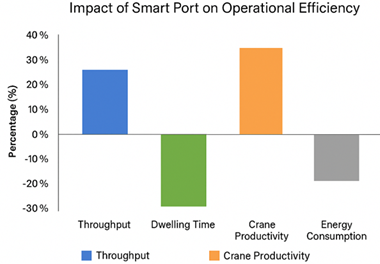
Indonesian ports play a vital role in supporting national and international logistics systems, as more than 90% of global trade volume is transported by sea. However, many Indonesian ports still face operational inefficiency, such as long vessel waiting times, high container dwelling times, and limited coordination among stakeholders. The implementation of a Smart Port System based on the Internet of Things (IoT) offers an innovative solution to support the digital transformation of ports toward the Port 4.0 era. This concept enables improvements in productivity, operational transparency, and energy efficiency through the integration of digital systems, data analytics, and process automation. This study is a systematic literature review examining international and national publications between 2019 and 2025 regarding Smart Port System implementation. The focus includes identifying key technologies (sensors, RFID, AGV, TOS), analyzing the impact on port performance indicators (throughput, dwelling time, crane productivity), and exploring barriers to implementation in the Indonesian context. The findings indicate that smart port adoption can significantly improve operational efficiency: throughput increases by 15–30%, dwelling time decreases by 25–40%, crane productivity rises by 20–35%, and energy consumption drops by 15–20%. However, the effectiveness depends on digital infrastructure readiness, investment, regulatory policy, and human resource capacity. This study recommends a phased implementation strategy starting with administrative digitalization, IoT deployment in key equipment, and full-scale data and cybersecurity integration. Such a framework is expected to strengthen Indonesia’s port competitiveness and contribute to reducing national logistics costs.
Article Details
Section
How to Cite
References
[1] Behdani, B. (2023). Port 4.0: A Conceptual Model for Smart Port Digitalization. Case Studies on Transport Policy, 11(3), 100–112.
[2] Belmoukari, A. (2023). Smart Port: A Systematic Literature Review. European Transport Research Review, 15(3), 45–60.
[3] Dağıstan, H., Yildiz, S., & Ergun, H. (2025). Sustainability of Smart Ports: A Systematic Literature Review. Maritime Policy & Management, 52(1), 33–52.
[4] Durlik, I., Nowak, P., & Kowalski, M. (2023). A Comprehensive Review on Data Analysis in Maritime IoT Applications. Applied Sciences, 13(17), 9742.
[5] Djamaluddin, A. (2025). Manajemen Operasional Pelabuhan. Makassar: Universitas Hasanuddin Press.
[6] Heilig, L., Schwarze, S., & Voß, S. (2021). Digital Transformation in Maritime Logistics and Port Operations: Smart Port Perspectives. Maritime Economics & Logistics, 23(2), 178–199.
[7] Lee, P. T.-W., & Lam, J. S. L. (2022). Developing Smart Ports in the Era of Digitalization: Benefits, Challenges, and Policy Implications. Transport Policy, 116, 1–11.
[8] Munim, Z. H. (2023). Impacts of IoT Adoption on Port Efficiency: Evidence from European Ports. Journal of Shipping and Trade, 8(1), 1–19.
[9] Nguyen, T. H., Pham, D. Q., & Le, V. H. (2023). Application of IoT Technologies in Seaport Management. Journal of Marine Science and Engineering, 11(2), 234–245.
[10] Putra, A., Rahman, F., & Sari, D. (2023). Evaluasi Penerapan Digitalisasi Operasional Pelabuhan di Indonesia. Jurnal Transportasi Maritim Indonesia, 9(2), 55–68.
[11] Raza, Z. (2023). Digital Transformation of Maritime Logistics: Exploring Trends, Barriers and Opportunities. Journal of Transport and Logistics, 14(2), 89–105.
[12] Sari, R., & Widodo, H. (2024). Tantangan Implementasi Smart Port di Pelabuhan Indonesia: Studi Kasus Tanjung Priok dan Makassar New Port. Jurnal Manajemen Transportasi Laut, 12(1), 21–34.
[13] World Bank. (2022). Indonesia Logistics Performance Index 2022 Report. Washington, DC: World Bank.