
Evaluation and Sensitivity Analysis of a 2D Portal Frame under Variations in Geometry and Boundary Conditions Using SAP2000
Article Sidebar
Main Article Content
Abstract
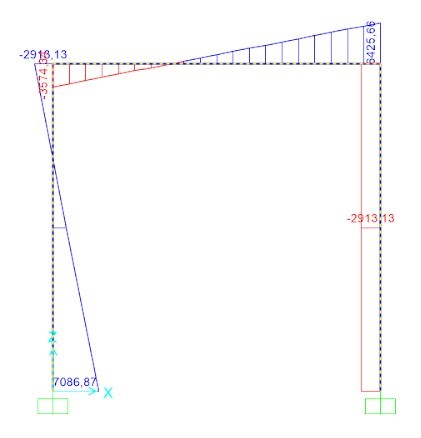
The stiffness of a two-dimensional portal frame is governed by the interaction among geometry, section properties, joint rigidity, support restraints, and loading pattern. This paper revises and expands an initial SAP2000 analysis of a 2D portal frame by incorporating a unit audit, model-data reconstruction, normalized sensitivity formulations, a verification procedure, and a mechanically consistent interpretation of the results. The baseline model represents a one-story, one-bay rigid portal made of ASTM A992 steel and subjected to vertical and horizontal distributed loads under linear static analysis. The original outputs show maximum raw values of 7086.87 for shear force, 20673.05 for bending moment, -5874.94 for compressive axial force, and 0.2022 for lateral displacement. Because the screenshots do not explicitly preserve the active output units, these values are treated as raw software results; under an N-m unit system, the force values correspond to 7.087 kN and 5.875 kN, while the moment corresponds to 20.673 kN·m. The normalized screening analysis demonstrates that the flexural response is highly sensitive to column height and beam span because displacement scales approximately with the cube of member length. A 10% increase in height is expected to increase lateral displacement by about 33.1%, whereas a 20% increase produces an increase of about 72.8% when flexural action dominates. A 20% reduction in the second moment of area increases deformation by approximately 25%. Support conditions also modify moment redistribution and drift, with fixed-fixed bases providing the highest restraint compared with configurations involving rotational releases. The revised study emphasizes that SAP2000 results should not be used for design decisions before the model units, geometry, reactions, rotations, and section properties have been independently verified.
Article Details
Section
How to Cite
References
[1] American Petroleum Institute, API RP 2A-WSD: Planning, Designing and Constructing Fixed Offshore Platforms. Washington, DC, USA: API, 2007.
[2] R. Bhattacharyya, Dynamics of Marine Structures. Hoboken, NJ, USA: Wiley, 2011.
[3] S. L. Chan and P. P. T. Chui, Non-Linear Static and Cyclic Analysis of Steel Frames. Oxford, U.K.: Elsevier, 2000.
[4] R. D. Cook, D. S. Malkus, M. E. Plesha, and R. J. Witt, Concepts and Applications of Finite Element Analysis, 4th ed. New York, NY, USA: Wiley, 2002.
[5] Computers and Structures, Inc., SAP2000 Analysis Reference Manual, Version 22. Berkeley, CA, USA: CSI, 2020.
[6] J. M. Gere and B. J. Goodno, Mechanics of Materials, 8th ed. Stamford, CT, USA: Cengage Learning, 2012.
[7] R. R. Husaini, M. Yazid, A. D. Islami, T. J. Gunawan, and M. D. Wahyudi, “Analisis struktur rangka batang 2D dengan metode matriks kekakuan,” Jurnal Rab Construction Research, vol. 8, no. 2, pp. 322-338, 2023.
A. Kassimali, Matrix Analysis of Structures, 2nd ed. Stamford, CT, USA: Cengage Learning, 2012.
[8] W. McGuire, R. H. Gallagher, and R. D. Ziemian, Matrix Structural Analysis, 2nd ed. New York, NY, USA: Wiley, 2000.
[9] S. P. Timoshenko and D. H. Young, Elements of Strength of Materials. Princeton, NJ, USA: D. Van Nostrand, 1965.
[10] S. T. Zulfikar, Dasar-Dasar Metode Elemen Hingga untuk Teknik Mesin. Ambarawa, Indonesia: Universitas Muhammadiyah Ambarawa, 2019.
[11] J. N. Reddy, An Introduction to the Finite Element Method, 3rd ed. New York, NY, USA: McGraw-Hill, 2006.
[12] O. C. Zienkiewicz, R. L. Taylor, and J. Z. Zhu, The Finite Element Method: Its Basis and Fundamentals, 7th ed. Oxford, U.K.: Elsevier, 2013.
[13] T. H. G. Megson, Structural and Stress Analysis, 3rd ed. Oxford, U.K.: Butterworth-Heinemann, 2014.
[14] Y. C. Fung and P. Tong, Classical and Computational Solid Mechanics. Singapore: World Scientific, 2001.
[15] W. F. Chen and E. M. Lui, Structural Stability: Theory and Implementation. New York, NY, USA: Elsevier, 1987.
[16] S. S. Rao, The Finite Element Method in Engineering, 5th ed. Burlington, MA, USA: Butterworth-Heinemann, 2011.
[17] American Institute of Steel Construction, ANSI/AISC 360-22: Specification for Structural Steel Buildings. Chicago, IL, USA: AISC, 2022.
[18] American Society of Civil Engineers, ASCE/SEI 7-22: Minimum Design Loads and Associated Criteria for Buildings and Other Structures. Reston, VA, USA: ASCE, 2022.
[19] International Organization for Standardization, ISO 19902:2020, Petroleum and Natural Gas Industries Fixed Steel Offshore Structures. Geneva, Switzerland: ISO, 2020.
[20] K. J. Bathe, Finite Element Procedures, 2nd ed. Watertown, MA, USA: Klaus-Jürgen Bathe, 2014.
[21] R. C. Hibbeler, Structural Analysis, 10th ed. Hoboken, NJ, USA: Pearson, 2018.
[22] R. W. Clough and J. Penzien, Dynamics of Structures, 3rd ed. Berkeley, CA, USA: Computers & Structures, Inc., 2003.
A. K. Chopra, Dynamics of Structures: Theory and Applications to Earthquake Engineering, 5th ed. Boston, MA, USA: Pearson, 2017.
[23] European Committee for Standardization, EN 1993-1-1:2005+A1:2014, Eurocode 3 Design of Steel Structures Part 1-1: General Rules and Rules for Buildings. Brussels, Belgium: CEN, 2014.
[24] Computers and Structures, Inc., SAP2000 Verification Manual, Version 22. Berkeley, CA, USA: CSI, 2020.
[25] S. P. Timoshenko and J. M. Gere, Theory of Elastic Stability, 2nd ed. New York, NY, USA: McGraw-Hill, 1961.
[26] R. D. Ziemian, Ed., Guide to Stability Design Criteria for Metal Structures, 6th ed. Hoboken, NJ, USA: Wiley, 2010.