
Conceptual Design and Fabrication Assessment of a Single Large-Diameter Pile Foundation for Compact Offshore Jacket Structures
Article Sidebar
Main Article Content
Abstract
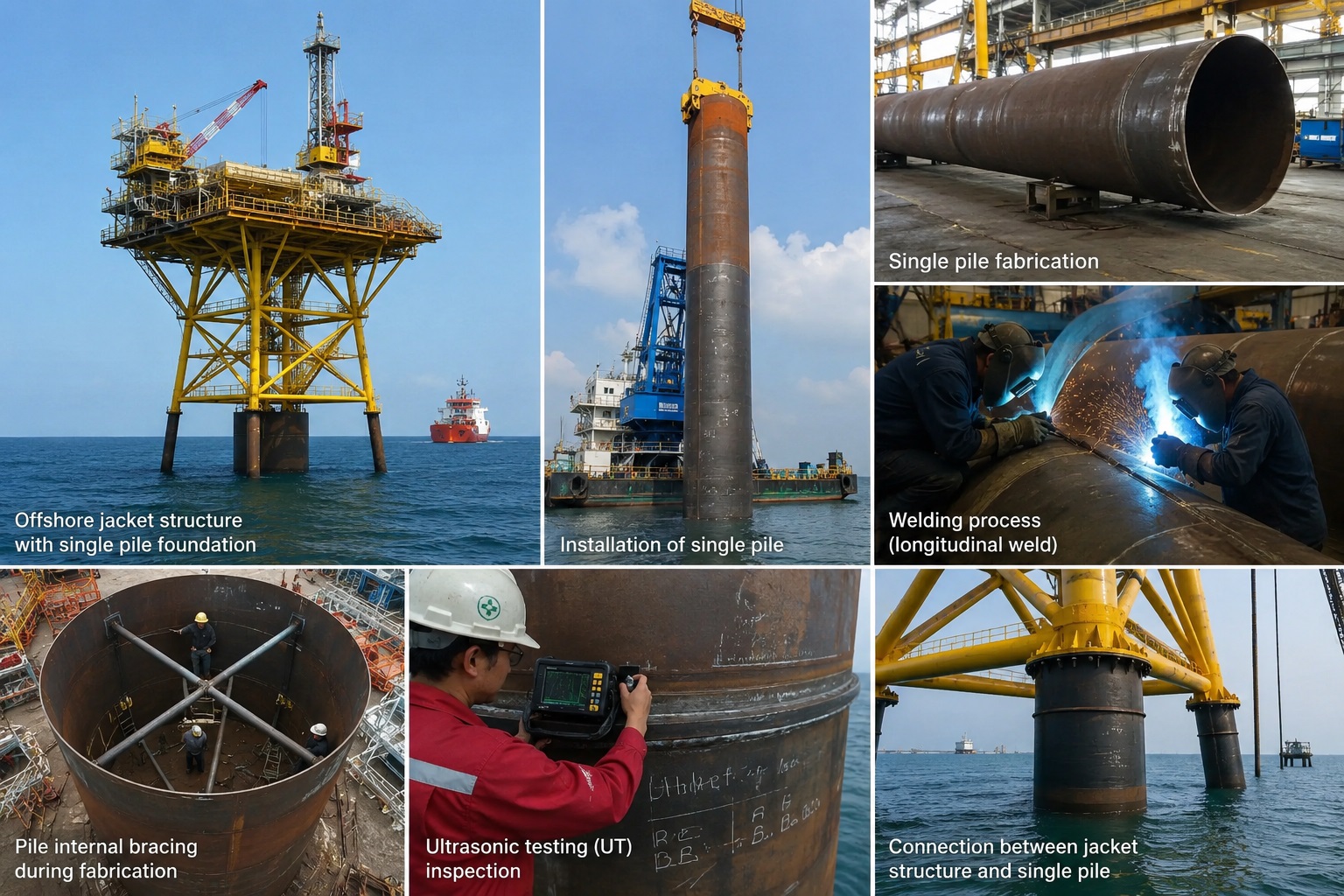
A large-diameter single pile is a potentially attractive alternative for simplifying the foundation system of compact offshore jackets; however, concentrating all actions into one load path requires more rigorous geotechnical, structural, fabrication, and installation verification. This paper develops an integrated pre-design framework for assessing the concept. The assessment combines offshore structural design principles, soil–pile load-transfer mechanisms, axial and lateral capacity screening, tubular section stress checks, and fabrication quality planning. An illustrative reference case with a 3.0 m diameter steel pile, 60–80 mm wall thickness, 70 m total length, and 45 m embedment is used to demonstrate the influence of diameter, penetration, soil stiffness, wall thickness, and scour. The screening results indicate that axial resistance increases strongly with diameter and embedment, whereas lateral response is particularly sensitive to soil stiffness, diameter, and scour. For an illustrative combination of 20 MN axial load and 120 MN·m overturning moment, a 60 mm wall gives a combined nominal stress of approximately 337 MPa, leaving limited margin to a 355 MPa yield strength; increasing the wall to 70–80 mm reduces the stress to approximately 291–257 MPa. Fabrication reliability is governed by material traceability, ovality, alignment, welding parameters, non-destructive testing, corrosion protection, and loadout readiness. The concept can be efficient for light-to-medium topsides in relatively uniform ground, but it should not be selected merely because it reduces the number of piles. A final decision requires site-specific ground investigation, nonlinear soil–structure analysis, fatigue verification, drivability assessment, accidental limit-state checks, and installation-spread evaluation.
Article Details
Section
How to Cite
References
[1] International Organization for Standardization, ISO 19902:2020, Petroleum and Natural Gas Industries Fixed Steel Offshore Structures. Geneva, Switzerland: ISO, 2020.
[2] American Petroleum Institute, API RP 2A-WSD, Recommended Practice for Planning, Designing and Constructing Fixed Offshore Platforms Working Stress Design, 22nd ed. Washington, DC, USA: API, 2014.
[3] American Petroleum Institute, API RP 2GEO/ISO 19901-4, Geotechnical and Foundation Design Considerations, 1st ed. Washington, DC, USA: API, 2011.
[4] DNV, DNV-RP-C212, Offshore Soil Mechanics and Geotechnical Engineering. Høvik, Norway: DNV, 2021.
[5] DNV, DNV-ST-N001, Marine Operations and Marine Warranty. Høvik, Norway: DNV, 2023.
[6] DNV, DNV-OS-C401, Fabrication and Testing of Offshore Structures. Høvik, Norway: DNV, 2025.
[7] DNV, DNV-RP-C203, Fatigue Design of Offshore Steel Structures. Høvik, Norway: DNV, 2024.
[8] American Bureau of Shipping, Rules for Building and Classing Offshore Installations. Spring, TX, USA: ABS, 2024.
[9] American Welding Society, AWS D1.1/D1.1M:2020, Structural Welding Code Steel. Miami, FL, USA: AWS, 2020.
[10] International Organization for Standardization, ISO 3834-2:2021, Quality Requirements for Fusion Welding of Metallic Materials Part 2: Comprehensive Quality Requirements. Geneva, Switzerland: ISO, 2021.
[11] International Organization for Standardization, ISO 17635:2016, Non-Destructive Testing of Welds General Rules for Metallic Materials. Geneva, Switzerland: ISO, 2016.
[12] International Organization for Standardization, ISO 5817:2023, Welding Fusion-Welded Joints in Steel, Nickel, Titanium and Their Alloys Quality Levels for Imperfections. Geneva, Switzerland: ISO, 2023.
[13] S. K. Chakrabarti, Handbook of Offshore Engineering. Amsterdam, Netherlands: Elsevier, 2005.
[14] O. M. Faltinsen, Sea Loads on Ships and Offshore Structures. Cambridge, U.K.: Cambridge University Press, 1990.
[15] M. F. Randolph and S. Gourvenec, Offshore Geotechnical Engineering. London, U.K.: Spon Press, 2011.
[16] H. G. Poulos and E. H. Davis, Pile Foundation Analysis and Design. New York, NY, USA: Wiley, 1980.
[17] L. C. Reese and W. F. Van Impe, Single Piles and Pile Groups Under Lateral Loading, 2nd ed. Boca Raton, FL, USA: CRC Press, 2011.
[18] H. Matlock, “Correlations for design of laterally loaded piles in soft clay,” in Proc. 2nd Offshore Technology Conf., Houston, TX, USA, 1970, Paper OTC 1204, pp. 577–594.
[19] L. C. Reese, W. R. Cox, and F. D. Koop, “Analysis of laterally loaded piles in sand,” in Proc. 6th Offshore Technology Conf., Houston, TX, USA, 1974, Paper OTC 2080, pp. 473–483.
[20] R. J. Jardine, F. C. Chow, R. F. Overy, and J. R. Standing, ICP Design Methods for Driven Piles in Sands and Clays. London, U.K.: Thomas Telford, 2005.
[21] B. W. Byrne et al., “PISA design model for monopiles for offshore wind turbines: Application to a stiff glacial clay till,” Géotechnique, vol. 70, no. 11, pp. 1030–1047, 2020.
[22] H. J. Burd et al., “PISA design model for monopiles for offshore wind turbines: Application to a marine sand,” Géotechnique, vol. 70, no. 11, pp. 1048–1066, 2020.
[23] S. Bhattacharya, Design of Foundations for Offshore Wind Turbines. Chichester, U.K.: Wiley, 2019.
[24] J. K. Paik and A. K. Thayamballi, Ultimate Limit State Design of Steel-Plated Structures. Chichester, U.K.: Wiley, 2003.
[25] M. B. Zaaijer, “Foundation modelling to assess dynamic behaviour of offshore wind turbines,” Applied Ocean Research, vol. 28, no. 1, pp. 45–57, 2006.
[26] IEC, IEC 61400-3-1:2019, Wind Energy Generation Systems Part 3-1: Design Requirements for Fixed Offshore Wind Turbines. Geneva, Switzerland: IEC, 2019.
[27] DNV, DNV-ST-0126, Support Structures for Wind Turbines. Høvik, Norway: DNV, 2021.
[28] R. E. Olson, “Axial load capacity of offshore piles,” Journal of Geotechnical Engineering, vol. 109, no. 5, pp. 623–635, 1983.
[29] M. H. El Naggar and M. Novak, “Nonlinear analysis for dynamic lateral pile response,” Journal of Geotechnical Engineering, vol. 120, no. 2, pp. 308–329, 1994.
[30] J. M. Duncan and S. G. Wright, Soil Strength and Slope Stability. Hoboken, NJ, USA: Wiley, 2005.