
Analisis Desain dan Fabrikasi Fondasi Tiang Tunggal pada Struktur Jacket Lepas Pantai
Bilah Samping Artikel
Isi Artikel Utama
Abstrak
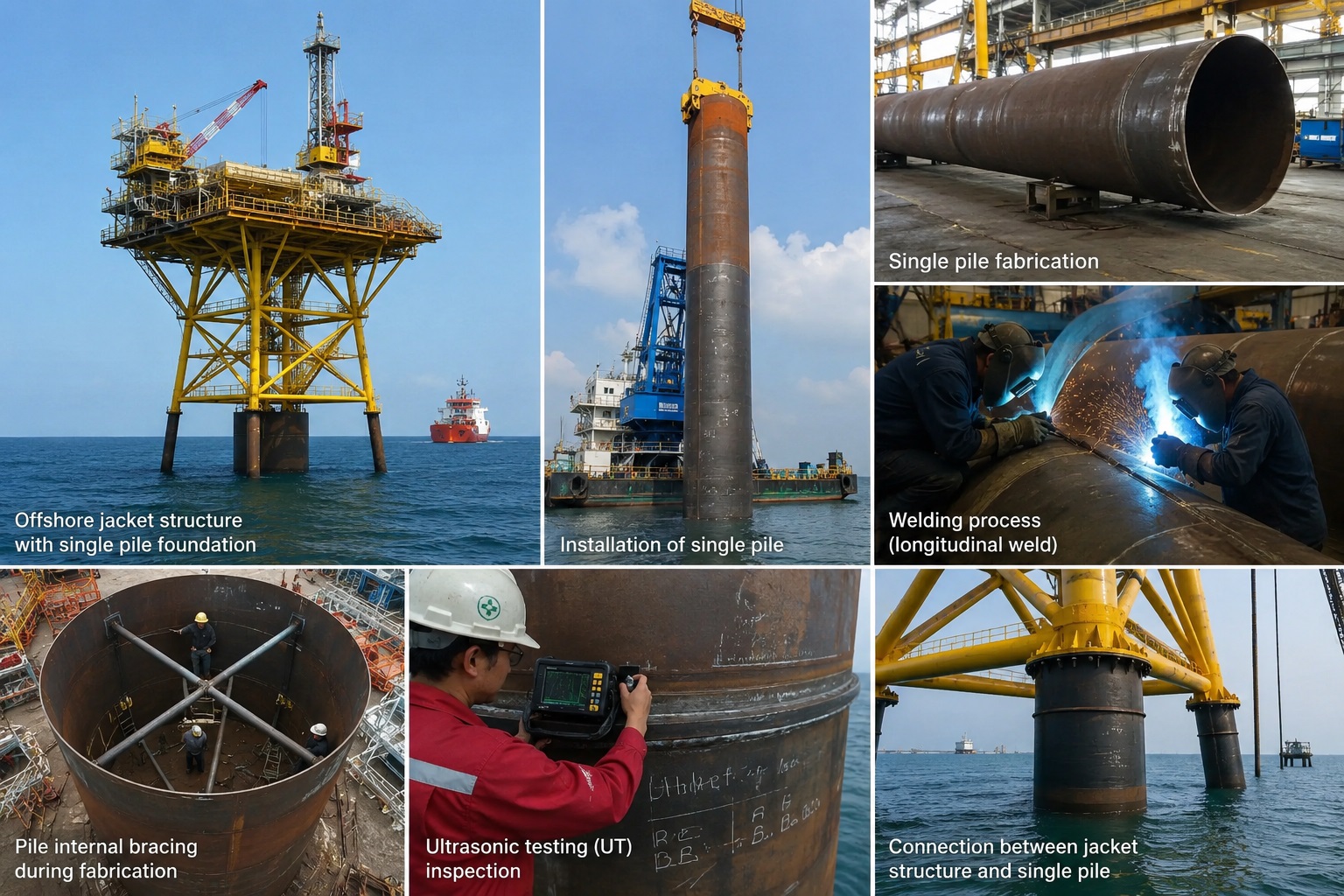
Meningkatnya kebutuhan akan struktur lepas pantai yang efisien secara biaya telah mendorong pengembangan sistem fondasi alternatif, salah satunya adalah fondasi tiang tunggal (single pile foundation). Penelitian ini menyajikan analisis komprehensif terhadap aspek perancangan dan fabrikasi fondasi tiang tunggal yang diterapkan pada struktur offshore jacket. Kajian ini berfokus pada mekanisme transfer beban, interaksi tanah–tiang, integritas struktur, serta tantangan dalam proses fabrikasi. Metode yang digunakan meliputi pendekatan analitis dan studi literatur untuk mengevaluasi kelayakan serta kinerja sistem tersebut. Hasil penelitian menunjukkan bahwa fondasi tiang tunggal dapat menjadi solusi yang efisien dan andal pada kondisi tanah dan pembebanan tertentu, dengan syarat dilakukan analisis geoteknik yang mendalam serta pengendalian mutu fabrikasi yang ketat (1).
Rincian Artikel
Terbitan
Bagian
Cara Mengutip
Referensi
[1] International Organization for Standardization, ISO 19902:2020, Petroleum and Natural Gas Industries Fixed Steel Offshore Structures. Geneva, Switzerland: ISO, 2020.
[2] American Petroleum Institute, API RP 2A-WSD, Recommended Practice for Planning, Designing and Constructing Fixed Offshore Platforms Working Stress Design, 22nd ed. Washington, DC, USA: API, 2014.
[3] American Petroleum Institute, API RP 2GEO/ISO 19901-4, Geotechnical and Foundation Design Considerations, 1st ed. Washington, DC, USA: API, 2011.
[4] DNV, DNV-RP-C212, Offshore Soil Mechanics and Geotechnical Engineering. Høvik, Norway: DNV, 2021.
[5] DNV, DNV-ST-N001, Marine Operations and Marine Warranty. Høvik, Norway: DNV, 2023.
[6] DNV, DNV-OS-C401, Fabrication and Testing of Offshore Structures. Høvik, Norway: DNV, 2025.
[7] DNV, DNV-RP-C203, Fatigue Design of Offshore Steel Structures. Høvik, Norway: DNV, 2024.
[8] American Bureau of Shipping, Rules for Building and Classing Offshore Installations. Spring, TX, USA: ABS, 2024.
[9] American Welding Society, AWS D1.1/D1.1M:2020, Structural Welding Code Steel. Miami, FL, USA: AWS, 2020.
[10] International Organization for Standardization, ISO 3834-2:2021, Quality Requirements for Fusion Welding of Metallic Materials Part 2: Comprehensive Quality Requirements. Geneva, Switzerland: ISO, 2021.
[11] International Organization for Standardization, ISO 17635:2016, Non-Destructive Testing of Welds General Rules for Metallic Materials. Geneva, Switzerland: ISO, 2016.
[12] International Organization for Standardization, ISO 5817:2023, Welding Fusion-Welded Joints in Steel, Nickel, Titanium and Their Alloys Quality Levels for Imperfections. Geneva, Switzerland: ISO, 2023.
[13] S. K. Chakrabarti, Handbook of Offshore Engineering. Amsterdam, Netherlands: Elsevier, 2005.
[14] O. M. Faltinsen, Sea Loads on Ships and Offshore Structures. Cambridge, U.K.: Cambridge University Press, 1990.
[15] M. F. Randolph and S. Gourvenec, Offshore Geotechnical Engineering. London, U.K.: Spon Press, 2011.
[16] H. G. Poulos and E. H. Davis, Pile Foundation Analysis and Design. New York, NY, USA: Wiley, 1980.
[17] L. C. Reese and W. F. Van Impe, Single Piles and Pile Groups Under Lateral Loading, 2nd ed. Boca Raton, FL, USA: CRC Press, 2011.
[18] H. Matlock, “Correlations for design of laterally loaded piles in soft clay,” in Proc. 2nd Offshore Technology Conf., Houston, TX, USA, 1970, Paper OTC 1204, pp. 577–594.
[19] L. C. Reese, W. R. Cox, and F. D. Koop, “Analysis of laterally loaded piles in sand,” in Proc. 6th Offshore Technology Conf., Houston, TX, USA, 1974, Paper OTC 2080, pp. 473–483.
[20] R. J. Jardine, F. C. Chow, R. F. Overy, and J. R. Standing, ICP Design Methods for Driven Piles in Sands and Clays. London, U.K.: Thomas Telford, 2005.
[21] B. W. Byrne et al., “PISA design model for monopiles for offshore wind turbines: Application to a stiff glacial clay till,” Géotechnique, vol. 70, no. 11, pp. 1030–1047, 2020.
[22] H. J. Burd et al., “PISA design model for monopiles for offshore wind turbines: Application to a marine sand,” Géotechnique, vol. 70, no. 11, pp. 1048–1066, 2020.
[23] S. Bhattacharya, Design of Foundations for Offshore Wind Turbines. Chichester, U.K.: Wiley, 2019.
[24] J. K. Paik and A. K. Thayamballi, Ultimate Limit State Design of Steel-Plated Structures. Chichester, U.K.: Wiley, 2003.
[25] M. B. Zaaijer, “Foundation modelling to assess dynamic behaviour of offshore wind turbines,” Applied Ocean Research, vol. 28, no. 1, pp. 45–57, 2006.
[26] IEC, IEC 61400-3-1:2019, Wind Energy Generation Systems Part 3-1: Design Requirements for Fixed Offshore Wind Turbines. Geneva, Switzerland: IEC, 2019.
[27] DNV, DNV-ST-0126, Support Structures for Wind Turbines. Høvik, Norway: DNV, 2021.
[28] R. E. Olson, “Axial load capacity of offshore piles,” Journal of Geotechnical Engineering, vol. 109, no. 5, pp. 623–635, 1983.
[29] M. H. El Naggar and M. Novak, “Nonlinear analysis for dynamic lateral pile response,” Journal of Geotechnical Engineering, vol. 120, no. 2, pp. 308–329, 1994.
[30] J. M. Duncan and S. G. Wright, Soil Strength and Slope Stability. Hoboken, NJ, USA: Wiley, 2005.