
The Future of Underwater Technology: Challenges and Opportunities for Indonesia in the Global Ocean Economy
Bilah Samping Artikel
Isi Artikel Utama
Abstrak
A large-diameter single pile is a potentially attractive alternative for simplifying the foundation system of compact offshore jackets; however, concentrating all actions into one load path requires more rigorous geotechnical, structural, fabrication, and installation verification. This paper develops an integrated pre-design framework for assessing the concept. The assessment combines offshore structural design principles, soil–pile load-transfer mechanisms, axial and lateral capacity screening, tubular section stress checks, and fabrication quality planning. An illustrative reference case with a 3.0 m diameter steel pile, 60–80 mm wall thickness, 70 m total length, and 45 m embedment is used to demonstrate the influence of diameter, penetration, soil stiffness, wall thickness, and scour. The screening results indicate that axial resistance increases strongly with diameter and embedment, whereas lateral response is particularly sensitive to soil stiffness, diameter, and scour. For an illustrative combination of 20 MN axial load and 120 MN·m overturning moment, a 60 mm wall gives a combined nominal stress of approximately 337 MPa, leaving limited margin to a 355 MPa yield strength; increasing the wall to 70–80 mm reduces the stress to approximately 291–257 MPa. Fabrication reliability is governed by material traceability, ovality, alignment, welding parameters, non-destructive testing, corrosion protection, and loadout readiness. The concept can be efficient for light-to-medium topsides in relatively uniform ground, but it should not be selected merely because it reduces the number of piles. A final decision requires site-specific ground investigation, nonlinear soil–structure analysis, fatigue verification, drivability assessment, accidental limit-state checks, and installation-spread evaluation.
Rincian Artikel
Terbitan
Bagian
Cara Mengutip
Referensi
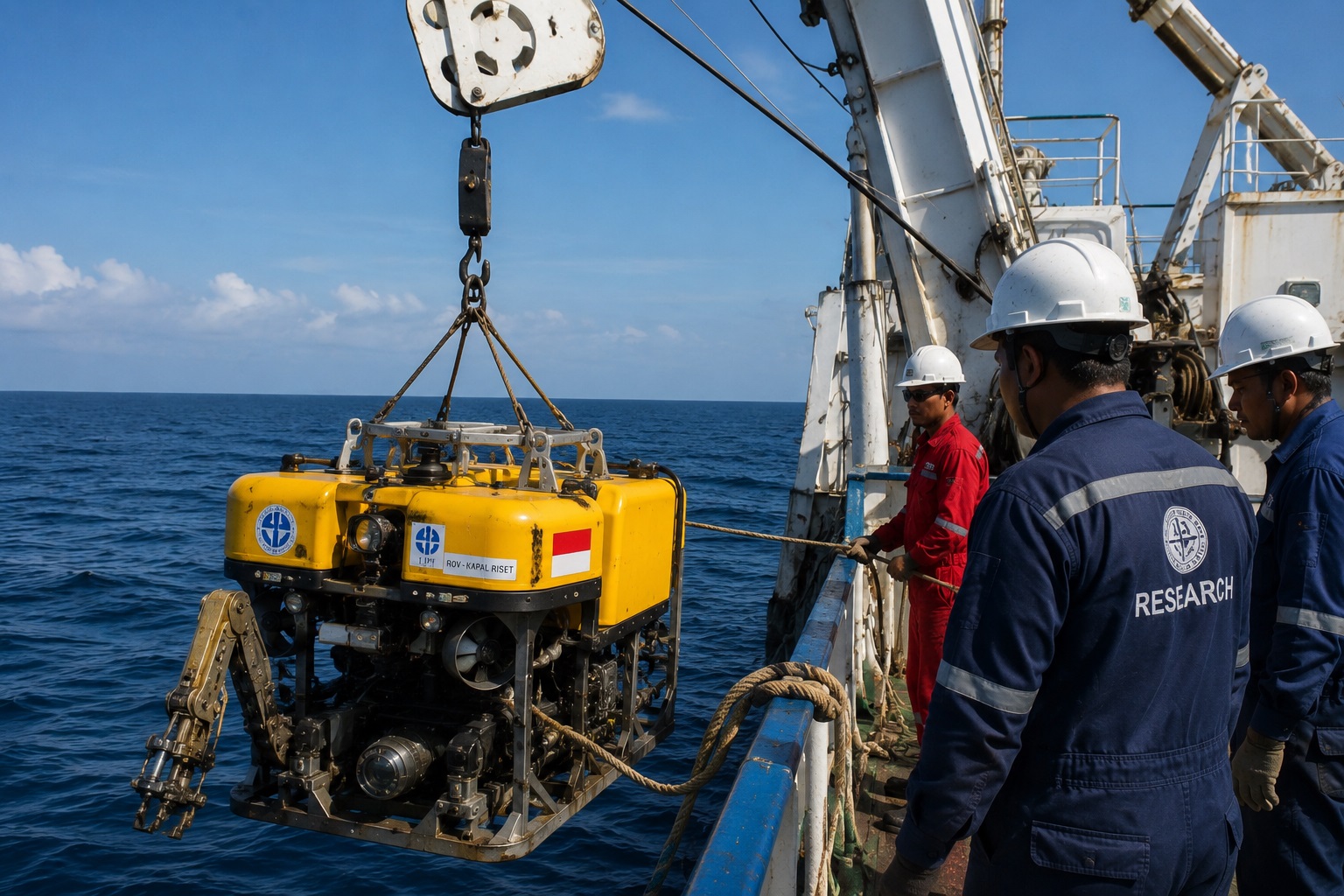
Underwater technology is strategic infrastructure connecting the blue economy, ocean science, offshore energy, submarine-cable resilience, environmental protection, and maritime security. This perspective paper reframes Indonesia's underwater-technology agenda through a structured literature synthesis, capability-gap analysis, value-chain mapping, and a proposed 2026–2045 roadmap. The analysis indicates that the central challenge is not merely the limited number of domestic vehicle prototypes. More consequential constraints include dependence on critical imported components, fragmented test facilities, unclear certification pathways, discontinuous research funding, limited mission software and data infrastructure, and the absence of reliable first markets for domestic systems. Near-term priorities should therefore emphasize inspection and mapping services, observation-class remotely operated vehicles, oceanographic sensors, control software, system integration, calibration, maintenance, and lifecycle support. These capabilities can subsequently be extended toward shallow-water autonomous underwater vehicles, acoustic modems, persistent observing systems, and deep-water platforms. The paper proposes a national mission ecosystem linking universities and BRIN, industry, government, regulators, and end users through shared infrastructure, open interfaces, performance-based procurement, and a stage-gate mechanism from research to commercialization. A four-phase roadmap positions Indonesia first as an effective operator and integrator, then as a manufacturer of certified systems, and ultimately as a regional provider of underwater products and lifecycle services by 2045. Progress should be assessed using operational reliability, meaningful local content, certified-system counts, accumulated sea hours, lifecycle cost, and export growth rather than prototype counts alone.