Keywords
How to Cite
Abstract
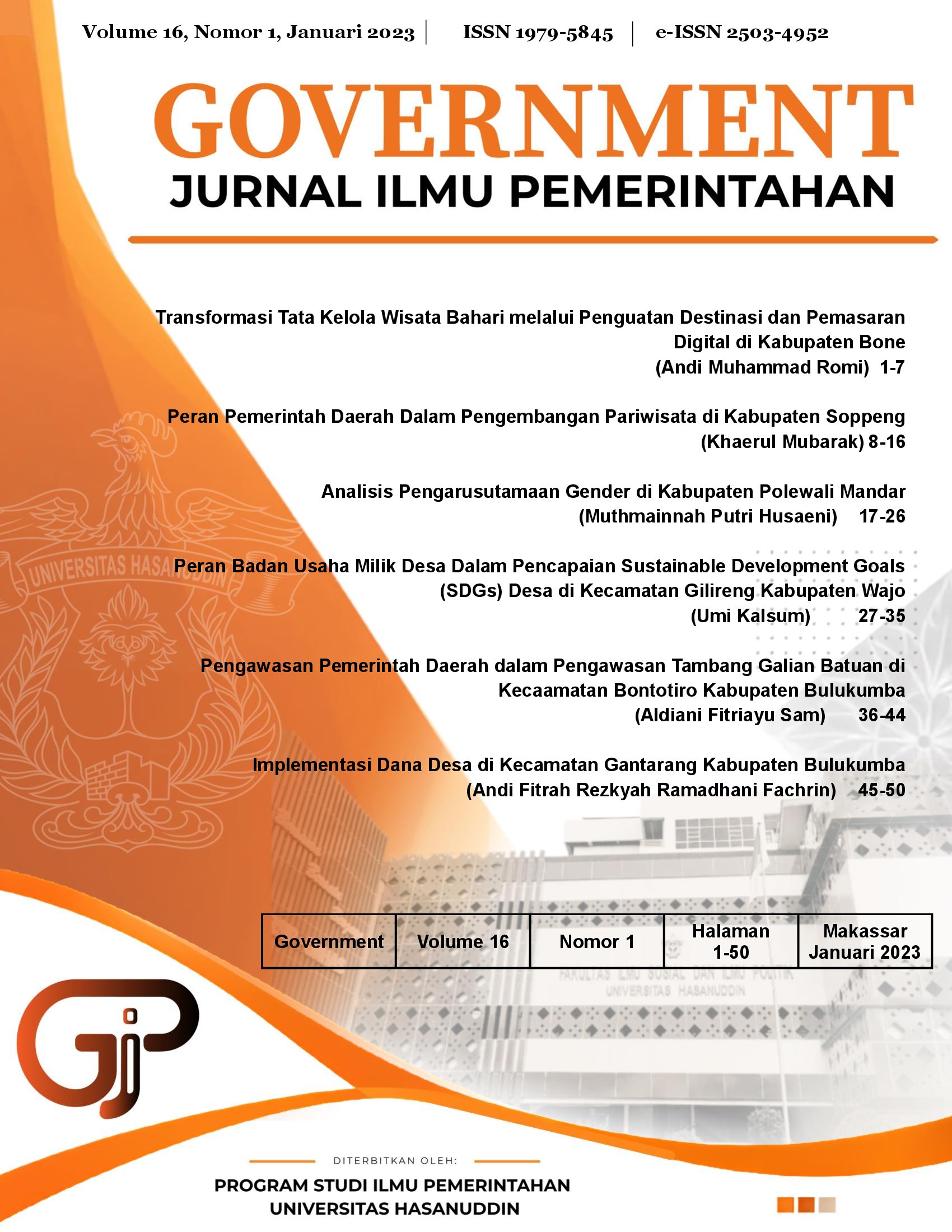
Marine tourism is a strategic sector with significant potential to stimulate regional economic growth, improve community welfare, and enhance the competitiveness of tourism destinations. Bone Regency, as one of the coastal regions in South Sulawesi Province, possesses various marine tourism resources that require adaptive and innovative governance to maximize their potential. This study aims to analyze the transformation of marine tourism governance in Bone Regency, focusing on marine tourism destination development and digital-based tourism marketing. The research employed a qualitative approach with a descriptive-analytical research design. Data were collected through interviews, observations, and documentation involving the Bone Regency Tourism Office, tourism destination managers, Tourism Awareness Groups (Pokdarwis), tourism business actors, and coastal communities. Data analysis was conducted through data reduction, data presentation, and conclusion drawing. The findings reveal that the Bone Regency Government has transformed marine tourism governance through the development of supporting infrastructure, improvement of tourism facilities, community empowerment, and the strengthening of Tourism Awareness Groups in destination management. Furthermore, digital tourism marketing has been implemented through the utilization of social media, websites, and other digital platforms to broaden destination promotion.
References
Bramwell, B., & Lane, B. (2011). Critical research on the governance of tourism and sustainability. Journal of Sustainable Tourism, 19(4–5), 411–421. https://doi.org/10.1080/09669582.2011.580586
Emerson, K., Nabatchi, T., & Balogh, S. (2012). An integrative framework for collaborative governance. Journal of Public Administration Research and Theory, 22(1), 1–29. https://doi.org/10.1093/jopart/mur011
Gretzel, U., Sigala, M., Xiang, Z., & Koo, C. (2015). Smart tourism: Foundations and developments. Electronic Markets, 25(3), 179–188. https://doi.org/10.1007/s12525-015-0196-8
Hall, C. M. (2011). A typology of governance and its implications for tourism policy analysis. Journal of Sustainable Tourism, 19(4–5), 437–457. https://doi.org/10.1080/09669582.2011.570346
Kotler, P., Bowen, J. T., & Makens, J. C. (2017). Marketing for hospitality and tourism (7th ed.). Pearson Education.
Miles, M. B., Huberman, A. M., & Saldaña, J. (2014). Qualitative data analysis: A methods sourcebook (3rd ed.). Sage Publications.
Provan, K. G., & Kenis, P. (2008). Modes of network governance: Structure, management, and effectiveness. Journal of Public Administration Research and Theory, 18(2), 229–252. https://doi.org/10.1093/jopart/mum015
United Nations World Tourism Organization. (2018). Tourism for development: Key areas for action. UNWTO. https://doi.org/10.18111/9789284419401
Xiang, Z., & Fesenmaier, D. R. (2017). Big data analytics, tourism design and smart tourism. Journal of Tourism Futures, 3(2), 85–98. https://doi.org/10.1108/JTF-12-2016-0058
Yin, R. K. (2018). Case study research and applications: Design and methods (6th ed.). Sage Publications.

This work is licensed under a Creative Commons Attribution 4.0 International License.