Keywords
How to Cite
Abstract
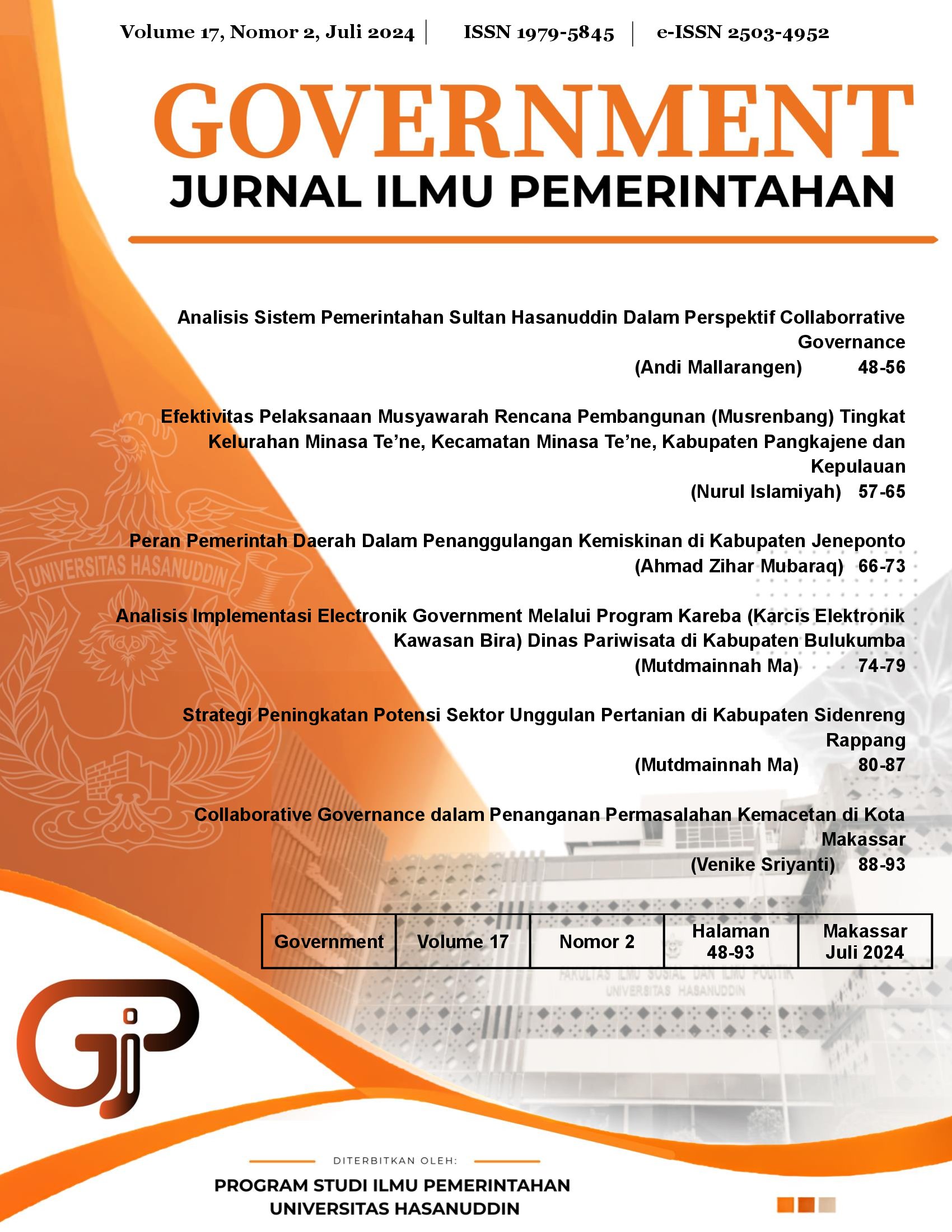
Traffic congestion is one of the most complex urban problems that requires the involvement of multiple stakeholders in its management. Makassar City, as the center of economic, governmental, and service activities in Eastern Indonesia, faces challenges arising from the increasing number of motor vehicles that are not proportional to the available road infrastructure capacity. This condition has resulted in severe traffic congestion on several major roads throughout the city. This study aims to analyze the implementation of collaborative governance in addressing traffic congestion in Makassar City. The research employed a qualitative approach with a descriptive research design. Data were collected through observation, interviews, documentation, and literature review. Data analysis was conducted through data reduction, data presentation, and conclusion drawing. The study adopted Ansell and Gash’s Collaborative Governance framework, which consists of starting conditions, institutional design, facilitative leadership, and collaborative process. The findings indicate that the implementation of collaborative governance in addressing traffic congestion in Makassar City has been relatively effective. The initial conditions of collaboration were established through a shared commitment among stakeholders to address congestion issues. Institutional design was supported by clear divisions of roles and responsibilities among agencies. Facilitative leadership played an important role in fostering coordination and communication among stakeholders, while the collaborative process was reflected through cooperation, information sharing, and the implementation of joint programs. The established collaboration has contributed positively to more effective and integrated traffic congestion management in Makassar City.
Traffic congestion is one of the most complex urban problems that requires the involvement of multiple stakeholders in its management. Makassar City, as the center of economic, governmental, and service activities in Eastern Indonesia, faces challenges arising from the increasing number of motor vehicles that are not proportional to the available road infrastructure capacity. This condition has resulted in severe traffic congestion on several major roads throughout the city. This study aims to analyze the implementation of collaborative governance in addressing traffic congestion in Makassar City. The research employed a qualitative approach with a descriptive research design. Data were collected through observation, interviews, documentation, and literature review. Data analysis was conducted through data reduction, data presentation, and conclusion drawing. The study adopted Ansell and Gash’s Collaborative Governance framework, which consists of starting conditions, institutional design, facilitative leadership, and collaborative process. The findings indicate that the implementation of collaborative governance in addressing traffic congestion in Makassar City has been relatively effective. The initial conditions of collaboration were established through a shared commitment among stakeholders to address congestion issues. Institutional design was supported by clear divisions of roles and responsibilities among agencies. Facilitative leadership played an important role in fostering coordination and communication among stakeholders, while the collaborative process was reflected through cooperation, information sharing, and the implementation of joint programs. The established collaboration has contributed positively to more effective and integrated traffic congestion management in Makassar City.
References
Ansell, C., & Gash, A. (2008). Collaborative governance in theory and practice. Journal of Public Administration Research and Theory, 18(4), 543–571. https://doi.org/10.1093/jopart/mum032
Emerson, K., Nabatchi, T., & Balogh, S. (2012). An integrative framework for collaborative governance. Journal of Public Administration Research and Theory, 22(1), 1–29. https://doi.org/10.1093/jopart/mur011
Indrajit, R. E. (2006). Electronic Government: Strategi Pembangunan dan Pengembangan Sistem Pelayanan Publik Berbasis Teknologi Digital. Yogyakarta: Andi.
Ratnasari, D., Nurmandi, A., & Purnomo, E. P. (2022). Implementation of e-government in improving public service performance. Jurnal Studi Pemerintahan, 13(2), 145–160.
Wibawa, A., Syamsuddin, M., & Rahman, A. (2023). E-government and public participation in local governance. Jurnal Ilmu Pemerintahan, 16(1), 45–58.
Undang-Undang Nomor 23 Tahun 2014 tentang Pemerintahan Daerah.

This work is licensed under a Creative Commons Attribution 4.0 International License.