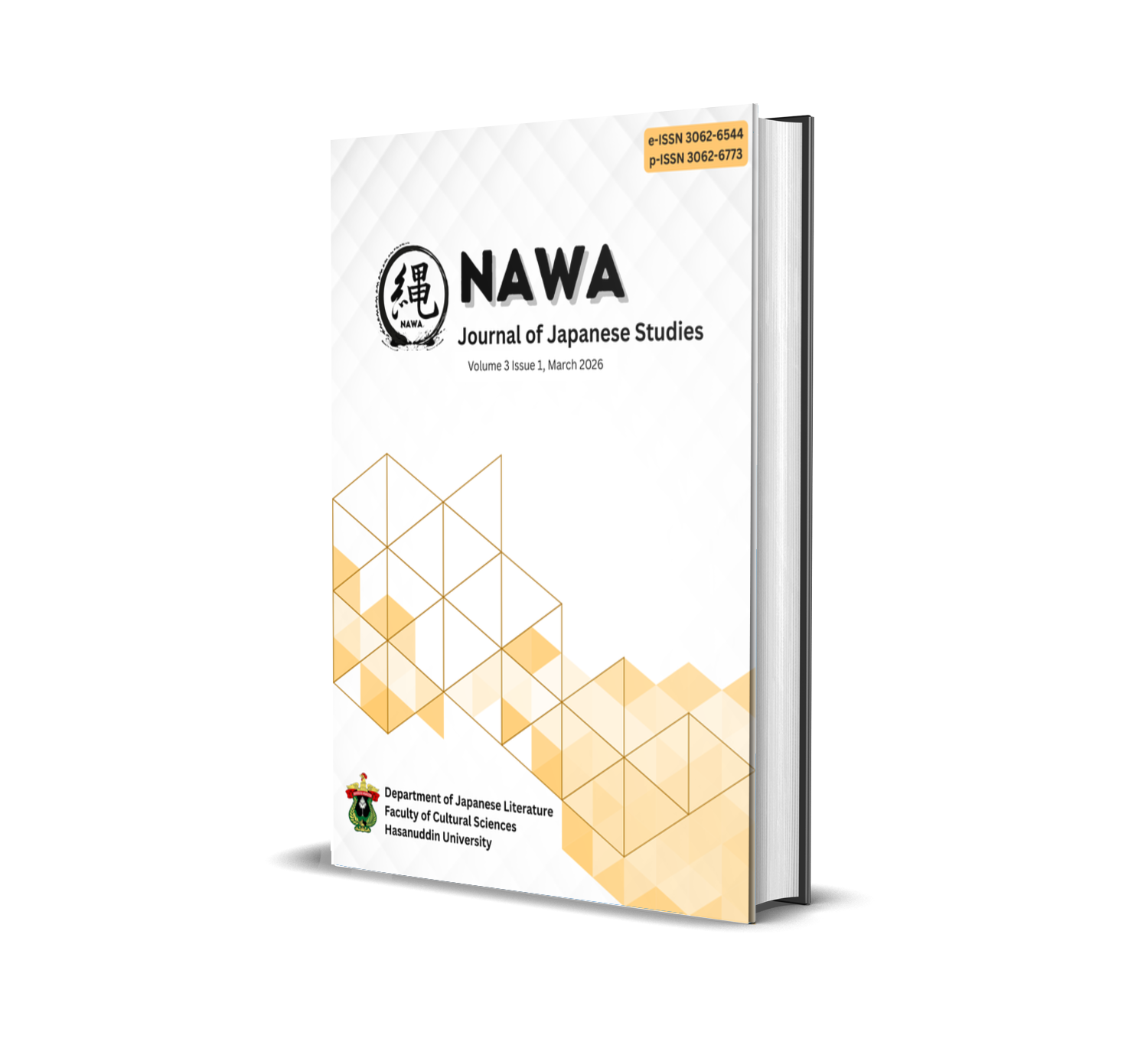
Directive Speech Acts by Child Characters in the Japanese Film Monster (2023)
A Pragmatic Analysis
DOI:
https://doi.org/10.69908/nawa.v3i1.49748Keywords:
Directive speech acts, Pragmatics, Japanese film, Child discourse, SPEAKING frameworkAbstract
This study investigates the forms and types of directive speech acts produced by child characters in the Japanese film Monster (2023) directed by Hirokazu Koreeda. Using a qualitative approach, the study analyzes 20 directive utterances drawn from the film’s dialogue to examine how directive meanings are realized in emotionally and socially complex interactions. The data were selected by identifying utterances spoken by child characters that pragmatically function to prompt the addressee to perform or refrain from performing an action. The analysis is informed by speech act theory and contextual interpretation through Dell Hymes’ SPEAKING framework, enabling systematic examination of linguistic form, pragmatic function, and interactional context. The findings reveal that directive speech acts are realized through direct and indirect as well as literal and non-literal forms. Among these, indirect literal directive speech acts of the requestive type occur most frequently. This pattern indicates that directive intentions are commonly conveyed through interrogative or declarative structures rather than explicit imperatives, particularly in emotionally sensitive interactions such as family communication and peer relationships affected by bullying. Overall, the study demonstrates that child characters exhibit pragmatic awareness by employing directive strategies that balance communicative effectiveness with interpersonal consideration.
References
Austin, JL. 1962. Speech Acts.
Brown, Penelope, and Stephen C Levinson. 1987. Politeness: Some Universals in Language Usage. Cambridge university press.
Ibrahim, N. (2024). Analisis Tindak Tutur Direktif Pada Interaksi Guru Dan Siswa Kelas Vii Smp Negeri 13 Kota Bengkulu (Doctoral dissertation, UIN Fatmawati Sukarno Bengkulu).
Dynel, M. (2011). You talking to me? The viewer as a ratified listener to film discourse. Journal of Pragmatics, 43(6), 1628-1644.
Ervin-Tripp, Susan. 1976. Is Sybil There? The Structure of Some American English Directives. Language in society 5(1): 25–66.
Firdaus, M. F., Taqdir, T., & Kasmawati, K. (2021). Pemanfaatan Konsep Wajah Dalam Film Death Note (2006). Jurnal Ilmu Budaya, 9(1), 134–141. https://journal.unhas.ac.id/index.php/jib/article/view/13033
Hymes, Dell. 1992. The Concept of Communicative Competence Revisited. Thirty years of linguistic evolution 1(2): 31–57.
Ide, S. (1989). Formal Forms and Discernment: Two Neglected Aspects of Universals of Linguistic Politeness. Multilingua, 8, 223-248. http://dx.doi.org/10.1515/mult.1989.8.2-3.223
Lexy J. Moleong. 2009. Metodologi Penelitian Kualitatif. Remaja Rosdakarya.
Maynard, Senko K. 1997. Japanese Communication: Language and Thought in Context. University of Hawaii Press.
Ninio, Anat, and Catherine Snow. 2018. Pragmatic Development. Routledge.
Nugrahani, Farida. 2014. Metode Penelitian Kualitatif. Bandung: Remaja Rosdakarya.
Rachmawati, D. 2019. Tindak Tutur Ilokusi Dalam Acara Kuis ‘WIB’ Episode 9 Juli 2018 Di NET TV. Kajian Linguistik 5(3): 1–23.
Hidayah, S. H. (2024). Tindak tutur dan kesopanan dalam komunikasi interpersonal: Kajian pragmatik. WIDYANTARA, 2(2), 193-202.
Saputra, A., Kasmawati, Taqdir. (2022). Analisis Tindak Tutur Wabi Hyougen (Meminta Maaf) dalam Drama Tennou No Ryouriban Suatu Tinjauan Pragmatik. Pustaka: Jurnal Ilmu-Ilmu Budaya, 22 (1): 19-25
Saputri, Ulin Intan. 2020. Analisis Bentuk Tindak Tutur Direktif Dalam Dialog Film ‘Rembulan Tenggelam Di Wajahmu’ Karya Tere Liye. Jurnal Kajian Bahasa, Sastra Dan Pengajaran (KIBASP) 3(2): 249–60.
Searle, J. R. (1975). A Taxonomy of Illocutionary Acts. In K. Gunderson (Ed.), Language, Mind, and Knowledge (Minnesota Studies in the Philosophy of Science, Vol. 7, pp. 344–369). University of Minnesota Press.
Sukmadinata, N. S. (2005). Metode Penelitian Pendidikan. Jakarta: PT. Remaja Rosdakarya.
Tsui, Amy BM. 1994. English Conversation. Oxford University Press.
Yule, George. 1996. Pragmatics. Oxford university press.
Downloads
Published
Issue
Section
License
Copyright (c) 2026 Erland Rakarussi Gading, Kasmawati Kasmawati

This work is licensed under a Creative Commons Attribution-NonCommercial 4.0 International License.