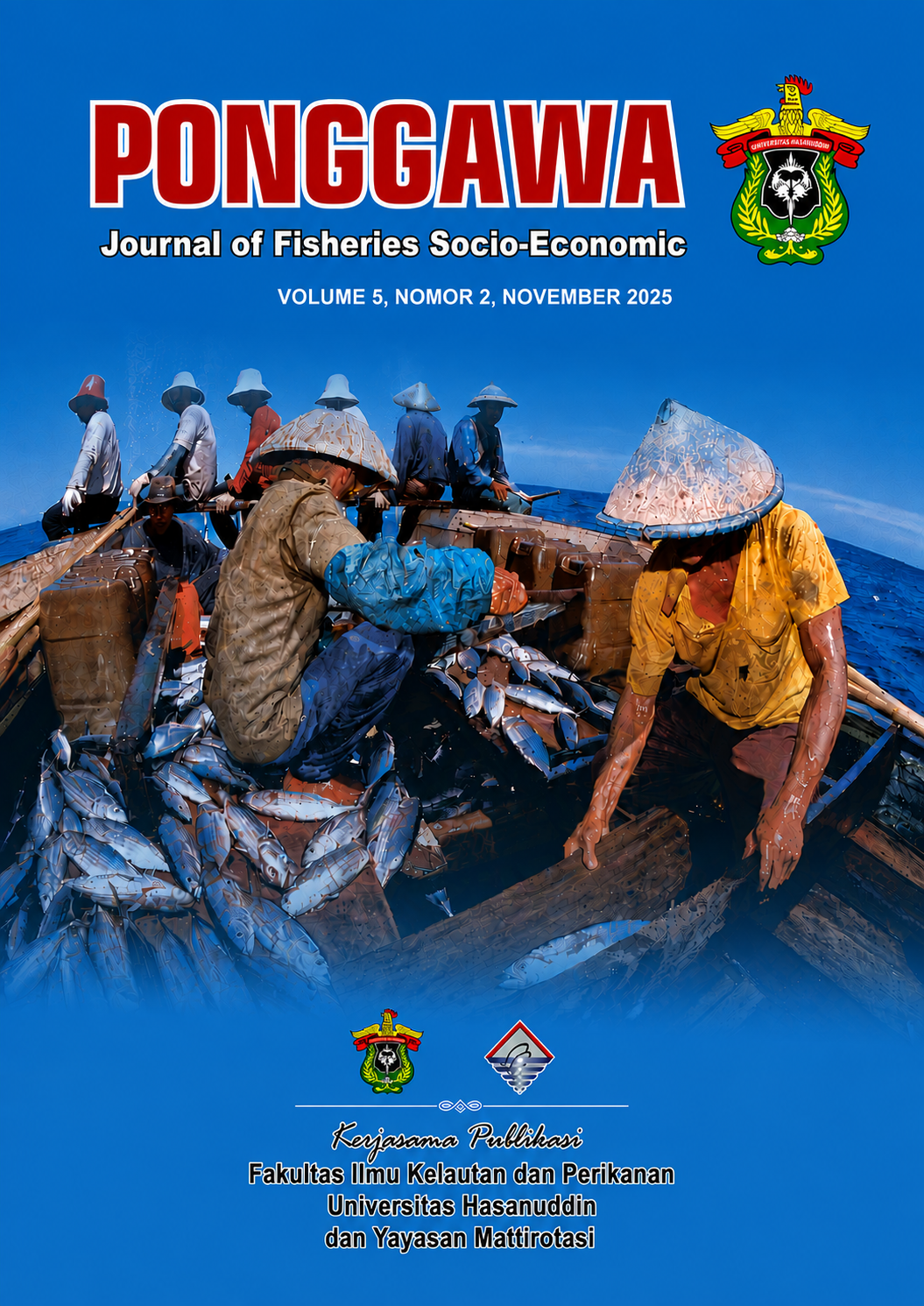
The Role of Local Institutions in Fisheries Business Activities in Pundata Baji Village, Labakkang District, Pangkep Regency
DOI:
https://doi.org/10.35911/ponggawa.v5i2.48322Keywords:
Local institutions, rules, fisheries business activitiesAbstract
Local institutions are the values, rules, structures, and practices that exist within local communities and are interrelated with the activities carried out by a community. This study aims to determine the form and role of local institutions in fishing activities in Pundata Baji Village, Labakkang District, Pangkep Regency. This study was conducted from October 2024 to January 2025. This study used qualitative descriptive analysis and informant perception analysis using a Likert scale with data collection through interviews, observation, documentation, and literature study. The informants for this study were people whose livelihoods were in the fisheries sector, including fishermen, seaweed farmers, and fish farmers. During the field research, the researcher obtained 26 informants, and using the guidelines for determining informants, a total of 19 main informants were selected as references for providing information. The results of the study show that the existence of local community institutions such as punggawa sawi, sipakatongeng, nakasa, pappalele, and mabbulo sibatang in fishing activities plays an important role in the sustainability of the fishing industry. Local institutions act as a forum for coordination, a mechanism for profit sharing and economic roles, conflict management, collaboration and solidarity, and play a role in ecosystem sustainability.
Local institutions are the values, rules, structures, and practices that exist within local communities and are interrelated with the activities carried out by a community. This study aims to determine the form and role of local institutions in fishing activities in Pundata Baji Village, Labakkang District, Pangkep Regency. This study was conducted from October 2024 to January 2025. This study used qualitative descriptive analysis and informant perception analysis using a Likert scale with data collection through interviews, observation, documentation, and literature study. The informants for this study were people whose livelihoods were in the fisheries sector, including fishermen, seaweed farmers, and fish farmers. During the field research, the researcher obtained 26 informants, and using the guidelines for determining informants, a total of 19 main informants were selected as references for providing information. The results of the study show that the existence of local community institutions such as punggawa sawi, sipakatongeng, nakasa, pappalele, and mabbulo sibatang in fishing activities plays an important role in the sustainability of the fishing industry. Local institutions act as a forum for coordination, a mechanism for profit sharing and economic roles, conflict management, collaboration and solidarity, and play a role in ecosystem sustainability.
References
Abdussamad Zuchri. (2021). Buku-Metode-Penelitian-Kualitatif (1) (Rapanna Patta, Ed.). CV. Syakir Media Press.
Arief, A. A. (2023). Kelembagaan Perikanan. Deepublish.
Ariski, Y., & Ratnasari, W. P. (2022). Peran Kelembagaan Lokal dalam Aktivitas Pemberdayaan Masyarakat Pesisir. Jurnal Pemberdayaan Masyarakat, 10(1), 10–22. Https://Doi.Org/10.37064/Jpm.V10i1.9921
Bado Basri, & Zulkifli. (2020). Buku Pemberdayaan Ekonomi Masyarakat Wilayah Pesisir. Penerbit Desanta Muliavisitama.
Daris Lukman, Massiseng ANP, & Rochmady R. (2022). Peran Kelembagaan Masyarakat Lokal Dalam Pengelolaan Sumberdaya Perikanan Tangkap di Wilayah Pesisir Kabupaten Maros. 15(2), 527–532. https://doi.org/10.29239/J.Agrikan.15.2.527-532
Mosriula Mosriula. (2019). Analysis Of Land Suitability, Carrying Capacity, And Development Strategies for Seaweed Cultivation in Labakkang District, Pangkep Regency, Indonesia. Https://Www.Sangia.Org/
Sogiyono. (2019). Metode Penelitian Kuantitatif, Kualitatif dan R&D. Alfabeta.