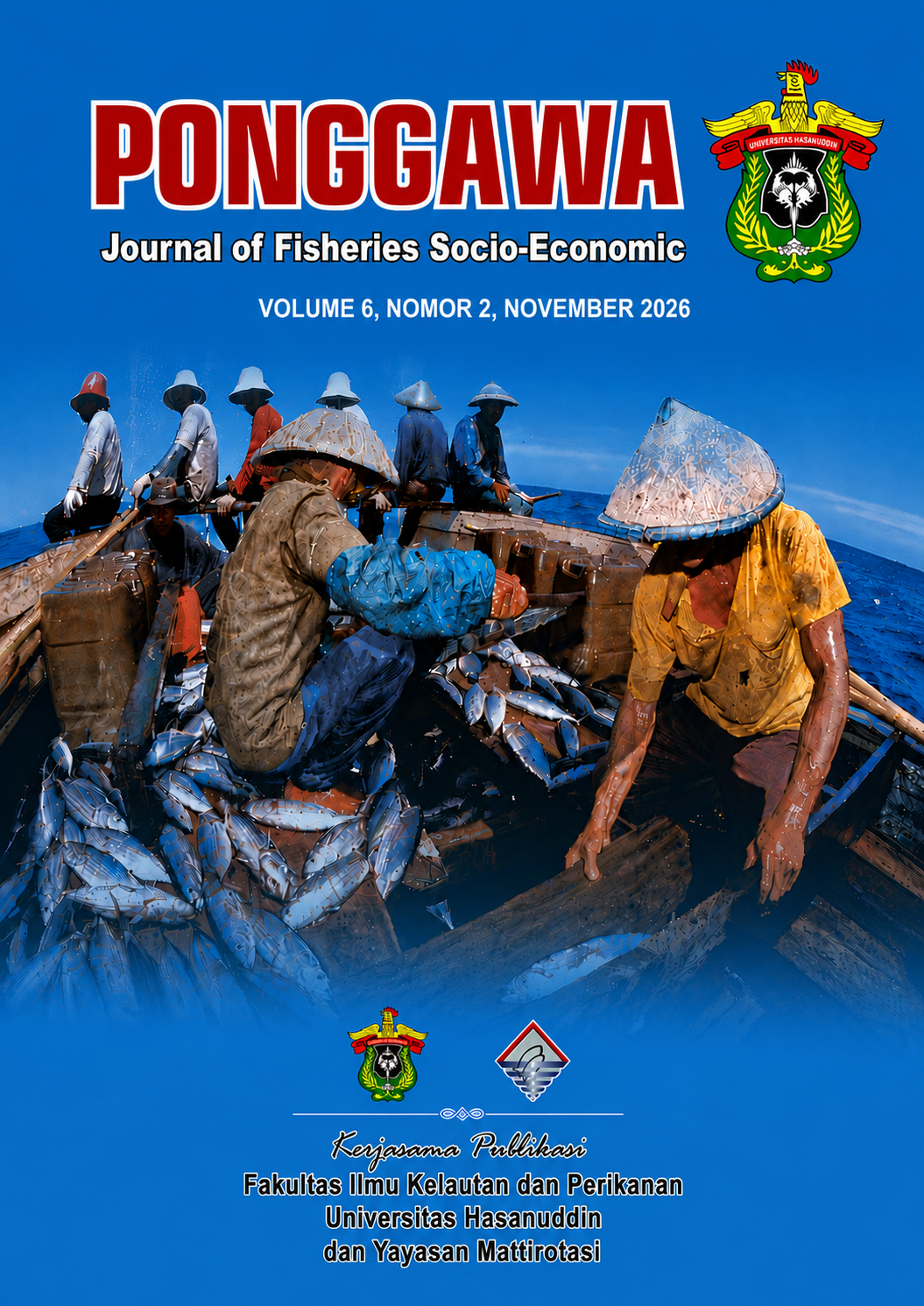
Economic Business Analysis of Polyculture Pond Cultivation of Shrimp and Milkfish in Turikale District, Maros Regency
DOI:
https://doi.org/10.35911/ponggawa.v6i1.49926Keywords:
Aquaculture, economic analysis, polyculture farmingAbstract
Aquaculture plays a strategic role in supporting food security, economic growth, and the welfare of coastal communities in Indonesia. Turikale District in Maros Regency is one of the regions with high potential for implementing polyculture pond systems, particularly for black tiger shrimp Penaeus monodon and milkfish Chanos chanos. This study aimed to evaluate the economic aspects of polyculture pond farming in this area, focusing on profitability and economic feasibility. The research was conducted in response to the growing demand for efficient and sustainable aquaculture models to optimize fisheries resource management. The study employed a descriptive quantitative approach, collecting primary data through interviews, questionnaires, and direct field observations involving 24 fish farmers in Taroada Village. Data analysis included calculations of total production costs, total revenues, profit margins, and R/C ratio analysis to assess business efficiency. The total production cost per cycle (6 months) was Rp18,242,320.61, comprising fixed costs of Rp1,036,877.86 and variable costs of Rp17,205,442.75. The total revenue reached Rp27,857,697.22, yielding a net profit of Rp9,615,376.598. Feasibility analysis revealed an R/C ratio of 1.53, indicating that for every Rp1 spent, the business generated Rp1.53 in revenue, thus confirming its economic viability. These findings demonstrate that polyculture farming of black tiger shrimp and milkfish not only provides significant financial returns to farmers but also has the potential to enhance local economic development. It is recommended to expand the implementation of this system while ensuring operational efficiency and sustainable pond management practices.
References
Ahmed, N., & Thompson, S. (2019). The blue dimensions of aquaculture: A global synthesis. Science of the Total Environment, 652, 851–861. https://doi.org/10.1016/j.scitotenv.2018.10.163
Asche, F., Cojocaru, A. L., & Roth, B. (2018). The development of large-scale aquaculture production: A comparison of the supply chains for chicken and salmon. Aquaculture, 493, 446–455. https://doi.org/10.1016/j.aquaculture.2016.10.031
Badan Pusat Statistik Kabupaten Maros. (2024). Kabupaten Maros Dalam Angka 2024. Maros: BPS Kabupaten Maros.
Bangun, W. 2007. Teori Ekonomi Mikro. PT. Refika Aditama : Bandung.
Baso, A., Najamuddin, Firman, Chasyim Hasani, M., & Kasri. (2021). Economic analysis of shortfin scads fish (Decapterus spp) business using purse seine in Bone Regency, Indonesia. In IOP Conference Series: Earth and Environmental Science (Vol. 860, No. 1, p. 012052). IOP Publishing.
Dadiono, M. S., Wijaya, R., Kusuma, R. O., & Aminin. (2022). Simulasi analisis kelayakan usaha budidaya ikan bandeng (Chanos chanos) kuartal pertama tahun 2022. Jurnal Perikanan Pantura, 6(1).
Dolorosa, E., Masyhuri, Lestari, & Jamhari. (2015). Analisis kelayakan finansial usaha perikanan tambak polikultur bandeng-udang windu. Jurnal Social Economic of Agriculture, 3(2).
Engle, C. R. (2020). Aquaculture Economics and Financing: Management and Analysis. Wiley-Blackwell.
Food and Agriculture Organization (FAO). (2024). The State of World Fisheries and Aquaculture 2024: Blue Transformation in Action. Rome: FAO. https://doi.org/10.4060/cd0683en
Hafiludin, M. (2015). Kandungan Gizi dan Nilai Ekonomi Ikan Bandeng. Jurnal Perikanan.
Hendrajat, E. A., Ratnawati, E., & Mustafa, A. (2018). Penentuan pengaruh kualitas tanah dan air terhadap produksi total tambak polikultur udang vaname dan ikan bandeng di Kabupaten Lamongan, Provinsi Jawa Timur melalui aplikasi analisis jalur. Jurnal Ilmu dan Teknologi Kelautan Tropis, 10(1), 195–210. https://doi.org/10.29244/jitkt.v10i1.21675
Hukom, V., Nielsen, R., & Nielsen, M. (2022). Effects of co-management on technical efficiency and environmental stressors: An application to small-scale shrimp polyculture in Indonesia. Aquaculture Economics & Management, 26(1), 98–117.
Ishak, A., Fakhriyyah, S., & Hasani, M. C. (2021). Feasibility Analysis of Handline Fishing Equipment Case Study on Barrang Caddi Island, Sangkarrang District, Makassar City. PONGGAWA: Journal of Fisheries Socio-Economic, 51-59.
Khatimah, K. (2019). Analisis kelayakan finansial budidaya udang vannamei di Desa Parangtritis, DIY. Jurnal Ekonomi Pertanian dan Agribisnis (JEPA), 3(1), 21–32.
Murachman, B., et al. (2010). Polikultur sebagai Sistem Budidaya Berkelanjutan.Jurnal Akuakultur Indonesia.
Pai, W. T., Schafferer, C., Lee, J. M., Ho, L. M., Lu, Y. H., Yang, H. C., & Yeh, C. Y. (2022). Effect of culture period and stocking density on input demand and scale economies of milkfish (Chanos chanos) polycultures with white shrimp (Penaeus indicus). Fishes, 7(3), 110.
Rahim, A., & Hastuti, D. R. D. (2018). Pengantar Teori dan Kasus Ekonomika Pertanian. Penebar Swadaya.
Ramdhan, M. (2021). Metode Penelitian (AA Effendy). Cipta Media Nusantara.
Rian, A. A. D. N., Fakhriyyah, S., & Cangara, A. S. (2022). Feasibility Study of Purse Seine Business Units In Tanete Riattang Timur Sub-District Bone District. PONGGAWA: Journal of Fisheries Socio-Economic, 79-90.
Salsabilah, J. A., Amiluddin, A., Cangara, A. S., Baso, A., & Gosari, B. A. J. (2021). Socio-Economic Analysis of Fresh Fish Traders During The COVID-19 Pandemic at The Rajawali TPI Makassar City. PONGGAWA: Journal of Fisheries Socio-Economic, 15-28.
Septiningsih, E., & Tahe, S. (2019). Pemasyarakatan teknologi polikultur udang windu (Penaeus monodon), ikan bandeng (Chanos chanos), dan rumput laut (Gracilaria verrucosa) di tambak. Jurnal Ilmu Alam dan Lingkungan, 11(1).
Soekartawi, 2006. Ilmu Usaha Tani. Jakarta : Universitas Indonesia.
Soekarwati, 2016. Agribisnis Teori dan Aplikasinya. PT.Raja Grafindo Persada. Jakarta.
Sukirno. 2002. Teori Mikro Ekonomi. Jakarta : Rajawali Press
Widowati, L. L., Fitarani, N., Rejeki, S., & Ariyati, R. W. (2024). Hubungan produktivitas primer dengan tingkat produksi tambak polikultur rumput laut dengan udang dan ikan bandeng: Studi kasus di Brebes, Jawa Tengah, Indonesia. Jurnal Riset Akuakultur, 19(2).
World Bank. (2023). Digital Opportunities for Fisheries Value Chains in Developing Countries. Washington, DC: World Bank.