Effect of lime (Citrus × aurantiifolia (Christm.) Swingle) and kaffir lime leaves (Citrus hystrix DC.) powders on the red flour beetle, Tribolium castaneum (Herbst)
DOI:
https://doi.org/10.64128/wppj.v1i2.48521Keywords:
Essential oils, mortality, rice, secondary pest, pest controlAbstract
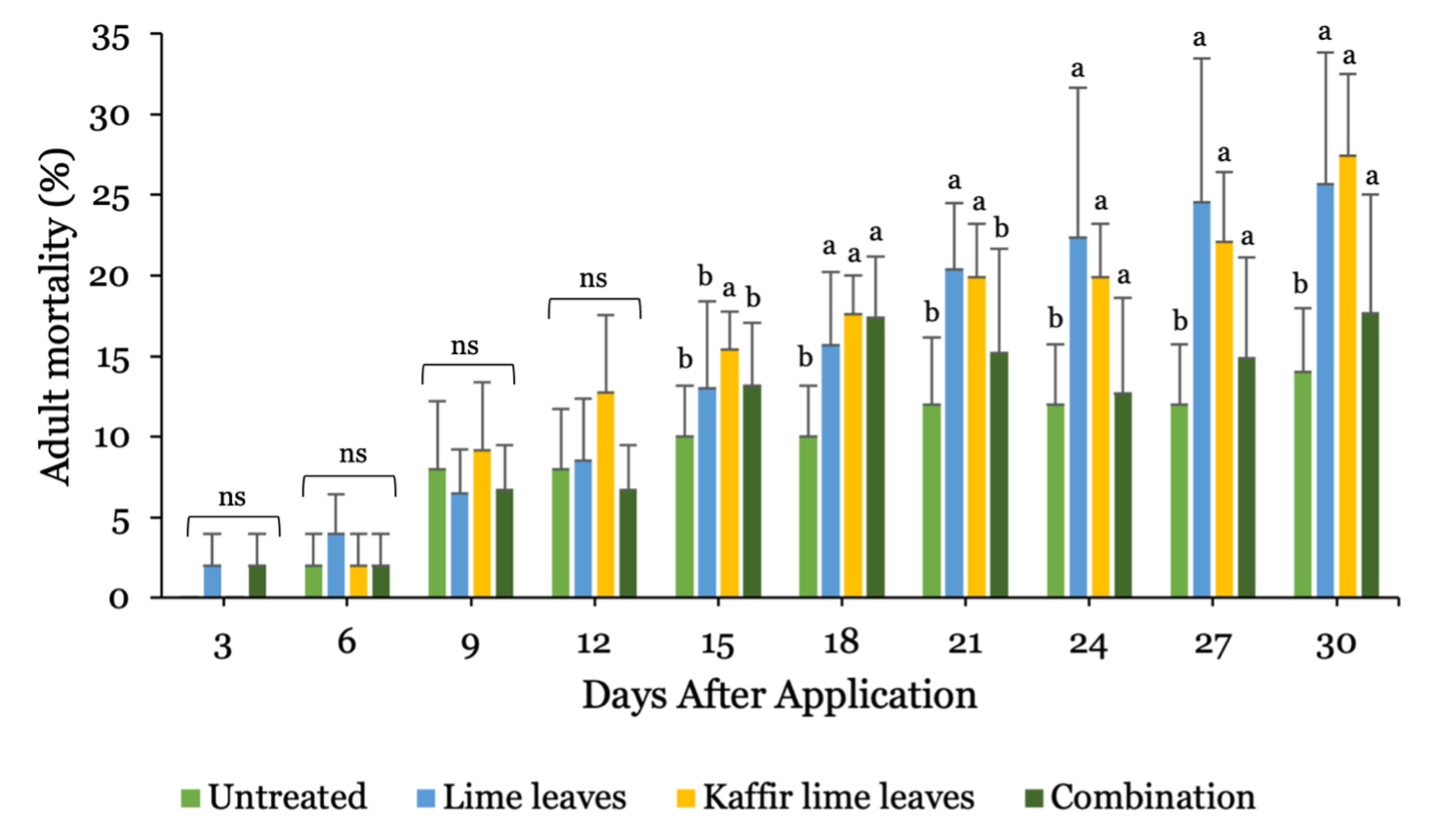
One of the secondary pests of stored rice is Tribolium castaneum (Herbst) (Coleoptera: Tenebrionidae). Damage caused by this insect includes fungal contamination and the release of benzoquinone-containing secretions, which may pose health risks to humans. Postharvest pest control commonly relies on synthetic fumigant insecticides, yet their use is associated with environmental and health concerns. Plant-derived fumigants offer a more eco-friendly alternative. This study aimed to evaluate the fumigant effects of plant powders from lime (Citrus × aurantifolia (Christm.) Swingle) and kaffir lime leaves (Citrus hystrix DC.) on the mortality of T. castaneum adult. The experiment employed a untreated, lime leaves, kaffir lime leaves, and a combination of lime + kaffir lime leaves with five replications. Adult mortality was recorded from 3 to 30 days after treatment. Results indicated that by the final observation on day 30, treatment effects were most distinct. Lime leaves (25.67%) and kaffir lime leaves (27.44%) produced significantly higher mortality than both the untreated and the combined treatment (F₃,₁₉ = 0.83, P < 0.05). The combined treatment resulted in only 17.67% mortality, indicating no synergistic effect between the two leaves powders. Mortality in the untreated group remained below 14% throughout the experiment. Lime and kaffir lime leaves, when used individually, exhibit promising fumigant activity against T. castaneum and may serve as potential botanical alternatives for postharvest pest management.
References
Abbott, W. S. (1925). A method of computing the effectiveness of an insecticide. Journal of Economic Entomology, 18(2), 265–267. https://doi.org/10.1093/jee/18.2.265a
Altazani, M., Azzahra, G., Soabir, C. F., Salsabila, P. C., Hatimah, H., Kafle, L., & Mario, M. B. (2024). Potential of solid gel formulation of kaffir lime peel extract against postharvest pest Sitophilus zeamais on stored rice. In BIO Web of Conferences. EDP Sciences. https://doi.org/10.1051/bioconf/20249602006
Anggraini, A., Hamidah, H., & Moehammadi, N. (2013). Uji efektivitas ekstrak daun jeruk purut (Citrus hystrix D.C.) dan daun jeruk kalamondin (Citrus mitis Blanco) sebagai biolarvasida terhadap kematian larva instar III nyamuk Aedes aegypti I. Jurnal Ilmiah Biologi FST, 1.
Asawalam, E. F., & Arukwe, U. E. (2004). Effect of combination of some plant powders on the control of Sitophilus zeamais Motsch. Nigeria Agricultural Journal, 35, 76-85.
Babarinde, S. A., Kemabonta, K. A., Aderanti, I. A., Kolawole, F. C., & Adeleye, A. D. (2018). Synergistic effect of spinosad with selected botanical powders as biorational insecticides against adults of Tribolium castaneum Herbst, 1797 (Coleoptera: Tenebrionidae). Journal of Agricultural Sciences, Belgrade, 63(1), 39-51. https://doi.org/10.2298/JAS1801039B
Bedini, S., Djebbi, T., Ascrizzi, R., Farina, P., Pieracci, Y., Echeverría, M. C., Flamini, G., Trusendi, F., Ortega, S., Chiliquinga, A., & Conti, B. (2024). Repellence and attractiveness: The hormetic effect of aromatic plant essential oils on insect behavior. Industrial Crops and Products, 210, 118122. https://doi.org/10.1016/j.indcrop.2024.118122
Buatone, S., & Indrapichate, K. (2011). Protective effects of mintweed, kitchen mint and kaffir lime leaf extracts against rice weevils, Sitophilus oryzae L., in stored, milled rice. International Journal of Agriculture Sciences, 3(3), 133. https://doi.org/10.9735/0975-3710.3.3.133-139
Byrns, G., & Fuller, T. P. (2011). The risks and benefits of chemical fumigation in the health care environment. Journal of Occupational and Environmental Hygiene, 8(2), 104-112. https://doi.org/10.1080/15459624.2011.547453
Campbell, J. F., Athanassiou, C. G., Hagstrum, D. W., & Zhu, K. Y. (2022). Tribolium castaneum: A model insect for fundamental and applied research. Annual Review of Entomology, 67(1), 347–365. https://doi.org/10.1146/annurev-ento-080921-075157
Campolo, O., Giunti, G., Russo, A., Palmeri, V., & Zappalà, L. (2018). Essential oils in stored product insect pest control. Journal of Food Quality, 2018 (1), 6906105. https://doi.org/10.1155/2018/6906105
Deb, M., & Kumar, D. (2021). Grain protectant behaviour of Artemisia annua and reduction in nutritional damage of wheat flour (Triticum aestivum L.) caused by Tribolium castaneum. Food Control, 127, 108114. https://doi.org/10.1016/j.foodcont.2021.108114
Fan, G.-W., Wang, P., Liu, Y.-S., Sang, Y.-L., Liu, N., & Hao, Y.-J. (2025). Insecticidal activity of two Pelargonium essential oils and head transcriptome analysis of stored-product pest Tribolium castaneum (Herbst) (Coleoptera: Tenebrionidae) in response to citronellyl formate fumigation. Pesticide Biochemistry and Physiology, 208, 106278. https://doi.org/10.1016/j.pestbp.2024.106278
Fouad, H. A., & da Camara, C. A. (2017). Chemical composition and bioactivity of peel oils from Citrus aurantiifolia and Citrus reticulata and enantiomers of their major constituent against Sitophilus zeamais (Coleoptera: Curculionidae). Journal of stored products research, 73, 30-36. https://doi.org/10.1016/j.jspr.2017.06.001
Hamzah, A. F. A., Zainalabidin, N., & Elias, N. H. (2024). Insecticidal Activity of kaffir lime (Citrus hystrix) against rice weevil (Sitophylus oryzae). Advanced and Sustainable Technologies (ASET), 3, 63-70. https://doi.org/10.58915/aset.v3i.584
Heinrichs, E. A., E.G., M., & H.R., R. (1985). Genetic Evaluation For Insect Resistance in Rice. International Rice Research Institute.
Hendrival, H., Juhaimi, J., Sari, Y., Usnawiyah, U., & Khaidir, K. (2022). Pengaruh kepadatan populasi dan periode penyimpanan terhadap pertumbuhan populasi Sitophilus oryzae (L.) dan kerusakan sorgum. Jurnal Agrium, 19(3), 248. https://doi.org/10.29103/agrium.v19i3.8753
Istianah, M. ., Utami, U., & Ameliana, W. (2013). Effectivity biolarvasida kaffir lime oil (Citrus hystrix) against larva stage III mosquito Aedes aegypti). Artikel Ilmiah Hasil Penelitian Mahasiswa.
Kannan, N., & Chandrasekaran, N. (2026). Targeting Tribolium castaneum with nanoemulsified essential oils: A green approach to pest control. Journal of Stored Products Research, 115, 102829. https://doi.org/10.1016/j.jspr.2025.102829
Khorrami, F., Valizadegan, O., Forouzan, M., & Soleymanzade, A. (2018). The antagonistic/synergistic effects of some medicinal plant essential oils, extracts and powders combined with Diatomaceous earth on red flour beetle, Tribolium castaneum Herbst (Coleoptera: Tenebrionidae). Archives of Phytopathology and Plant Protection, 51(13-14), 685-695. https://doi.org/10.1080/03235408.2018.1458412
Kim, B. H., Han, G. D., Kwon, H., Chun, Y. S., Na, J., & Kim, W. (2019). Chlorine dioxide fumigation to control stored product insects in rice stored in a room. Journal of Stored Products Research, 84, 101527. https://doi.org/10.1016/j.jspr.2019.101527
Kim, S. I., & Lee, D. W. (2014). Toxicity of basil and orange essential oils and their components against two coleopteran stored products insect pests. Journal of Asia-Pacific Entomology, 17(1), 13-17. https://doi.org/10.1016/j.aspen.2013.09.002
Majd-Marani, S., Naseri, B., Hassanpour, M., Razmjou, J., & Jalaeian, M. (2023). Life History and life table parameters of the rice weevil, Sitophilus oryzae L. (Coleoptera: Curculionidae) fed on 10 rice cultivars and lines in Iran. Journal of Stored Products Research, 102(February), 102118. https://doi.org/10.1016/j.jspr.2023.102118
Mario, M. B., Astuti, L. P., Hsu, J. L., Kafle, L., & Fernando, I. (2023). Bioefficacy of eight different plant powders applied as fumigants against the adzuki bean weevil, Callosobruchus chinensis. Crop Protection, 167, 106200. https://doi.org/10.1016/j.cropro.2023.106200
Mario, M. B., Astuti, L. P., Jue-Hsu, L., & Kafle, L. (2021). Fumigant activity of four plant powders against cowpea weevil, Callosobruchus maculatus (Fabricius) (Coleoptera: Chrysomelidae) in stored adzuki bean. Legume Research-An International Journal, 44(6), 667-672. https://doi.org/10.18805/LR-533
Naimi, I., Bouamama, H., & M'hamed, T. B. (2025). Individual and combined effects of Juniperus phoenicea and J. oxycedrus powders on insecticidal activity against Tribolium castaneum (Herbst) (Coleoptera: Tenebrionidae) and Rhyzopertha dominica (Fabricius) (Coleoptera: Bostrichidae). Journal of Stored Products Research, 111, 102573. https://doi.org/10.1016/j.jspr.2025.102573
Ngegba, P. M., Cui, G., Khalid, M. Z., & Zhong, G. (2022). Use of botanical pesticides in agriculture as an alternative to synthetic pesticides. Agriculture, 12(5), 600. https://doi.org/10.3390/agriculture12050600
Nta, A. I., Okweche, S. I., & Udo, I. A. (2017). Insecticidal and insect reproductive inhibition potential of Citrus peel powder on Tribolium castaneum (Herbst). Applied Tropical Agriculture, 22(2), 111-117.
Ogilvie-Battersby, J. D., Nagarajan, R., Mosurkal, R., & Orbey, N. (2022). Microencapsulation and controlled release of insect repellent geraniol in gelatin/gum arabic microcapsules. Colloids and Surfaces A: Physicochemical and Engineering Aspects, 640, 128494. https://doi.org/10.1016/j.colsurfa.2022.128494
Piangsuwan, P., Tangkawanit, U., & Thongphak, D. (2025). Biotoxicity of Limnophila aromatica (Lam.) Merr essential oils against the rice weevil Sitophilus oryzae (Coleoptera: Curculionidae). Journal of Stored Products Research, 111, 102499. https://doi.org/10.1016/j.jspr.2024.102499
Rajath, M., Remesh, A. V., Mokshith, D. G., Babu, C. V., & Bettadaiah, B. K. (2025). Resource utilization of Citrus maxima (Pomelo) fruit peel essential oil for its insecticidal efficacy against Rhyzopertha dominica, a major stored grain insect pest. Food and Humanity, 100909. https://doi.org/10.1016/j.foohum.2025.100909
Rizwan, M., Yasin, M., Tahir, M., Ahmad, A., Banazeer, A., Shahzad Afzal, M. B., & Sagheer, U. (2024). Effect of zinc fortified, arid and irrigated wheat varieties flour upon life history parameters of red flour beetle, Tribolium castaneum (Herbest) (Coleoptera: Tenebrionidae). Journal of Stored Products Research, 108, 102370. https://doi.org/10.1016/j.jspr.2024.102370
Sharma, K. R., Raju, S. V. S., Singh, S. K., Singh, R., Dhanapal, R., & Kumar, R. (2024). Differential preference of grain of landrace and commercial rice genotypes to Sitophilus oryzae (L.) (Coleoptera: Curculionidae) attack. Journal of Stored Products Research, 108, 102373. https://doi.org/10.1016/j.jspr.2024.102373
Shashikumar, C., Singha, S., & Mitra, S. (2025). Assessment of protective ability of some selected leaf powders against rice weevil (Sitophilus oryzae) and their effect on sensory properties of two exotic rice varieties. Journal of Natural Pesticide Research, 14, 100142. https://doi.org/10.1016/j.napere.2025.100142
Srinivasan, A., Manickavasagam, K., Malaichamy, K., Arunachalam, L., Sundaram, P., Kolanthasamy, E., & Kasivelu, G. (2023). Impact of silver nanoparticles against stored product pest Sitophilus oryzae (L.) and effect on agromorphological characteristics of Zea mays (maize seeds). Process Safety and Environmental Protection, 177, 1336–1350. https://doi.org/10.1016/j.psep.2023.07.074
Tak, J. H., & Isman, M. B. (2017). Penetration-enhancement underlies synergy of plant essential oil terpenoids as insecticides in the cabbage looper, Trichoplusia ni. Scientific reports, 7(1), 42432. https://doi.org/10.1038/srep42432
Yadav, D. K., Rathee, S., Sharma, V., & Patil, U. K. (2024). A comprehensive review on insect repellent agents: medicinal plants and synthetic compounds. Anti-Inflammatory & Anti-Allergy Agents in Medicinal Chemistry. https://doi.org/10.2174/0118715230322355240903072704.
Downloads
Published
Issue
Section
License
Copyright (c) 2025 Binti Nur Anggriani, Ade Rosmana, M. Bayu Mario, Wardani Syahrani, Ahdin Gassa

This work is licensed under a Creative Commons Attribution 4.0 International License.