
Perception of the pest status of the oriental latrine fly (Chrysomya megacephala) and its control methods in Ogbomoso Agricultural Zone, Southwestern Nigeria
DOI:
https://doi.org/10.64128/wppj.v2i1.49910Keywords:
Biological control, Botanical control, Chemical control, Cultural control, Physical control, PollinatorAbstract
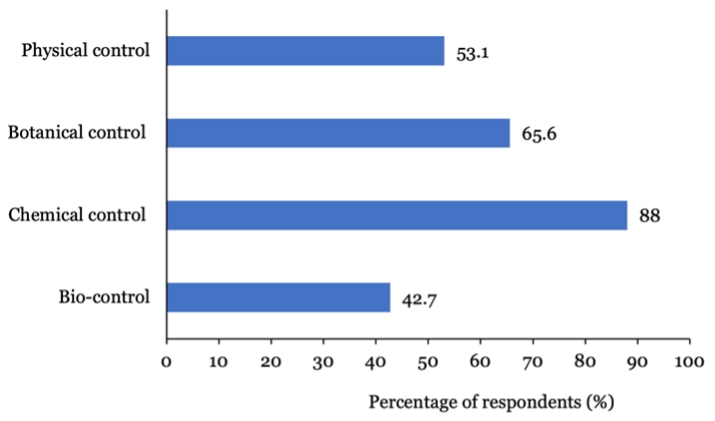
Chrysomya megacephala, known as the oriental latrine fly, thrives in human settlements and poses significant public health risks due to its role in spreading pathogens. This study assessed residents' perceptions of the pest status and control methods of C. megacephala in Ogbomoso Agricultural Zone, Nigeria. Two Local Government Areas, Ogbomoso North and Surulere, were purposively selected. Using a snowball technique, 192 respondents were interviewed through a structured questionnaire, gathering data on socio-economic characteristics, awareness, perceptions, control methods, and the pest’s significance. Descriptive statistics were used for analysis. Findings showed that 61.5% of respondents were male, suggesting male dominance in livestock rearing and processing, which attracts blowflies. The mean respondent age was 51.7 years. A high level of awareness (82.8%) of C. megacephala was observed. Residents perceived the fly as a serious pest; its infestation of wounded animals, reducing their economic value, and its role in transmitting cholera via contaminated meat ranked highest (WMS = 4.3). Other impacts included causing typhoid and animal weight loss (WMS = 4.1). In terms of control, 87.0% preferred chemical methods, 77.0% preferred botanicals, and 34% preferred biological control agents, while 33% preferred physical control. Although C. megacephala was viewed as a pollinator (83.3%), a large proportion of the respondents viewed it as a health threat (77.6%) and disease vector (67.7%). Therefore, the study recommends promoting eco-friendly alternatives to chemical control, such as botanical and cultural controls, to enhance human well-being and reduce public health risks connected to C. megacephala in Ogbomoso Agricultural Zone, Nigeria.
References
Alonge, G. O., Makinde, G. E. O., Owolade, E. O., Martins, M. O., & Adegbite, O. O. (2016). Gender dimension in livestock production in Oyo State, Nigeria. Nigerian Journal of Rural Sociology, 16(4), 34–38. https://doi.org/10.22004/ag.econ.287486
Anggriani, B. N., Rosmana, A., Mario, M. B., Syahrani, W., & Gassa, A. (2025). Effect of lime (Citrus × aurantiifolia (Christm.) Swingle) and kaffir lime leaves (Citrus hystrix DC.) powders on the red flour beetle, Tribolium castaneum (Herbst). Wallacea Plant Protection Journal, 1(2), 39–44. https://doi.org/10.64128/wppj.v1i2.48521
Babarinde, S. A., & Akinyemi, A. O. (2024). Natural products for fumigation and treatment. In D. S. Jayas (Ed.), Control and management of pests in stored products. CRC Press, Taylor & Francis.
Babarinde, S. A., Akinyemi, A. O., Odewole, A. F., Yisa, S., Oke, O. O., & Adeyemo, A. O. (2016). Phytochemical composition and insecticidal properties of mechanically extracted castor, seed oil against cowpea seed bruchid (Callosobruchus maculatus Fabricius) infesting bambara groundnut. Elixir Agriculture, 92, 39086–39092.
Babarinde, S. A., Dawodu, E. O., Ogundeji, D., Solomon, R., Audu, F. O., Adeyemi, A. A., Lawal, V., & Ibitoye, A. B. (2023). Chemical composition and toxicity of essential oils of clove flower buds and goat weed leaves against housefly larvae. International Journal of Environmental Studies, 80(3), 635–648. https://doi.org/10.1080/00207233.2022.2099101
Bambaradeniya, Y. T. B., Karunaratne, W. A. I. P., Tomberlin, J. K., Goonerathne, I., Kotakadeniya, R. B., & Magni, P. A. (2019). Effect of temperature and tissue type on the development of the forensic fly Chrysomya megacephala (Diptera: Calliphoridae). Journal of Medical Entomology, 56(6), 1571–1581. https://doi.org/10.1093/jme/tjz097
Bari, Md. L., & Yeasmin, S. (2018). Foodborne diseases and responsible agents. In Food safety and preservation (pp. 195–229). Elsevier. https://doi.org/10.1016/B978-0-12-814956-0.00008-1
Carneiro, J. S., Pires, E. M., Nogueira, R. M., Shiomi, H. F., Soares, M. A., Oliveira, M. A., & Melo, I. S. (2014). Bacteria carried by Chrysomya megacephala (Fabricius, 1794) (Diptera: Calliphoridae) in Sinop, Mato Grosso, Brazil. Scientific Electronic Archives, 6(1), 18–22. https://doi.org/10.36560/61201457
Chaiwong, T., Srivoramas, T., Sueabsamran, P., Sukontason, K., Sanford, M. R., & Sukontason, K. L. (2014). The blow fly, Chrysomya megacephala, and the house fly, Musca domestica, as mechanical vectors of pathogenic bacteria in Northeast Thailand. Tropical Biomedicine, 31(2), 336–346.
Goddard, J., De Jong, G., & Meyer, F. (2020). Unidirectional en masse larval dispersal of blow flies (Diptera: Calliphoridae). Food Webs, 23, e00137. https://doi.org/10.1016/j.fooweb.2019.e00137
Guiadem, L. S., Dhuideu, C. T., Bozdoğan, H., Mballa, A. N., & Kekeunou, S. (2023). Spatio-temporal distribution of Chrysomya megacephala (Diptera: Calliphoridae), mechanical vector of infectious diseases in the city of Yaoundé (Centre-Cameroon). International Journal of Tropical Insect Science, 43(2), 617–627. https://doi.org/10.1007/s42690-023-00969-w
Hall, M. J. R. (1991). Screwworm flies as agents of wound myiasis. World Animal Review, 8–17.
Hamed, R. M. H., Rahman, A. H., Abdalmagid, M. A., & Jamal, A. E. (2013). Study: Ecology and distribution of common house flies at Khartoum State, 2007. Sudanese Journal of Public Health, 8(3), 107–112.
James, O. A. (2014). Household size and agricultural land-use pattern in Obagaji area of the Guinea Savanna region, Nigeria. Journal of Agricultural Extension and Rural Development, 6(1), 48–54. https://doi.org/10.5897/JAERD12.123
Javaid, S., Mukhtar, M. K., Amjad, N., Khan, S. Y., & Khan, H. A. A. (2025). Resistance status of blowfly, Chrysomya megacephala against selected insecticides from central Punjab, Pakistan. Journal of Animal and Plant Sciences, 35(5), 1257–1268. https://doi.org/10.36899/japs.2025.5.0107
Kumar, M., Jaiswal, S., Sodhi, K. K., Shree, P., Singh, D. K., Agrawal, P. K., & Shukla, P. (2019). Antibiotics bioremediation: Perspectives on its ecotoxicity and resistance. Environment International, 124, 448–461. https://doi.org/10.1016/j.envint.2018.12.065
Li, D., & Suh, S. (2019). Health risks of chemicals in consumer products: A review. Environment International, 123, 580–587. https://doi.org/10.1016/j.envint.2018.12.033
Odewole, A. F., Adebayo, T. A., Babarinde, S. A., & Awolokun, G. S. (2020). Insecticidal activity of aqueous indigenous plant extracts against insect pests associated with cucumber (Cucumis sativus L.) in Southern Guinea Savannah Zone of Nigeria. Archives of Phytopathology and Plant Protection, 53(5–6), 230–246. https://doi.org/10.1080/03235408.2020.1741854
Ojo, J. (2016). Pesticides use and health in Nigeria. Ife Journal of Science, 18(4), 981–991.
Okafor, C. C., Udemadu, M. O., Adetimehin, A. D., & Uyi, O. (2026). Diversity and abundance of blow flies during the dry season in Ovia North-East local government area of Benin City, Edo State, Nigeria. Journal of Applied Sciences and Environmental Management, 30(1), 95–104. https://doi.org/10.4314/jasem.v30i1.12
Olatubi, I. V., Ashipa, O. S., Aromolaran, O., Akinkunle, V. A., & Adeleke, O. A. (2021). Isolation and characterization of bacteria from blowflies Chrysomya chloropyga collected from two different abattoirs in two communities. Academia Journal of Microbiology Research, 9(2), 033–039.
Onifade, O. O., Adesina, G. O., & Babarinde, S. A. (2022). Ethnobotanical survey and chemical composition analysis of plants used for the management of snakebite symptoms in cattle by herdsmen in Saki and Ogbomoso Agricultural Zones, Southwest Nigeria. South African Journal of Botany, 151, 876–888. https://doi.org/10.1016/j.sajb.2022.11.003
Osei, M.-M., Dayie, N. T. K. D., Azaglo, G. S. K., Tettey, E. Y., Nartey, E. T., Fenny, A. P., Manzi, M., Kumar, A. M. V., Labi, A.-K., Opintan, J. A., & Sampane-Donkor, E. (2022). Alarming levels of multidrug resistance in aerobic Gram-negative bacilli isolated from the Nasopharynx of healthy under-five children in Accra, Ghana. International Journal of Environmental Research and Public Health, 19(17), 10927. https://doi.org/10.3390/ijerph191710927
Pimentel, D. (2010). The effects of antibiotic and pesticide resistance on public health. In Antibiotic Resistance: Implications for global health and novel intervention strategies (pp. 294–300). National Academies Press.
Radhakrishnan, S., Gopalan, A. K. K., Ravindran, R., Rajagopal, K., Sooryadas, S., & Promod, K. (2012). First record of Chrysomya albiceps Wiedemann, 1819 (Diptera: Calliphoridae) maggots from a sambar deer (Rusa unicolor) in Kerala, South India. Journal of Parasitic Diseases, 36(2), 280–282. https://doi.org/10.1007/s12639-012-0110-7
Rashid, R. Abd., Osman, K., Ismail, M. I., Zuha, R. M., & Hassan, R. A. (2008). Determination of malathion levels and the effect of malathion on the growth of Chrysomya megacephala (Fibricius) in malathion-exposed rat carcass. Tropical Biomedicine, 25(3), 184–190.
Rezende, L. do C., Oliveira, T. M. de, Teixeira, C. M., Santos, M. A. de S., Cunha, L. M., Silva, M. X., & Martins, N. R. da S. (2019). Synanthropic diptera affecting layer poultry farms: A review. Arquivos Do Instituto Biológico, 86, e0922017. https://doi.org/10.1590/1808-1657000922017
Sakulpanich, A., Attrapadung, S., & Gritsanapan, W. (2023). Larvicidal activity of Stemona collinsiae root extract against Musca domestica and Chrysomya megacephala. Scientific Reports, 13(1), 15689. https://doi.org/10.1038/s41598-023-42500-8
Santos, A. R. dos, Nascimento, R. F. S. C. do, Cruz, J. D. da, da Silva Xavier, A., Ramos, A. de S., Ferreira, J. L. P., Maria, A. C. B., Almeida, M. M. H. de, Mpalantinos da Silva, M. A., Correa, P. G., Silva, J. R. de A., Queiroz, M. M. de C., & Amaral, A. C. F. (2023). Evaluation of essential oils and diluents against Chrysomya megacephala, an important mechanical vector. Journal of Natural Pesticide Research, 3, 100024. https://doi.org/10.1016/j.napere.2023.100024
Sukontason, K., Chaiwong, T., Tayutivutikul, J., Somboon, P., Choochote, W., Piangjai, S., & Sukontason, K. L. (2005). Susceptibility of Musca domestica and Chrysomya megacephala to permethrin and deltamethrin in Thailand. Journal of Medical Entomology, 42(5), 812–814. https://doi.org/10.1093/jmedent/42.5.812
Tan, S. H., Kurahashi, H., & Sawabe, K. (2024). Fly. In K. Sawabe, C. Sanjoba, & Y. Higa (Eds.), Medical entomology in Asia (pp. 91–147). Springer. https://doi.org/10.1007/978-981-97-4406-0_3
Ugwu, J. A., Omoloye, A. A. ., Asogwa, E. U., & Aduloju, A. R. (2015). Pesticide-handling practices among smallholder vegetable farmers in Oyo state, Nigeria. Scientific Research Journal, 3(4), 40–47.
Umar, Y. A., Abu, I. A., Sani, M. H., Idi, S., & Owoade, E. O. (2023). Gender analysis of cattle farmers’ participation in cattle production in Bauchi and Yobe States, Nigeria. Asian Journal of Agricultural Extension, Economics & Sociology, 41(9), 637–646. https://doi.org/10.9734/ajaees/2023/v41i92085
Wells, J. D. (1991). Chrysomya megacephala (Diptera: Calliphoridae) has reached the continental United States: Review of its biology, pest status, and spread around the world. Journal of Medical Entomology, 28(3), 471–473. https://doi.org/10.1093/jmedent/28.3.471
Downloads
Published
Issue
Section
License
Copyright (c) 2026 Ilesanmi Bayo Olatunji, Prof Samuel Adelani Babarinde, Adeola Odewole

This work is licensed under a Creative Commons Attribution 4.0 International License.