Potential of Trichoderma species against purple blotch disease and increase shallot yields
DOI:
https://doi.org/10.64128/wppj.v2i1.50533Keywords:
Alternaria porri, Disease management, Shallot variety, Tabanan RegencyAbstract
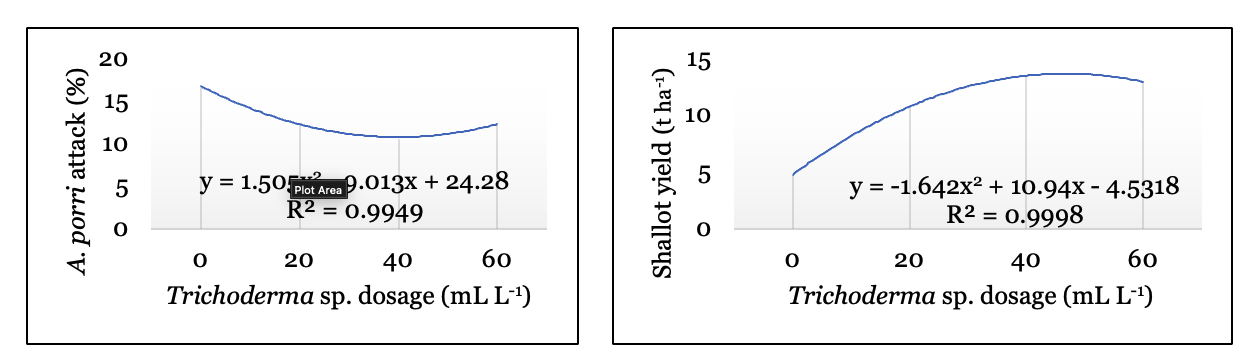
Purple blotch disease, caused by pathogenic fungi Alternaria porri, is an important foliar disease of shallot that can substantially reduce crop productivity. Biological control using Trichoderma-derived preparations offers a potential alternative to intensive reliance on synthetic fungicides. This study evaluated the effects of different concentrations of a Trichoderma sp. preparation on purple blotch development and yield performance of three shallot varieties under field conditions. The experiment was conducted in Tabanan Regency, Bali, Indonesia, from February to May 2020 using a factorial randomized block design. The treatments consisted of four concentrations of the Trichoderma preparation (0, 20, 40, and 60 mL L-1) and three shallot varieties (Bima Brebes, Bali Karet, and Local Tabanan), with four blocks. Disease development and yield-related parameters were evaluated to determine the responses to Trichoderma concentration, shallot variety, and their interaction. The combination of 40 mL L-1 Trichoderma preparation and Bali Karet was associated with a low purple blotch severity of 11.55%. However, the highest dry bulb yield (14.10 t ha-1) was recorded in the untreated Bali Karet control, whereas the 40 mL L-1 treatment in the same variety produced 13.89 t ha-1. These findings indicate that suppression of purple blotch did not necessarily correspond to a proportional increase in bulb yield and that treatment responses were dependent on shallot variety. Therefore, the effectiveness of the Trichoderma preparation should be interpreted by considering both disease suppression and varietal yield response rather than defining a single concentration as universally optimal.
References
Abdelrahman, M., Mahmoud, H. Y. A. H., El-Sayed, M., Tanaka, S., & Tran, L. S. (2017). Isolation and characterization of Cepa2, a natural alliospiroside A, from shallot (Allium cepa L. Aggregatum group) with anticancer activity. Plant Physiology and Biochemistry, 116, 167–173. https://doi.org/10.1016/j.plaphy.2017.05.006
Amin, A. W. B., Kuswanto, K., & Soegianto, A. (2013). Respon lima varietas jagung (Zea mays L.) pada aplikasi pyraclostrobin. Jurnal Produksi Tanaman, 1(1), 80–85.
Ansar, M., & Dabbas, M. R. (2012). Influence of abiotic environmental factors on purple blotchdisease (Alternaria porri Eliss CIF.) of onion. International Journal of Agricultural Sciences, 8(1), 171–173.
BPS. (2020). Produksi bawang merah di Provinsi Bali. https://bali.bps.go.id/id/statistics-table/2/MzMyIzI=/produksi-bawang-merah-provinsi-bali-menurut-kabupaten-kota.html
FAO. (2018). Produksi bawang merah dunia.
Fotoohiyan, Z., Rezaee, S., Bonjar, G. H. S., Mohammadi, A., & Moradi, M. (2015). Induction of systemic resistance by Trichoderma harzianum isolates in pistachio plants infected with Verticillium dahliae. Journal of Nuts, 6(2), 95–111.
Gaikwad, K., Jadhav, S. U., & Kakulte, V. R. (2014). Management of fungal diseases of onion (Allium cepa L.) by using plant extract. International Journal of Life Science and Pharma Research, 4(2), 28–30.
Golubkina, N., Zamana, S., Seredin, T., Poluboyarinov, P., Sokolov, S., Baranova, H., Krivenkov, L., Pietrantonio, L., & Caruso, G. (2019). Effect of selenium biofortification and beneficial microorganism inoculation on yield, quality and antioxidant properties of shallot bulbs. Plants, 8(4), 102. https://doi.org/10.3390/plants8040102
Gomez, K. A., & Gomez, A. A. (1995). Prosedur statistik untuk penelitian pertanian. UI Press.
Hanhong, B. (2011). Trichoderma species as abiotic and biotic stress quenchers in plants. Research Journal of Biotechnology, 6(3), 73–79.
Haq, I, U., Zaman, Z., Habib, A., Javed, N., Khan, S, A., Iqbal, M., & Ihsan, J. (2014). Assessment of yield losses caused by purple blotch disease in onion (Allium cepa L.) and its management. Pakistan Journal of Phytopathology, 26(02), 225–232.
Jalal, R., Bagheri, S. M., & Moghimi, A. (2011). The effect of Iranian shallot or garlic aqueous extracts on learning, memory and serum biochemical variables in fructose-fed wistar rats. Iranian Journal of Basic Medical Sciences, 14(3), 284–289. https://doi.org/10.22038/ijbms.2011.5007
Janisiewicz, W. J., Pimenta, R. S., & Jurick, W. M. (2011). A novel method for selecting antagonists against postharvest fruit decays originating from latent infections. Biological Control, 59(3), 384–389. https://doi.org/10.1016/j.biocontrol.2011.07.015
Jhala, P., Meena, M. K., & Mali, B. L. (2017). Impact of abiotic factors and age of host plant on purple blotch of onion caused by Alternaria porri (Ellis) and estimation of yield losses. Journal of Plant Development Sciences, 9(5), 447–451.
Kareem, M. A., Murthy, K. V. M. K., Hasansab, A. N., & Waseem, M. . (2011). Effect of temperature, relative humidity and light on lesion length due to Alternaria porri in onion. Bioinfolet, 9(3), 264–266.
Maruapey, A. (2012). Pengaruh pupuk kalium terhadap pertumbuhan dan produksi berbagai jagung pulut (Zea mays var. Ceratina L). Agrikan: Jurnal Agribisnis Perikanan, 5(2), 33–45. https://doi.org/10.29239/j.agrikan.5.2.33-45
Meliala, B. A. (2011). Uji adaptasi beberapa varietas bawang merah (Allium ascalonicum) pada musim hujan. Universitas Sumatera Utara.
Prakasam, V., & Sharma, P. (2012). Trichoderma harzianum (Th-3) a potential strain to manage the purple blotch of onion (Allium cepa L.) caused by Alternaria porri under North Indian plains. Journal of Agricultural Science, 4(10). https://doi.org/10.5539/jas.v4n10p266
Setyadjit, & Sukasih, E. (2015). Effect of addition of filler on the production of shallot (Allium cepa Var. Ascalonicum L.) powder with drum dryer. Procedia Food Science, 3, 396–408. https://doi.org/10.1016/j.profoo.2015.01.044
Shehata, A., Mohammed, A., Mosa, A., & Ali, M. (2018). Evaluation of some fungicides and biocontrol agents for controlling of Alternaria rot on citrus fruits. Arab Universities Journal of Agricultural Sciences, 26(2), 691–699. https://doi.org/10.21608/ajs.2018.16001
Sittisart, P., Yossan, S., & Prasertsan, P. (2017). Antifungal property of chili, shallot and garlic extracts against pathogenic fungi, Phomopsis spp., isolated from infected leaves of para rubber (Hevea brasiliensis Muell. Arg.). Agriculture and Natural Resources, 51(6), 485–491. https://doi.org/10.1016/j.anres.2018.03.005
Vinale, F., Sivasithamparam, K., Ghisalberti, E. L., Ruocco, M., Woo, S., & Lorito, M. (2012). Trichoderma secondary metabolites that affect plant metabolism. Natural Product Communications, 7(11). https://doi.org/10.1177/1934578X1200701133
Wenli, S., Mohamad, H. S., & Qi, C. (2019). The insight and survey on medicinal properties and nutritive components of shallot. Journal of Medicinal Plants Research, 13(18), 452–457. https://doi.org/10.5897/JMPR2019.6836
Downloads
Published
Issue
Section
License
Copyright (c) 2026 Ni Made D. Resiani, Sri Wahyuni Manwan, Ni Putu Sutami, Asti Irawanti Azis, Muhammad Iqbal Ardah

This work is licensed under a Creative Commons Attribution 4.0 International License.