
Design of a Modular Revetment Using Recycled Tires for Coastal Protection Mitigation at Amal Baru Beach, Tarakan
Article Sidebar
Main Article Content
Abstract
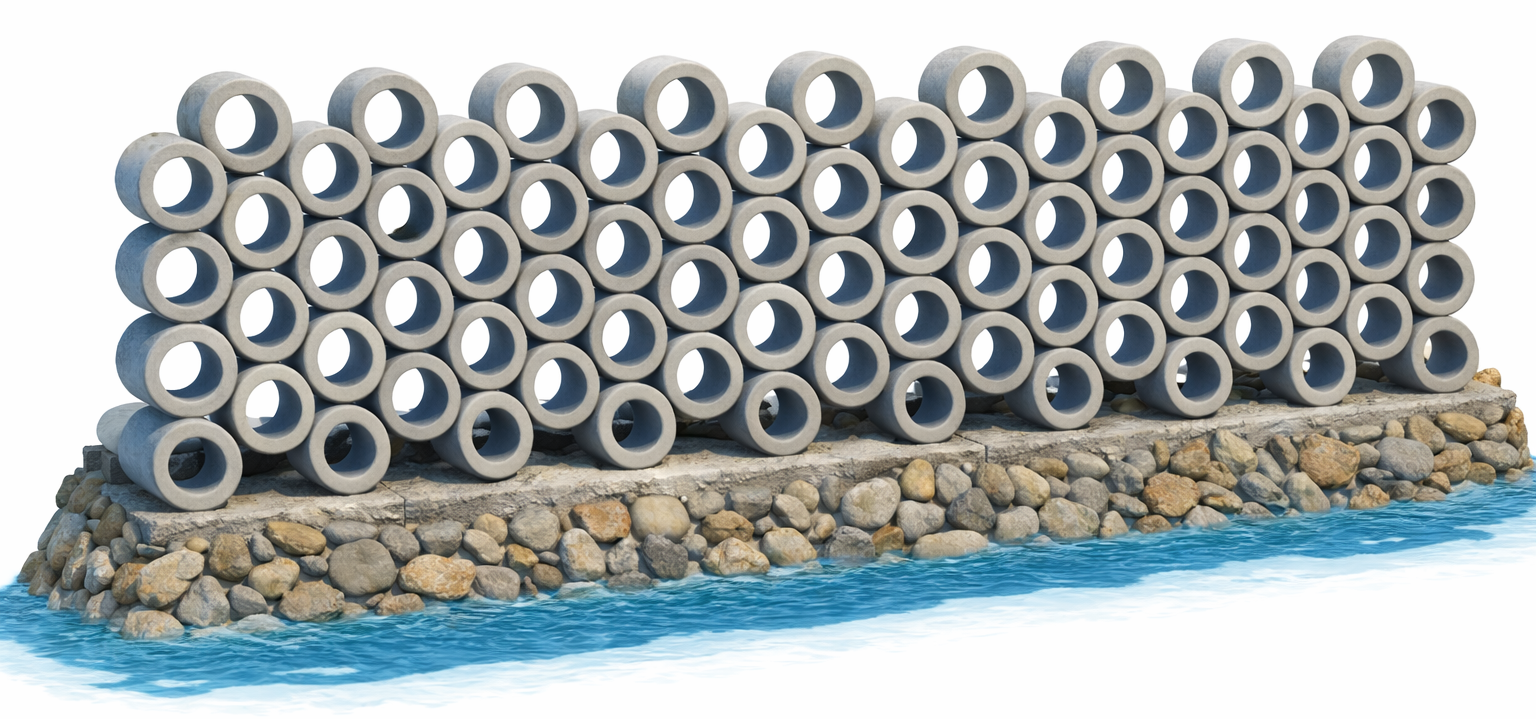
Costal abrasion in Tarakan City requires a protection system that is not only structurally effective but also economically feasible and implementable through community-based approaches. This study aims to design a modular revetment structure using recycled tires filled with concrete and compacted sand based on a design-based analytical approach. Wave transformation analysis at a depth of -0.52 meters indicates significant wave heights ranging from 1.19 to 1.70 meters, which serve as the primary basis for stability calculations using the Hudson formula with a conservative stability coefficient 1.25. The results show that a single concrete-filled tire unit weighs approximately 285 kg, and five units are required to form the primary armor layer with a height of 1.20 meters. To achieve the design crest elevation of +1.95 meters relative to HHWL, additional secondary protection layers and a toe protection system made of quarry stones were incorporated, resulting in a total structural height of 2.40 meters. Sensitivity analysis indicates that variations in significant wave height strongly influence the required weight of armor, whereas changes in material density produce more moderate effects. Compared with conventional stone revetments, the modular tire system offers greater flexibility, ease of installation without heavy equipment, and supports circular-economy principles through the reuse of waste tires. The implementation plan adopts a participatory appriach by engaging local fishermen and coastal communities in material collection, assembly, and maintenance activities. This study provides a sustainable, low-cost, and adaptive alternative for coastal protection that can be replicated in other shoreline areas with similar environment conditions.
Article Details
Section

This work is licensed under a Creative Commons Attribution 4.0 International License.
Allow anyone to modify, improve, and make derivative works, even for commercial purposes, as long as they credit to you for the original work.
How to Cite
References
[1] S. Widada, A. Ismanto, I. B. Priambodo, and H. Siagian, “Perubahan Garis Pantai dan Dampaknya Terhadap Banjir Rob di Kecamatan Pekalongan Utara, Kota Pekalongan, Privinsi Jawa Tengah,” Jurnal Kelautan Tropis, vol. 25, no. 1, pp. 121–130, Mar. 2022, doi: 10.14710/jkt.v25i1.13843.
[2] T. Rachman, H. Umar, and I. Haq Bahtiar, “Dampak Perubahan Garis Pantai Terhadap Pemanfaatan Lahan Pesisir Kecamatan Tamalanrea Kota Makassar,” Zona Laut, Jurnal Inovasi Sains dan Teknologi Kelautan, vol. 3, no. 1, pp. 7–14, Mar. 2022.
[3] M. P. Susunaga, I. A. G. Gongora, and E. M. Palmeira, “Evaluation of the Impact of Sustainable Infrastructure on the Perception of the Community Through the Use of Geocells Made of Recycled Tires in an Educational Environment,” Sustainability (Switzerland), vol. 17, no. 5, Mar. 2025, doi: 10.3390/su17051791.
[4] M. D. Bakri, E. Utomo, and D. Nawir, “Linear Regression Analysis on predicting the level of damage and changes in Amal Baru Beach Tarakan City Indonesia,” SINERGI, vol. 27, no. 1, p. 133, Jan. 2023, doi: 10.22441/sinergi.2023.1.015.
[5] C. Paotonan and F. Arif Nurdin, “Pemilihan Jenis Bangunan Pelindung Pantai Bonto Bahari Menggunakan Metode Analitycal Hierarchy Process (AHP),” SENSISTEK, vol. 3, no. 1, pp. 55–62, Nov. 2020.
[6] A. H. M. Rashidi, M. H. Jamal, M. Z. Hassan, S. S. M. Sendek, S. L. M. Sopie, and M. R. A. Hamid, “Coastal structures as beach erosion control and sea level rise adaptation in malaysia: A review,” Water (Switzerland), vol. 13, no. 13, pp. 1–34, Jul. 2021, doi: 10.3390/w13131741.
[7] E. Utomo and M. D. Bakri, “Studi Desain Bangunan Pelindung Pantai Tipe Groin Sebagai Upaya Penanganan Abrasi di Pantai Amal Baru Pulau Tarakan,” Borneo Engineering: Jurnal Teknik Sipil, vol. 8, no. 3, pp. 292–310, Dec. 2024.
[8] G. T. Haryanti and E. Utomo, “Penanganan Abrasi Pantai Amal Baru Kota Tarakan dengan Bangunan Pelindung Pantai Tipe Detached Breakwater,” CESJ: Civil Engineering Scientific Journal, vol. 3, no. 2, pp. 95–106, May 2024.
[9] A. Isyamelya Maharani and E. Utomo, “Studi Bangunan Pelindung Pantai Tipe Revetment Sebagai Alternatif Penanganan Abrasi di Pantai Amal Baru Kota Tarakan,” CESJ: Civil Engineering Scientific Journal, vol. 3, no. 3, pp. 138–149, Sep. 2024.
[10] T. A. S.V.J, “Analisis Mitigasi Bencana Abrasi pada Wilayah Pantai Galesong Kabupaten Takalar,” SENSISTEK, vol. 6, no. 2, pp. 237–241, Nov. 2023.
[11] P. M. Mayer et al., “Where the rubber meets the road: Emerging environmental impacts of tire wear particles and their chemical cocktails,” Elsevier B.V., Jun. 2024. doi: 10.1016/j.scitotenv.2024.171153.
[12] I. S. Bumi, Widyaningtias, and M. B. Adityawan, “Coastal Erosion Management by Implementing Concept of Building with Nature (BwN) in Demak Regency, Central Java, Indonesia,” in IOP Conference Series: Earth and Environmental Science, IOP Publishing Ltd, Mar. 2021. doi: 10.1088/1755-1315/698/1/012005.
[13] E. Damastuti, B. K. van Wesenbeeck, R. Leemans, R. S. de Groot, and M. J. Silvius, “Effectiveness of community-based mangrove management for coastal protection: A case study from Central Java, Indonesia,” Ocean Coast Manag, vol. 238, May 2023, doi: 10.1016/j.ocecoaman.2023.106498.
[14] V. Perricone, M. Mutalipassi, A. Mele, M. Buono, D. Vicinanza, and P. Contestabile, “Nature-based and bioinspired solutions for coastal protection: An overview among key ecosystems and a promising pathway for new functional and sustainable designs,” ICES Journal of Marine Science, vol. 80, no. 5, pp. 1218–1239, Jul. 2023, doi: 10.1093/icesjms/fsad080.
[15] R. Hartati, R. Pribadi, R. W. Astuti, R. Yesiana, and I. Yuni H, “Kajian Pengamanan dan Perlindungan Pantai di Wilayah Pesisir Kecamatan Tugu dan Genuk, Kota Semarang,” Jurnal Kelautan Tropis, vol. 19, no. 2, pp. 95–110, Nov. 2016.
[16] A. M. Lubis, N. Veronica, R. Saputra, J. Sinaga, M. Hasanudin, and E. Kusmanto, “Investigasi Arus Sejajar Pantai (Longshore Current) di Daerah Abrasi Bengkulu Utara,” Jurnal Kelautan Tropis, vol. 23, no. 3, pp. 316–324, Nov. 2020, doi: 10.14710/jkt.v23i3.8045.
[17] S. Sakka and B. Baharuddin, “Analisis Model Penanganan Garis Pantai di Pantai Ujung Pandaran Kabupaten Kotawaringin Timur,” JURNAL GEOCELEBES, pp. 23–34, Apr. 2021, doi: 10.20956/geocelebes.v5i1.9152.
[18] K. Regency, M. Nopiana, F. Yulianda, A. Fahrudin, and G. Yulianto, “Coastal rehabilitation efforts through community perception: A case study in,” 2021. [Online]. Available: http://www.bioflux.com.ro/aacl
[19] CERC, Shore Protection Manual, vol. 1. Washington, DC: Department of The Army US Army Corps of Engineers, 1984.
[20] B. Triatmodjo, Perencanaan Bangunan Pantai, 3rd ed. Yogyakarta: Beta Offset, 2014.
[21] Michelin, “Technical data book: Truck & Bus tires - Regional & On/Off Road.,” Clermont-Ferrand: Michelin Group.
[22] B. Triatmodjo, Teknik Pantai, 8th ed. Yogyakarta: Beta Offset, 2016.
[23] Y. Muliati, Rekayasa Pantai, 1st ed. Bandung: Itenas, 2020.
[24] E. Utomo and M. Djaya Bakri, “Studi Perubahan Garis Pantai dengan Metode DSAS (Digital Shoreline Analysis System) Sebagai Upaya Identifikasi Erosi di Pantai Utara Pulau Tarakan,” Borneo Engineering: Jurnal Teknik Sipil, vol. 7, no. 2, pp. 216–233, Aug. 2023, doi: https://doi.org/10.35334/be.v7i2.4208.
[25] M. E. Hanley, R. C. Thompson, and E. Tyllianakis, “Designing resilient infarastructure for coastal communities: A framework for incorporating ecosystem-based approaches.,” 2018.