
Stability Analysis of Floating Platforms for Supporting Renewable Energy-Powered Oil Skimmer Systems
Article Sidebar
Main Article Content
Abstract
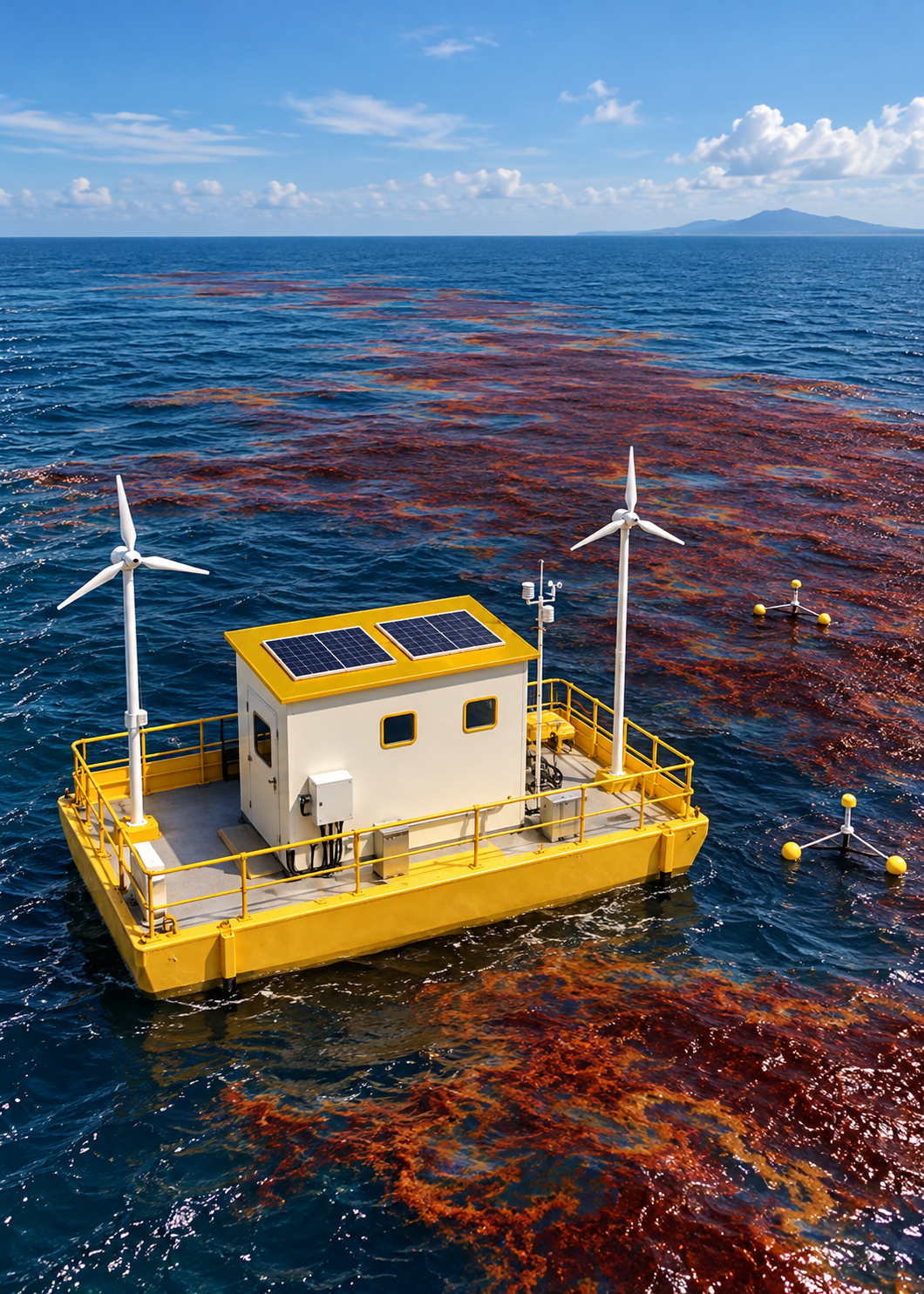
Oil spills in marine waters pose serious environmental and economic challenges, requiring effective and sustainable response technologies. Floating oil skimmer systems powered by renewable energy offer a promising solution; however, their operational performance strongly depends on the stability of the supporting floating platform. This study aims to evaluate the stability characteristics of three barge-type floating platform designs intended to support a renewable energy-powered oil skimmer system. Stability analysis was conducted by determining the hydrostatic characteristics, KG, GM, and GZ curves using several loading conditions, including full load, lightship, and ballast conditions. The stability performance of each design was evaluated according to the IMO Intact Stability Code (2008). The results indicate that all three platform designs satisfy the IMO stability criteria under full-load conditions, with Barge 1 demonstrating the best performance, achieving the highest values of GM0, GZmax, and GZ area. Under lightship conditions, however, all designs failed to satisfy the minimum GZmax angle criteria due to the relatively high KG. Stability improvements were achieved by introducing ballast water, where a minimum ballast level of 75% was required to satisfy the intact stability criteria. Furthermore, the platform could safely operate without ballast once the oil storage tanks reached at least 45% capacity. These findings demonstrate that Barge 1 provides the most favorable stability characteristics and is the most suitable platform configuration for supporting a renewable energy-powered floating oil skimmer system.
Article Details
Section

This work is licensed under a Creative Commons Attribution 4.0 International License.
Allow anyone to modify, improve, and make derivative works, even for commercial purposes, as long as they credit to you for the original work.
How to Cite
References
il/Chemical (Hazardous Materials) Spills Affecting the Marine Environment, Response Challenges, and Tanker Safety Design Regulations,” vol. 2, no. 1, pp. 326–346, 2025.
[3] C. S. De Claresya, R. H. T. Koestoer, W. S. Pranowo, and A. Cahyadi, “Pemodelan Pergerakan Tumpahan Minyak Sebagai Upaya Mitigasi Dampak Lingkungan di Perairan Lampung Timur, Indonesia,” J. Kelaut. Nas., vol. 18, no. 1, pp. 33–42, 2023, doi: http://dx.doi.org/10.15578/jkn.v18i1.12382.
[4] Supriyono, M. Yusuf, and D. T. Nurrohman, “Kajian Penanganan Tumpahan Minyak Menggunakan Oil Skimmer Tipe Rotary Disc pada Jenis Bahan Bakar Berbeda,” J. ECOTIPE, vol. 8, no. 1, pp. 53–58, 2021, doi: https://doi.org/10.33019/jurnalecotipe.v8i1.1466.
[5] S. W. Ko, J. Y. Moon, S. M. Bae, C. S. Kim, and C. H. Park, “A Sponge-Type oil skimmer for highly efficient removal of floating Oils: Superabsorbent and oleophilic sponge with Nano-Scale interface roughness,” Appl. Surf. Sci., vol. 606, p. 154750, 2022, doi: https://doi.org/10.1016/j.apsusc.2022.154750.
[6] B. Herren, M. C. Saha, M. C. Altan, and Y. Liu, “Funnel-Shaped Floating Vessel Oil Skimmer with Joule Heating Sorption Functionality,” Polymers (Basel)., vol. 14, no. 11, 2022.
[7] R. Manivel and R. Sivakumar, “Materials Today : Proceedings Boat type oil recovery skimmer,” in Materials Today: Proceedings, Elsevier Ltd., 2020, pp. 470–473. doi: 10.1016/j.matpr.2019.06.632.
[8] D. Motorin, H. Roozbahani, and H. Handroos, “Development of a novel method for estimating and planning automatic skimmer operation in response to offshore oil spills,” J. Environ. Manage., vol. 318, p. 115451, 2022, doi: 10.1016/j.jenvman.2022.115451.
[9] Y. Kim, H. Kim, and D. Cho, “Evolutionary Approach to Optimal Oil Skimmer Assignment for Oil Spill Response : A Case Study,” Biomimetics, vol. 9, no. 330, pp. 1–17, 2024.
[10] A. Yasim, M. Irsan, M. Dwiprayuda, M. Ikhsan, and M. Zulkifli, “A Comprehensive Study of Renewable-Powered Floating Oil Skimmer Design for Indonesian Oil Spill Recovery,” Kapal J. Ilmu Pengetah. dan Teknol. Kelaut., vol. 23, no. 1, pp. 37–48, Apr. 2026, doi: 10.14710/kapal.v23i1.79027.
[11] T. N. C. Bangun, A. Muntaha, and Sunardi, “STABILITAS KAPAL IKAN KATAMARAN SEBAGAI PENGGANTI KAPAL PURSE Oleh : Alumni Program Sarjana Departemen PSP FPIK Universitas Brawijaya,” ALBACORE, vol. I, no. 1, pp. 13–21, 2017, doi: https://doi.org/10.29244/core.1.1.11-19.
[12] Mujiburrahman, H. Irawan, and M. Suprapto, “Uji Stabilitas Performa Perahu Fortable Jenis Katamaran Berbasis Plywood dan Fiberglass,” J. CRANKSHAFT, vol. 8, no. 4, pp. 71–83, 2025, doi: https://doi.org/10.24176/cra.v8i4.16021.
[13] J. A. Hind, Stability and Trim of Fishing Vessels and Other Small Ships, 2nd ed. Wiley, 1982. [Online]. Available: https://books.google.co.id/books?id=bi4RAAAAYAAJ
[14] A. Yasim, R. Koekoeh Koentjoro Wibowo, D. Dwi Laksana, H. Indria Dwi Puspita, W. Sakinah, and P. Ganjar Widitiyo, “Hydrodynamics Comparison of V-shaped and U-shaped Hulls of 5 GT Fishing Vessels Based on the Characteristics of Southern Java Waters,” 2022. [Online]. Available: www.ijerd.com
[15] L. L. Goldberg, Principles of Naval Architecture, second revision, vol. I. Jersey City-US: Society of Naval Architects and Marine Engineers, 1988.
[16] S. C. Misra, Ships Marine Structures. Florida, US: CRC Press, 2016. [Online]. Available: http://www.crcpress.com
[17] Nurhasanah and E. Yuliora, “The Analysis of Ship Stability of Ferry Ro-Ro Based on Loadcase Changes,” Wave J. Ilm. Teknol. Marit., vol. 20, no. 01, pp. 47–55, 2026, doi: https://doi.org/10.55981/wave.2026.14236.
[18] G. W. Kayadoe, H. V. Dien, and R. D. C. Pamikiran, “Kajian Tentang Stabilitas KM. Surya Prima Yang Dibuat Di Desa Borgo, Kec. Tanawangko, Kab. Minahasa,” J. Ilmu Dan Teknol. Perikan. Tangkap, vol. 2, no. 1, pp. 19–22, 2015, doi: 10.35800/jitpt.2.1.2015.8330.
[19] IMO, International Code of Intact Stability 2008, 2020th ed. International Maritime Organization (IMO), 2020.
[20] H. I. D. Puspita, R. Rudianto, A. Yasim, and A. Nuruzzaman, “Analysis of Resistance and Stability In the Modification of Outrigged Fishing Boat Design in the Puger Water, JembeR,” J. Teknol. Perikan. dan Kelaut., vol. 16, no. 1, pp. 77–84, 2025, doi: https://doi.org/10.24319/jtpk.16.77-84.
[21] C. Huda, “Analisis Laju Korosi Material Aluminium 5083 Sebagai Aplikasi Bahan Lambung Kapal,” J. Pendidik. Tek. Mesin UNESA, vol. 06, no. 02, pp. 17–24, 2017.
[22] A. Yasim, M. Soetardjo, and Mahrani, “Analisa Performa Seakeeping Kapal Ikan 5 GT Setelah Modifikasi Palkah dan Penggantian Mesin Utama (Studi Kasus KM. Nelayan 2017-572),” J. Airaha, vol. 14, no. 02, pp. 205–218, 2025, doi: https://doi.org/10.15578/ja.v14i2.780.
[23] A. Yasim, R. K. Koentjoro Wibowo, and K. Priohutomo, “Kajian Sinkronisasi Mesin Utama dan Propeller pada Kapal Perikanan Pasca Reparasi (Studi Kasus KM. Nelayan 2017-572),” Wave J. Ilm. Teknol. Marit., vol. 15, no. 1, pp. 11–20, Aug. 2021, doi: 10.29122/jurnalwave.v15i1.4724.
[24] R. F. Kusnadi, P. G. Widityo, A. Yasim, and B. Ali, “Analysis of the Effect of Bilge Keel on the Rolling Motion of Ro-Ro Ferry Ship Using the Strip-Theory Method,” ROTOR, vol. 16, no. 1, pp. 15–20, 2023.
[25] H. I. D. Puspita, A. Yasim, Rudianto, R. K. K. Wibowo, R. F. Kusnadi, and M. A. N. Akmal, “Pengaruh Penambahan Skeg Terhadap Olah Gerak dan Hambatan Kapal Nelayan di Pelabuhan Perikanan Puger, Jember,” J. Teknol. Perikan. dan Kelaut., vol. 14, no. 2, pp. 169–179, 2023, doi: https://doi.org/10.24319/jtpk.14.169-179.