
Analysis of Movement Patterns and Recovery Rates of Sea Transport Passengers in Indonesia for the 2019–2024 Period Using Trend Analysis and Recovery Index Approach
Article Sidebar
Main Article Content
Abstract
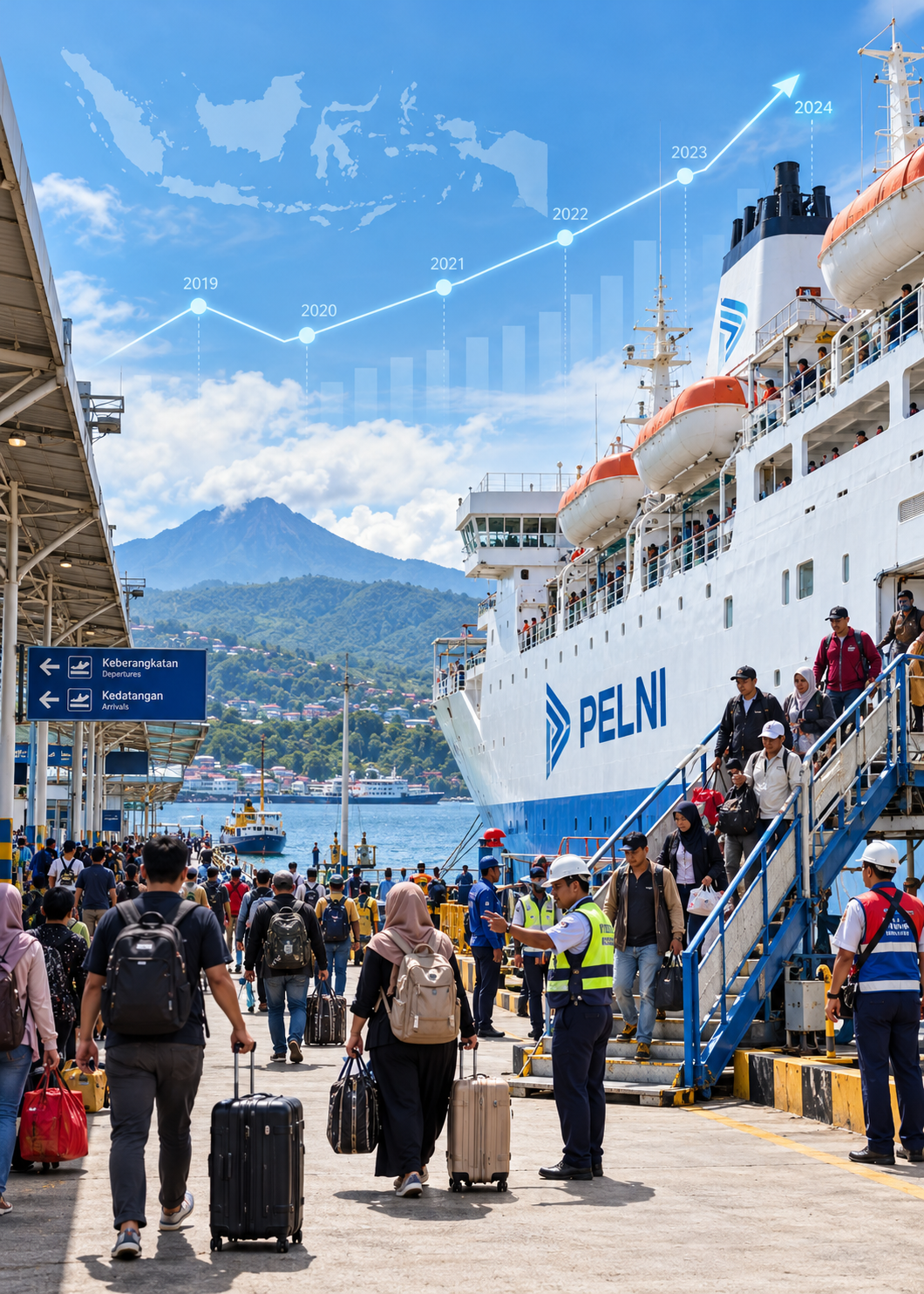
Sea transportation is a strategic mode of transportation that supports regional connectivity in Indonesia as an archipelagic country. The COVID-19 pandemic that began in 2020 caused a significant decrease in passenger numbers because of restrictions on population mobility. Although marine transportation activity increased after the pandemic, national-scale evaluations of the recovery trajectory remain limited. This study analyzes the movement patterns of Indonesian sea transportation passengers during 2019–2024 by identifying three phases: the pre-pandemic phase (2019), the contraction phase (2020–2021), and the recovery phase (2022–2024). The research uses a quantitative approach with secondary data from the Central Statistics Agency (BPS) Sea Transportation Statistics for 2019–2024. The analysis uses descriptive statistics, Annual Growth Rate (AGR), Compound Annual Growth Rate (CAGR), Recovery Index (RI), simple linear regression, and the Mann–Kendall test. Passenger numbers fell to 44.6% of the 2019 baseline in 2020 and then increased to a Recovery Index of 106.0% in 2024. Regression and Mann–Kendall results indicate a statistically significant upward trend during 2020–2024. The study contributes a national-level analytical framework that combines growth, baseline-relative recovery, and complementary trend tests to characterize post-pandemic maritime passenger recovery. The findings provide an empirical basis for capacity planning and adaptive national sea transportation policy.
Article Details
Section

This work is licensed under a Creative Commons Attribution 4.0 International License.
Allow anyone to modify, improve, and make derivative works, even for commercial purposes, as long as they credit to you for the original work.
How to Cite
References
[1] M. N. C. H. Nasrullah, “Maritime Connectivity and Economic Inclusion: A Decade of Indonesia’s Sea Toll Program,” Sinergi International Journal of Logistics, vol. 3, no. 3, pp. 180–189, 2025, doi: 10.61194/sijl.v3i3.890.
[2] W. T. Fofid, “The Development Strategy of Jayapura Port with SWOT Analysis towards Isolated, Outermost, Lagging, and Border areas of Indonesia (T3P),” Journal of Maritime Studies and National Integration, vol. 3, no. 1, pp. 22–29, 2019, [Online]. Available: https://doi.org/10.14710/jmsni.v3i1.4178
[3] A. C. Mappangara, L. Samang, R. Adisasmita, and G. Sitepu, “Sea Transportation Network Order of Sulawesi Corridor for Supporting Connectivity of Region,” International Journal of Engineering Research and Technology (IJERT), vol. 4, no. 11, pp. 744–750, 2015, [Online]. Available: www.ijert.org
[4] Badan Pusat Statistik, “Statistik Transportasi Laut 2019,” 2020.
[5] Badan Pusat Statistik, “Statistik Transportasi Laut 2022,” 2023.
[6] Badan Pusat Statistik, “Statistik Transportasi Laut 2021,” 2022.
[7] Badan Pusat Statistik, “Statistik Transportasi Laut 2023,” 2024.
[8] Badan Pusat Statistik, “Statistik Transportasi Laut 2024,” 2025.
[9] Badan Pusat Statistik, “Statistik Transportasi Laut 2020,” 2021.
[10] Welsy Kristianto, “Kajian Tarif Angkutan Laut Trayek Kota Makassar – Pulau Barrang Lompo Pada Saat Pandemi Covid-19,” Jurnal Inovasi Sains dan Teknologi Kelautan, vol. 4, no. 2, 2023.
[11] W. Kristianto, W. Djafar, A. S. Chairunnisa, A. H. Djalante, and R. Fitriah, “KAJIAN TARIF ANGKUTAN LAUT TRAYEK KOTA MAKASSAR-PULAU BARRANG LOMPO PADA SAAT PANDEMI COVID-19,” JURNAL INOVASI SAINS DAN TEKNOLOGI KELAUTAN, vol. 4, no. 2, pp. 61–66, 2023, [Online]. Available: https://journal.unhas.ac.id/index.php/zonalautZONALAUT
[12] Setia Pramana, “Impact of COVID-19 pandemic on tourism in Indonesia,” Taylor & Francis Current Issues in Tourism, vol. 25, pp. 2422–2442, 2022, [Online]. Available: https://doi.org/10.1080/13683500.2021.1968803
[13] M. Multiningsih, E. Siswanah, and M. Saleh, “Forecasting the Number of Ship Passengers with SARIMA Approach (A Case Study: Semayang Port, Balikpapan City),” JTAM (Jurnal Teori dan Aplikasi Matematika), vol. 6, no. 4, p. 1060, 2022, doi: 10.31764/jtam.v6i4.10211.
[14] N. P. Riau, F. Yanuar, and D. Devianto, “PEMODELAN JUMLAH PENUMPANG KAPAL DOMESTIK DI PELABUHAN TANJUNG PERAK MENGGUNAKAN MODEL VARIASI KALENDER SEASONAL ARIMAX,” Lebesgue: Jurnal Ilmiah Pendidikan Matematika, Matematika dan Statistika, vol. 5, no. 3, 2024.
[15] Dinda Sekar Selni Prawardani, “Analisis Permintaan Transportasi Laut Berdasarkan Data Historis Keberangkatan Penumpang di Jayapura,” Bearing Jurnal Penelitian dan Kajian Teknik Sipil, 2025, [Online]. Available: doi:10.32502/jbearing.v10i1.9800
[16] azka;aryo Azka, “Identification and Valuation of Blue Economy Sectors in the Seribu Islands Regency Based on Economic, Social and Environment Performance Azka,” JOURNAL OF OCEAN SCIENCE AND TECHNOLOGY INNOVATION Times, vol. 6, no. 2, pp. 295–302, 2025, [Online]. Available: https://journal.unhas.ac.id/index.php/zonalaut/article/view/42327/13188