Identification of Forage Potential for Grazing in Latimojong, Luwu, South Sulawesi
DOI:
https://doi.org/10.20956/hajas.v8i1.44988Abstract
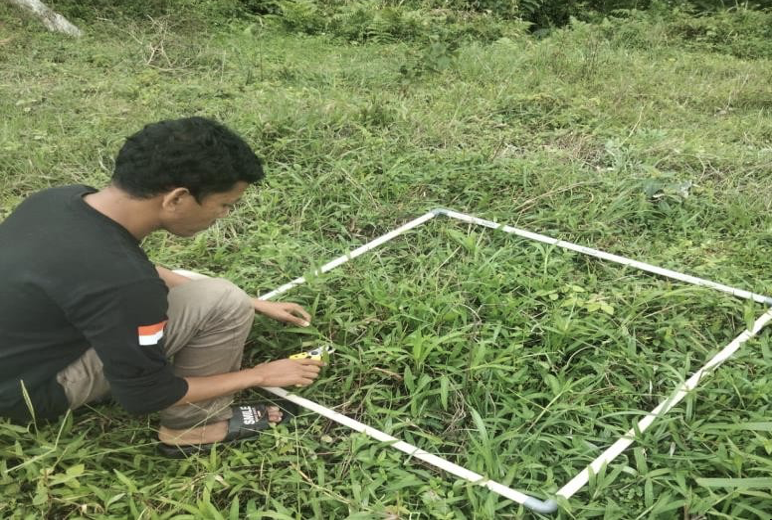
The objective of this study was to identify botanical composition, diversity, and forage production. This study was conducted in Kadundung village and Boneposi village, Latimojong subdistrict, Luwu regency. This study is classified as descriptive research using qualitative and quantitative approaches, through observational surveys and documentation studies. The parameters in this study include botani, biodiversitas, and forage production. The results showed that the average percentage of botanical composition in Kadundung Village was: grasses 48.29%, legumes 14.59%, and other plants 37.12%. Forage production yielded a fresh weight of 4.18 tons/ha/year, and the biodiversity richness index (4.20), diversity index (0.84), and evenness index (0.28) were measured, with a carrying capacity of 0.17 AU/ha/year. Meanwhile, the average percentage of botanical composition in Boneposi Village was: grasses 45.32%, legumes 16.52%, and other plants 38.16%. Forage production yielded a fresh weight of 4.36 tons/hectare/year, and the biodiversity richness index (2.90), diversity index (0.82), and evenness index (0.24). Therefore, botanical composition, vegetation diversity, and forage production are still. These findings underscore the importance of an integrated approach to grassland management that accounts for seasonal patterns to maintain ecological balance and sustain year-round grassland productivity.
Downloads
Published
Issue
Section
License
Copyright (c) 2026 M. Akbar, B. Budiman, R. Islamiyati

This work is licensed under a Creative Commons Attribution-NonCommercial 4.0 International License.