In Vitro Development and Gene Expression of Pig Embryos Cloned from Induced Pluripotent Stem Cells and Embryonic Fibroblasts
DOI:
https://doi.org/10.20956/hajas.v8i1.50505Abstract
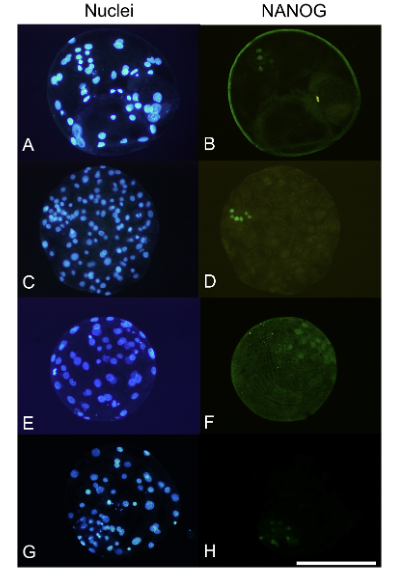
Somatic cell nuclear transfer (SCNT) in pigs remains inefficient, mainly due to incomplete nuclear reprogramming of donor cells. Induced pluripotent stem (iPS) cells have been proposed as promising nuclear donors, but their developmental competence in porcine SCNT is unclear. This study compared the in vitro developmental ability of embryos reconstructed with porcine embryonic fibroblasts (PEFs) or porcine iPS (piPS) cells. Developmental rates, total and epiblast cell numbers were assessed in SCNT, in vitro fertilization (IVF), intracytoplasmic sperm injection (ICSI), and parthenogenetic activation (PA) embryos. The effect of oocyte activation status on piPS-derived SCNT embryos was also examined. Expression of well-known pluripotency transcription factor genes OCT4, SOX2, NANOG, c-MYC, and KLF4 were quantified by quantitative Reverse Transcription Polymerase Chain Reaction (qRT-PCR). Results showed cleavage and blastocyst formation rates of piPS-derived embryos (55.0% and 14.6%) were comparable to PEF-derived SCNT, IVF, and ICSI, while PA embryos showed significantly higher rates (67.8% and 44.5%). Non-activated oocytes yielded higher development than activated ones. Blastocyst cell numbers were similar across groups; however, SCNT embryos contained fewer epiblast cells than IVF and PA. qRT-PCR showed markedly reduced OCT4, comparable SOX2, NANOG, and c-MYC, and higher KLF4 in NT and PA embryos than IVF. The results conclude that piPS cells can serve as nuclear donors but do not improve cloning efficiency compared with fibroblasts. Aberrant lineage allocation and dysregulated gene expression suggest incomplete reprogramming, highlighting the need for improved piPS quality.
Key words: induced pluripotent stem cells (iPSCs), pig, nuclear transfer
Downloads
Published
Issue
Section
License
Copyright (c) 2026 N. S. Machebe, T. Tani, S. Shimizu, M. Hata, K. Ohata, T. Fukuda, D. Hufana-Duran, Y. Kato

This work is licensed under a Creative Commons Attribution-NonCommercial 4.0 International License.