Kata Kunci
feminist security
Indonesian women migrant workers
narrative analysis
structural insecurity
Cara Mengutip
Abstrak
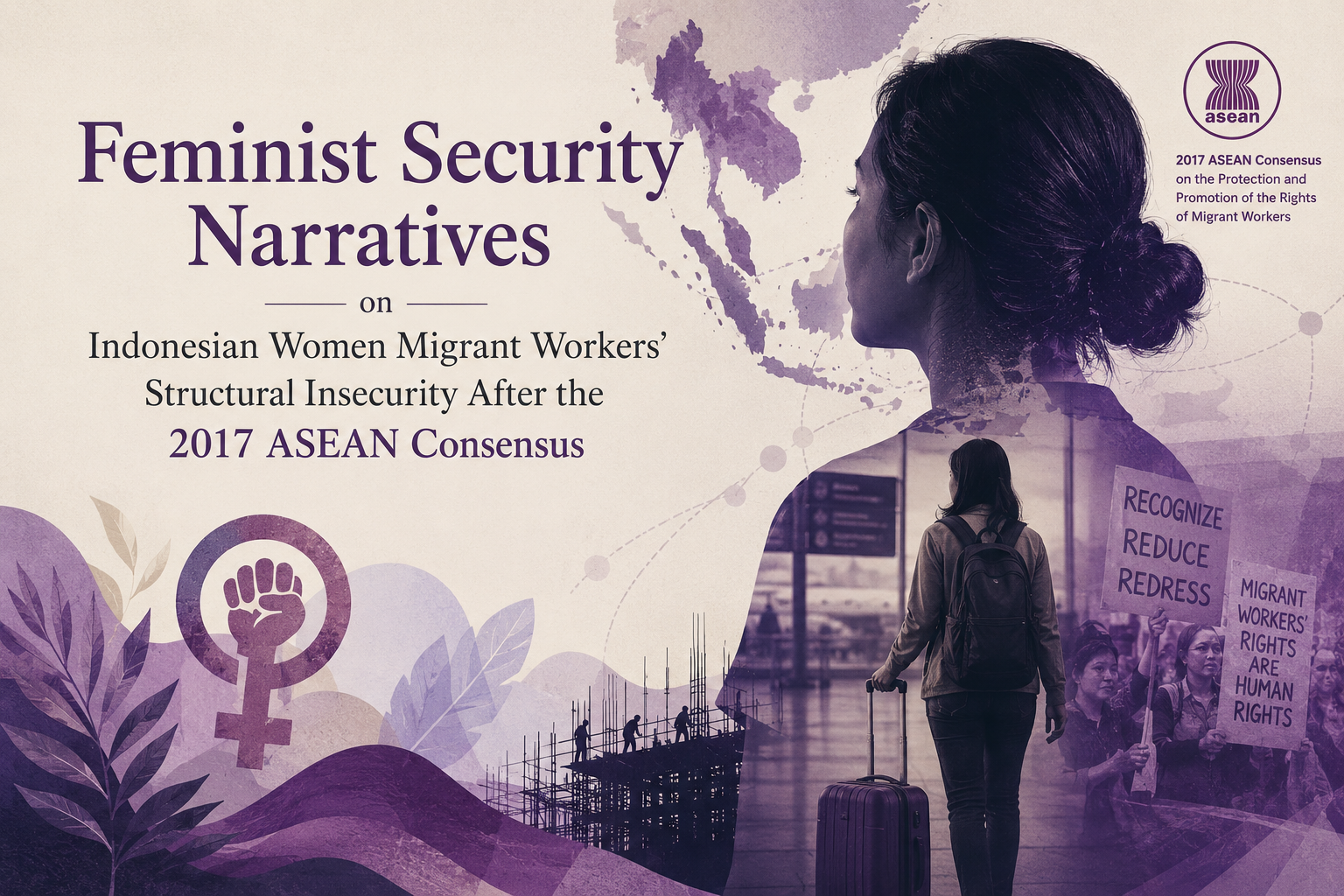
This article examines how Indonesian women migrant workers continue to experience structural insecurity across ASEAN member states despite the adoption of the ASEAN Consensus on the Protection and Promotion of the Rights of Migrant Workers in 2017. Existing scholarship often assumes that regional commitments naturally enhance workers’ protection, yet few studies interrogate how ASEAN constructs the narrative of “security” and whose experiences are marginalised in that process. Using Feminist Security Studies and Wibben’s poststructuralist narrative approach, this article analyses key ASEAN policy texts, particularly the 2007 Declaration and the 2017 Consensus, to identify how events, time, actors, locations, relationships, and points of view are narratively ordered. The findings demonstrate that ASEAN’s security narrative remains state-centric and institution-focused, prioritising intergovernmental cooperation while omitting the everyday lived realities of women migrant domestic workers. As a result, gendered sources of insecurity, such as recruitment intermediaries, employers, and the private household workplace, are obscured from the regional policy frame, allowing systemic vulnerabilities to persist across the region. This study contributes to feminist security scholarship by showing how narrative analysis reveals the limitations of ASEAN’s current discursive construction of security and argues that these limitations hinder the development of meaningful protection mechanisms for Indonesian women migrant workers in Southeast Asia.

Artikel ini berlisensi Creative Commons Attribution 4.0 International License.
Hak Cipta (c) 2026 Hasanuddin Journal of Strategic and International Studies (HJSIS)