
Analysis of Paint Material Requirements and Repair Costs for the KMP Balibo Ferry
Article Sidebar
Main Article Content
Abstract
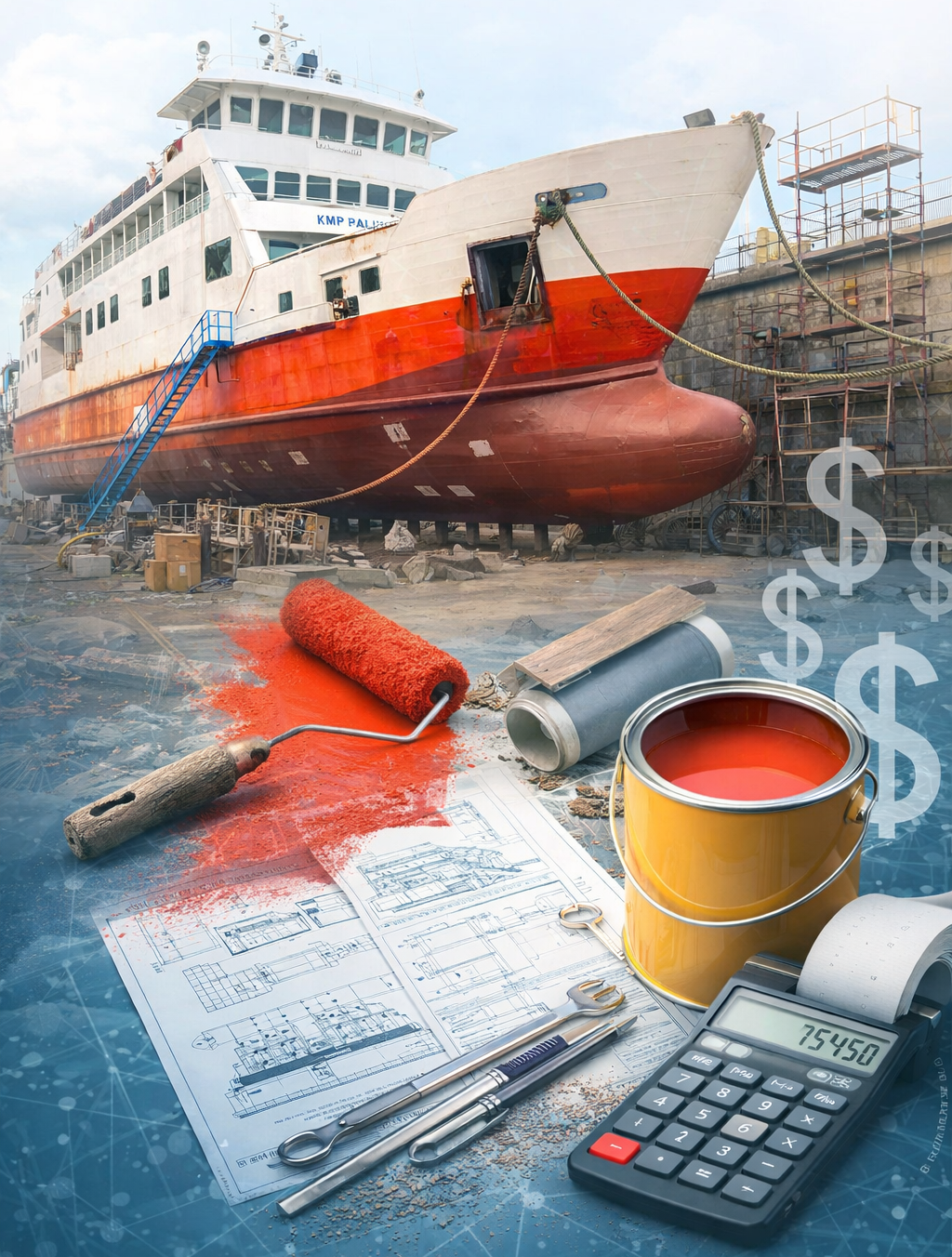
The shipping industry is a crucial sector supporting maritime transportation in Indonesia, making ship maintenance and repair a vital requirement to ensure operational safety and efficiency. Painting is a crucial aspect of repair, protecting the ship's structure from corrosion while simultaneously reducing operational costs. This study aims to analyze the paint material requirements and painting costs for the KMP. Balibo ferry using the Just In Time (JIT) approach. This study provides a comprehensive overview of the calculation of material requirements and painting costs for the ship, while also offering a more effective inventory management strategy for the Indonesian shipbuilding industry. The primary data used include ship specifications, paint coating types, and material prices from official references. The analysis method is carried out by calculating the painting area, paint volume requirements, thinner, and material cost estimates based on the Dry Film Thickness, Solid Volume, Theoretical Spreading Rate, and paint loss factors. The results show that the total paint and thinner requirements can be estimated accurately, with a total cost of Rp 310.000.000. The implementation of the Just In Time (JIT) method results in more efficient material delivery planning, reduces potential waste, and accelerates the repair process.
Article Details
Section

This work is licensed under a Creative Commons Attribution 4.0 International License.
Allow anyone to modify, improve, and make derivative works, even for commercial purposes, as long as they credit to you for the original work.
How to Cite
References
[1] Womack, J. P. dan Jones, D. T. (1996). Lean Thinking: Banish Waste and Create Wealth in Your Corporation. New York: Simon & Schuster.
[2] Rahardjo, B. (2020). Manajemen Perawatan dan Reparasi Kapal. Surabaya: Penerbit Andi.
[3] Supriyadi. (2022). Penerapan Sistem ERP dalam Industri Perkapalan. Jakarta: Penerbit Mitra Maritim.
[4] Utami, S. (2023). Penerapan Just In Time dalam Industri Perkapalan: Studi Kasus pada Perusahaan Reparasi Kapal. Bandung: Penerbit Maritim Sejahtera.
[5] Ohno, T. (1988). Toyota Production System: Beyond Large-Scale Production. Portland: Productivity Press.
[6] Shingo, S. (1989). A Study of the Toyota Production System from an Industrial Engineering Viewpoint. Portland: Productivity Press.
[7] Liker, J. K. (2004). The Toyota Way: 14 Management Principles from the World’s Greatest Manufacturer. New York: McGraw-Hill.
[8] Heizer, J., Render, B., dan Munson, C. (2017). Operations Management: Sustainability and Supply Chain Management. Harlow: Pearson.
[9] Slack, N., Brandon-Jones, A., dan Johnston, R. (2019). Operations Management. Harlow: Pearson.
[10] Wild, T. (2017). Best Practice in Inventory Management. London: Routledge.
[11] Gopalakrishnan, P. dan Sundaresan, M. (1985). Materials Management: An Integrated Approach. New Delhi: Prentice-Hall of India.
[12] Simanjuntak, P. D. (2024). Ship Maintenance Management Practices: Insights from Internships in Shipping Engineering. Journal of Maritime Studies, 3(2), 45–58.
[13] Fitriadi, F., dkk. (2023). Analysis of cycle efficiency improvement in traditional shipyard industry using lean manufacturing. International Journal of Industrial Engineering, Technology and Operations Management, 1(1), 1–10.
[14] Neves, A., dkk. (2025). Enhancing efficiency and sustainability in shipbuilding: Insights from lean implementation and challenges. Journal of Marine Science and Engineering, 13, 1–20.