
Cost Estimation for Blasting and Painting Repair Work on KMP. Kormomolin
Article Sidebar
Main Article Content
Abstract
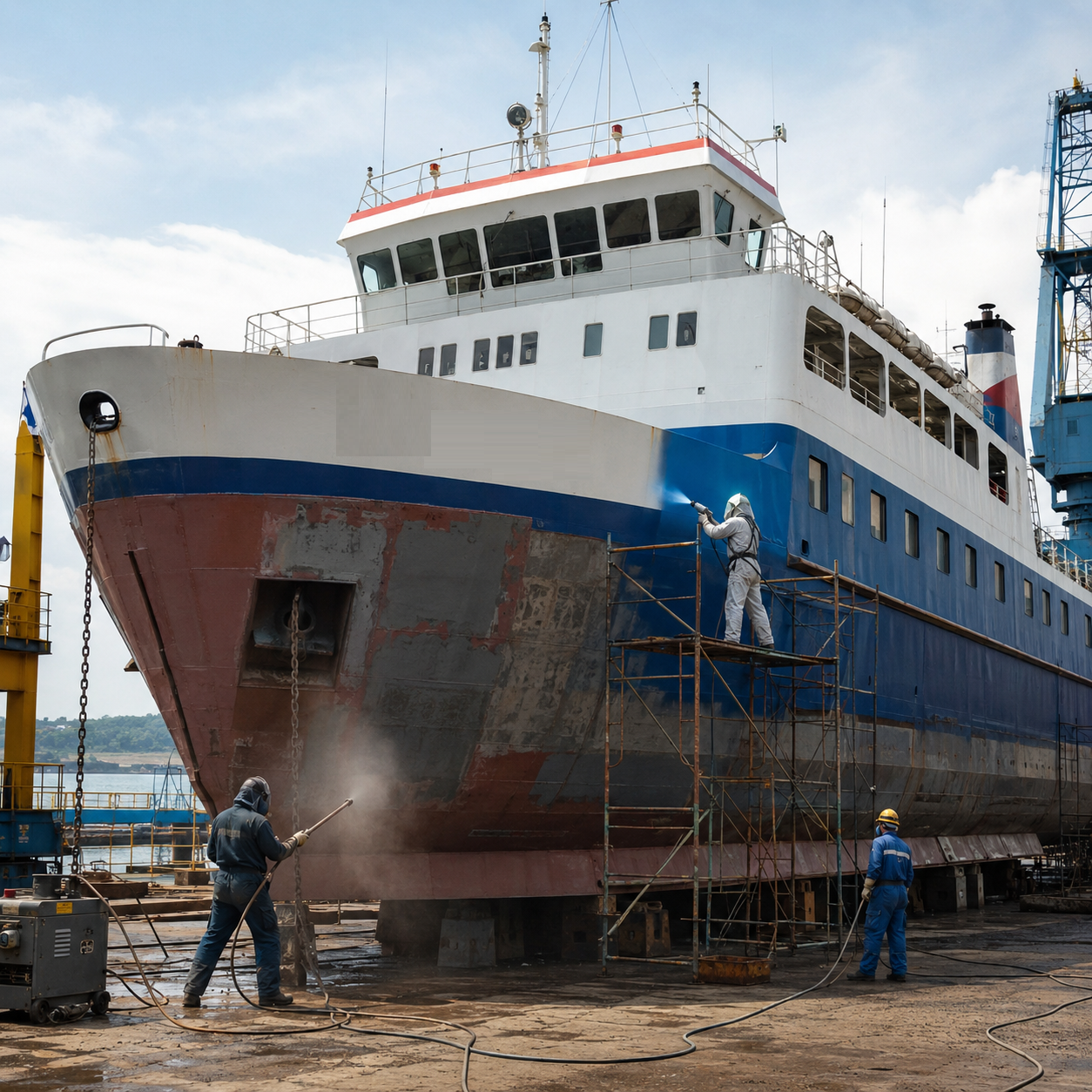
One of the stages in the ship hull maintenance and repair process is the blasting and painting process. Parts of the ship hull that do not fulfill classification standards will be repaired to extend the ship's operational life. This study aims to estimate the material requirements and costs of blasting and painting in the ship hull repair process, so that the calculation of material requirements and repair costs can be used as a reference for ship owners in future repair activities. The methods used include data collection and repair of the KMP Kormomolin ship, as well as calculations of material usage efficiency based on the area worked on. Estimates of the requirements for each material are calculated based on the surface area of the ship and the efficiency of use per liter, then converted to cans or kilograms. The analysis results show that the main material requirements consist of copper slag as a blasting medium, as well as various types of coat such as primer, anti-corrosion (AC), anti-fouling (AF), and finishing coat. The total cost is calculated from the number of requirements multiplied by the unit price of the material. From the calculation results, it is known that the highest costs come from anti-fouling coat.
Article Details
Section

This work is licensed under a Creative Commons Attribution 4.0 International License.
Allow anyone to modify, improve, and make derivative works, even for commercial purposes, as long as they credit to you for the original work.
How to Cite
References
[1] United Nations Conference on Trade and Development. Review of Maritime Transport 2024. Geneva: United Nations, 2024.
[2] Nurwanti, R., and Pribadi, T. W. “Analisa Peningkatan Kualitas Layanan Jasa Reparasi Kapal di Galangan Kapal Jawa Timur.” Institut Teknologi Sepuluh Nopember, 2016.
[3] Purnomo, H. “Analisis Biaya Perawatan Kapal pada Galangan Nasional.” Jurnal Teknik Perkapalan, vol. 5, no. 2, pp. 101–110, 2017.
[4] Wibowo, T., and Lestari, N. “Ship Maintenance and Safety: Ensuring Operational Efficiency.” Marine Engineering Journal, 2022.
[5] Kurniawan, A. “Cost Analysis of Ship Repair and Maintenance: A Case Study.” Maritime Economics & Logistics, 2019.
[6] Dinu, O., and Ilie, A. M. “Maritime Vessel Obsolescence, Life Cycle Cost and Design Service Life.” IOP Conference Series: Materials Science and Engineering, 2015.
[7] Idsan, M. A., and Rachman, T. “Estimasi Waktu Reparasi KM. Wilis Menggunakan Critical Path Method.” Riset Sains dan Teknologi Kelautan, vol. 7, no. 2, pp. 105–112, 2024. doi: 10.62012/sensistek.v7i2.41687.
[8] Stopford, M. Maritime Economics, 4th ed. London: Routledge, 2020.
[9] Hunt, E. C., and Butman, B. S. “Marine Commercial Ship Maintenance and Repair.” In Marine Engineering. Jersey City: Society of Naval Architects and Marine Engineers, 2018.
[10] Rao, M. V., and Reddy, K. S. “Utilization of Copper Slag as a Sustainable Abrasive Material for Surface Preparation in Shipbuilding.” Journal of Hazardous Materials, vol. 310, pp. 287–295, 2016.
[11] International Organization for Standardization. Paints and Varnishes Vocabulary, ISO 4618:2014. Geneva: ISO, 2014.