
Risk Analysis and Handling of Packaged Flammable Cargo Aboard the Ro-Ro Vessel DLN Nusantara
Article Sidebar
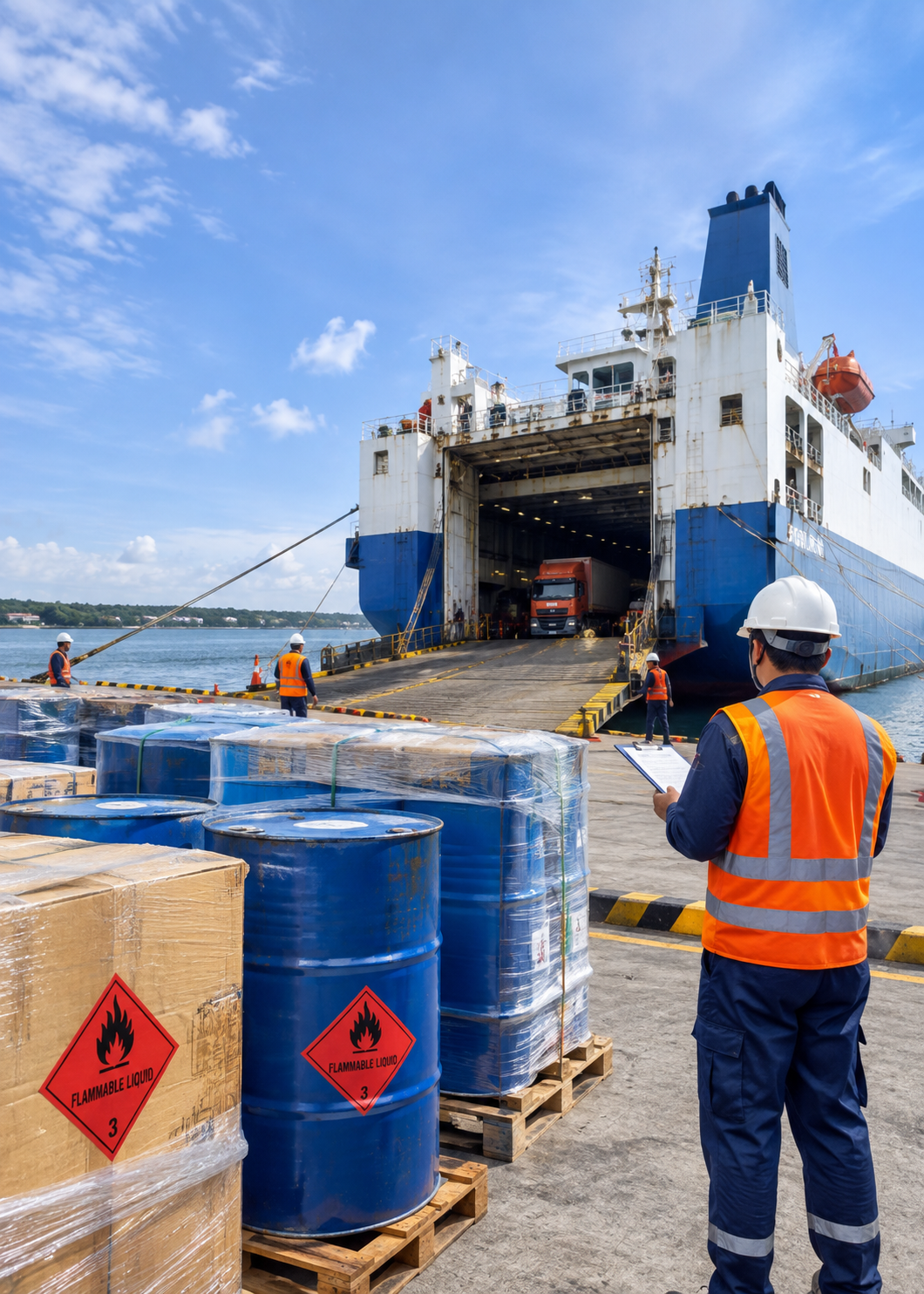
Main Article Content
Abstract
The handling of packaged flammable cargo on Ro-Ro vessels involves risks of leakage, fire, explosion, obstruction of evacuation routes, and vapor exposure, particularly when package inspection, vehicle placement, ventilation, and ignition-source control are not consistently implemented. This study aims to identify potential hazard factors, analyze risk-reduction strategies, and formulate procedures for handling packaged flammable cargo on board the Ro-Ro vessel DLN Nusantara. The study employed a mixed-method approach combining qualitative descriptive analysis and Failure Mode and Effects Analysis (FMEA). Data were collected through observations of loading operations and voyages, as well as interviews with the Master and deck officers. The data were then analyzed based on Severity, Occurrence, and Detection ratings to determine the Risk Priority Number.
The results indicate that hazard indicators include the physical condition of packages and vehicles, improper cargo placement, inadequate technical conditions within the cargo space, human factors, insufficient supervision, and emergency-response preparedness. The highest-risk failure mode was cargo placement that did not comply with the stowage plan and had the potential to obstruct evacuation routes, with an RPN of 168. Other significant risks included unidentified damage to packages or vehicles, cargo positioned near heat sources, inadequate ventilation, and segregation errors.
It is concluded that risk-control measures must be implemented sequentially, beginning with cargo-information verification, inspection of packages and vehicles, preparation of the stowage plan, loading, lashing and installation of wheel chocks, patrols during the voyage, and response procedures for spills and fires. Recommended preventive measures include verifying the actual cargo position before departure, strengthening inspections and patrols, controlling ignition sources, maintaining ventilation systems and closing arrangements, ensuring the readiness of portable fire extinguishers, hydrants, and spill kits, and conducting regular crew training and coordination.
Article Details
Section

This work is licensed under a Creative Commons Attribution 4.0 International License.
Allow anyone to modify, improve, and make derivative works, even for commercial purposes, as long as they credit to you for the original work.
How to Cite
References
[1] R. A. Alim, “Re-Design Layout Ruang Akomodasi Penumpang Kapal Ro-Ro Dengan Systematic Layout Planning ( Slp ) Dalam Upaya Pencegahan Penyebaran Skripsi,” Universitas Brawijaya, Malang, 2021.
[2] B. L. H. Widodo, E. T. Wahyuni, and M. A. Luhur, “Dangerous Goods Loading Management for Cargo Ship Safety and Crew B.,” J. Marit. Polimarin, vol. 9, no. 1, pp. 36–44, 2023.
[3] S. R. Alfitra, M. Z. Arifin, and R. H. Sari, “Fire Incident During Coal Cargo Operation: A Casu Study in MV Manalagi Tisya,” Din. Bahari, vol. I, no. October, pp. 37–46, 2024.
[4] Y. Tira et al., “Tata Kelola Pelayanan Kapal Ro-Ro Dumai-Tanjung Kapal Provinsi Riau,” J. Law Educ. Bus., vol. 2, no. 2, pp. 880–893, 2024.
[5] I. W. ALIF, “Evaluasi Penanganan Kebakaran Pada Muatan Di Mv. Armada Serasi Menurut Relasi Imdg Code,” 2024, [Online]. Available: https://repository.pip-semarang.ac.id/5754/
[6] W. Rizaldy, L. Lesmini, and A. A. Suryobuwono, “Evaluasi Sop Penanganan Barang Berbahaya Pada Green Terminal Container Teluk Lamong Surabaya Tahun 2023,” Pros. Semin. Nas. Manaj. Ind. dan Rantai Pasok, vol. 4, no. 1, pp. 16–26, 2023, [Online]. Available:
copyright is published under Lisensi Creative Commons Atribusi 4.0 Internasional.
ZONA LAUT, Vol. 7, No. 3. November 2026 241
https://jurnal.poltekapp.ac.id/index.php/SNMIP/article/view/1371%0Ahttps://jurnal.poltekapp.ac.id/inde x.php/SNMIP/article/viewFile/1371/259
[7] J. O. W. Hitalessy, M. Andiansyah, I. Hidayat, M. I. Arief, and N. I. Kadang, “Penanganan Muatan Berbahaya di Tempat Penumpukan atau Penyimpanan Barang Berbahaya pada Terminal Petikemas Semarang,” J. Penelit. Transp. Laut, vol. 25, no. 1, pp. 11–22, 2024, doi: 10.25104/transla.v25i1.2290.
[8] R. Hariyanti, F. Kristini, O. Wahyuni, D. K. Sari, and D. Meliana, “Upaya Mengurangi Risiko dalam Pengiriman Muatan Berbahaya,” Semin. Nas. Transp. dan Keselam., vol. 1, no. 1, pp. 334–347, 2024.
[9] D. Darmawan and A. Widayanti, “Analisis Penanganan Bongkar Muat Barang Berbahaya ( B3 ) di Pelabuhan Tanjung Perak Surabaya Analysis of Handling Loading and Unloading of Dangerous,” vol. 2, no. 1, 2024.
[10] F. Rodero and Á. Marrero, “Fire hazard reduction in ro-ro spaces by means of using a cargo distribution algorithm including fire risk management during the stowage process,” Transp. Res. Procedia, vol. 71, pp. 331–338, 2023, doi: 10.1016/j.trpro.2023.11.092.
[11] International Maritime Organization (IMO), “International Maritime Dangerous Goods (IMDG) Code: 2024 Edition (Amendment 42-24),” IMO, London, U.K., 2024. [Online]. Available: https://www.imo.org/en/publications/pages/imdg%20code.aspx
[12] J. Bao, Z. Bian, B. Li, Y. Li, and Y. Gong, “A hybrid approach for quantitative analysis of fire hazards in enclosed vehicle spaces on Ro-ro passenger ships,” Sustainability, vol. 15, no. 17, art. no. 13059, 2023, doi: 10.3390/su151713059.
[13] I. A. Koromila and K. J. Spyrou, “Design fire methodology for vehicle spaces onboard ships,” Fire Technol., vol. 59, pp. 1725–1759, 2023, doi: 10.1007/s10694-023-01403-w.
[14] S. Dahlbom, S. Andersson, E. De Carvalho, L. Lewandowski, and F. Evegren, “Fire risk model for fires in Ro-Ro ship Ro-Ro spaces,” J. Risk Anal. Crisis Response, vol. 14, no. 3, pp. 333–355, 2024, doi: 10.54560/jracr.v14i3.503.
[15] International Electrotechnical Commission (IEC), “Failure modes and effects analysis (FMEA and FMECA),” IEC 60812:2018, Geneva, Switzerland, 2018. [Online]. Available: https://webstore.iec.ch/en/publication/26359
[16] J. Fabis-Domagala, M. Domagala, and H. Momeni, “A concept of risk prioritization in FMEA analysis for fluid power systems,” Energies, vol. 14, no. 20, art. no. 6482, 2021, doi: 10.3390/en14206482.