
Hose Handling Procedures During Ship to Ship Oil Transfer Operations at Banyu Urip Marine Terminal
Article Sidebar
Main Article Content
Abstract
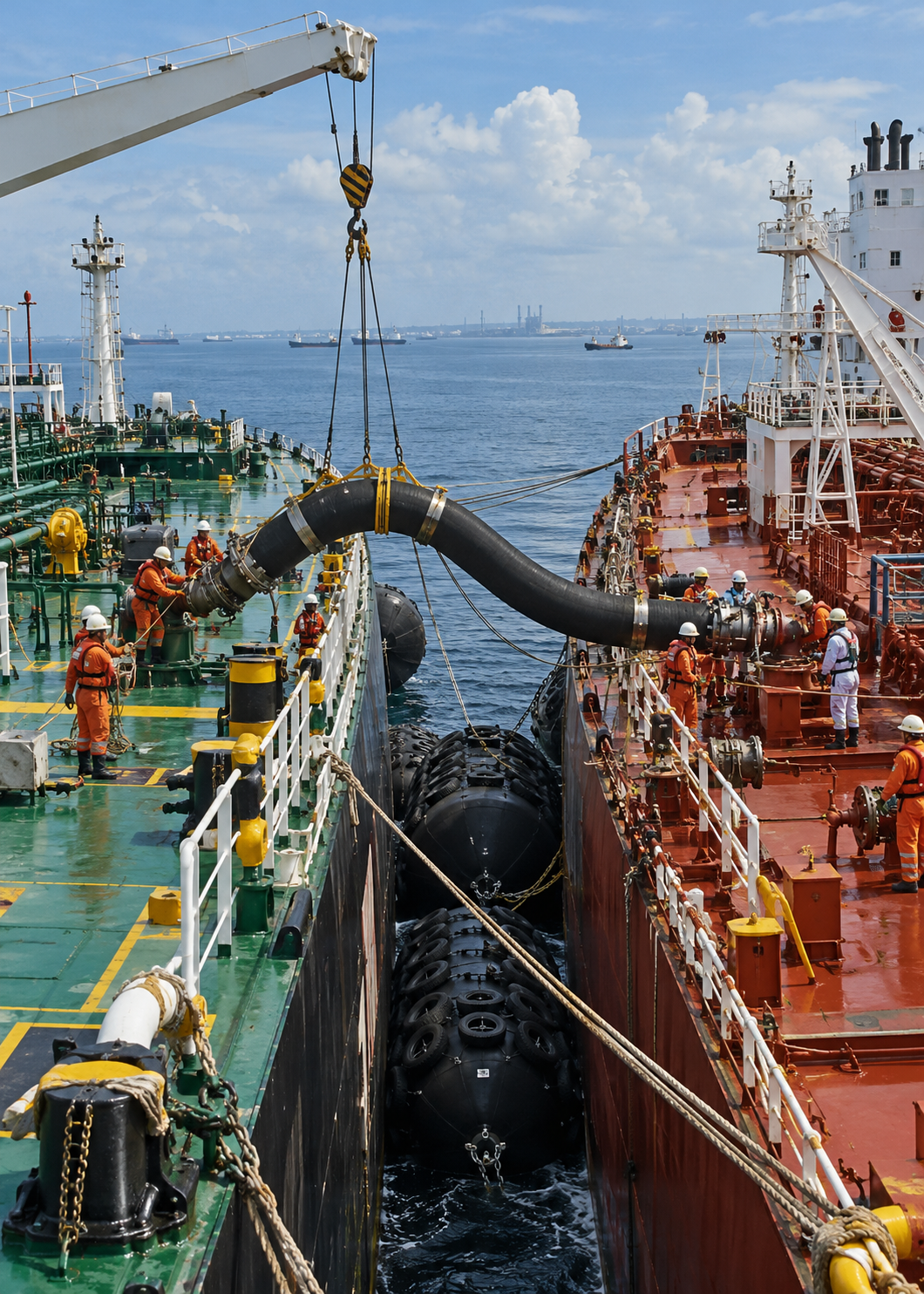
This study aims to investigate the implementation of hose handling procedures during the ship to ship transfer process in operational standards and safety requirements to maintain process continuity while minimizing the risk of work accidents, equipment damage, and marine pollution. In depth, this study identifies operational challenges faced throughout the process, and evaluates the steps taken to address those challenges. This study used a descriptive qualitative research design, utilizing direct observations, semi-structured interviews with crew members involved in ship to ship operations, and document analysis conducted aboard the AHTS ETZOMER 504 while operating at the Banyu Urip Marine Terminal (BUMT). The results showed that the hose handling process has implemented five interrelated operational phases: pre-transfer preparation and safety meeting, cargo hose retrieval from FSO Gagak Rimang, hose transfer to the receiving tanker, continuous supervision during cargo transfer, and safe hose termination after completion of operations. In addition, the main operational constraints include unfavorable weather and sea conditions that affect the stability of the ship, excessive pressure on the cargo hose, communication and coordination problems between participating ships, and gradual deterioration of equipment due to corrosion and repeated operational exposure. These challenges can be overcome through strengthening communication protocols, the implementation of strict occupational safety meetings, continuous weather assessments, and systematic inspections and preventive maintenance of operational equipment.
Article Details
Section

This work is licensed under a Creative Commons Attribution 4.0 International License.
Allow anyone to modify, improve, and make derivative works, even for commercial purposes, as long as they credit to you for the original work.
How to Cite
References
[1] V. Richard, "Factors Influencing Safety Risks in Processes Transfer Workers from PTAS Amanah Ship to Boat Landing Platform of Oil and Gas Refinery at Champion Oil Field. Ivet University.," 2025.
[2] M. Sökükcü, "New Trends and Issues Proceedings on Advances in Pure and Applied Sci- ences Ship-to-ship tanker Transfer operations and risk analysis : Probabilis- tic approach," vol. 15, no. 1, pp. 1–15, 2022.
[3] B. A. Pangestu and et al., "Analysis of Delay in the Loading Process of High Sulfur Fuel Oil (HSFO) and Low Sulfur Fuel Oil (LSFO) by Ship to Ship at Mt. Cendrawasih Analysis," pp. 1–7, 2024.
[4] Q. A. Sabaruddin1* , Indra Muda2 , Harris R. Dahlan3 , Eka Nurmala4 and 5 1, 3, 4, "Analysis of the Role of SV Ships . Fiona 38 in Supporting Lifting Operations," vol. 5, no. 1, pp. 266–272, 2026.
[5] S. Sartini and et al., "Analysis of Oil Product Loading and Unloading Process on Tankers," Maj. Ilm. Maritime Jogja, vol. 20, no. 1, pp. 62–73, 2022, doi: 10.33489/mibj.v20i1.290.
[6] A. Palapa and et al., "Efforts to Prevent Work Accidents in MV. Mochtar Prabu Mangkunekagara in the Process of Loading and Unloading Fertilizer," KALAOS Kalao's Marit. J., vol. 3, no. 2, pp. 46–60, 2022.
[7] A. Irwan and et al., "ANALYSIS OF PLANNING OF SHIP TO SHIP LOADING ACTIVITIES TRANSFER) REVIEWED FROM THE ASPECT OF SHIPPING SAFETY Asep," no. 2021, 2024.
[8] Sandi Febriansyah and et al., "Human Error Analysis of Activities Transfer Oil in the Tank Farm Speciality Fats Department Using the HEART Method at PT. X,” J. Ind. Manuf. Eng., vol. 9, no. 1, pp. 15–23, 2025, doi: 10.31289/jime.v9i1.12999.
[9] A. Y. Nainggolan and et, "Analysis of Productivity of Loading Activities with the Ship to Ship Process on Ships Brokered by PT. Adhika Samudera Jaya Banjarmasin Branch," vol. 4, no. 2, pp. 4972–4977, 2025.
[10] OCIMF, "Guidelines for the Handling, Storage, Use, Maintenance and Testing of STS Hoses."
[11] IMO, "ANY OTHER BUSINESS Second (2025) edition of the Ship to Ship Transfer Guide for Petroleum, Chemicals and Liquefied Gases (STS Transfer Guide)," 2025.
[12] Sabaruddin and al., "Optimizing Ship-to-Ship Activities (STS) for Operational Effectiveness on MT. Mount Kemala Optimizing Ship-to-Ship (STS) Activities for Effectivity Operations on MT . Mount Kemala," vol. 2, no. 1, pp. 32–41, 2025.
[13] Resulation A.683(20), "CODE OF SAFE PRACTICE FOR THE CARRIAGE OF CARGOES AND PERSONS BY OFFSHORE SUPPLY VESSELS (OSV CODE)."
[14] I. N. Kholiq and et al., "Risk Mitigation Strategies in Operations Transfer Ship to Ship Coal: MV Operational Safety Analysis. Lumoso Jaya in Bojonegara," no. March, 2025.
15] International Chamber of Shipping (ICS), Oil Companies International Marine Forum (OCIMF), and International Association of Ports and Harbors (IAPH), "International Safety Guide for Oil Tankers and Terminals (ISGOTT)," 6th ed., 2020.