
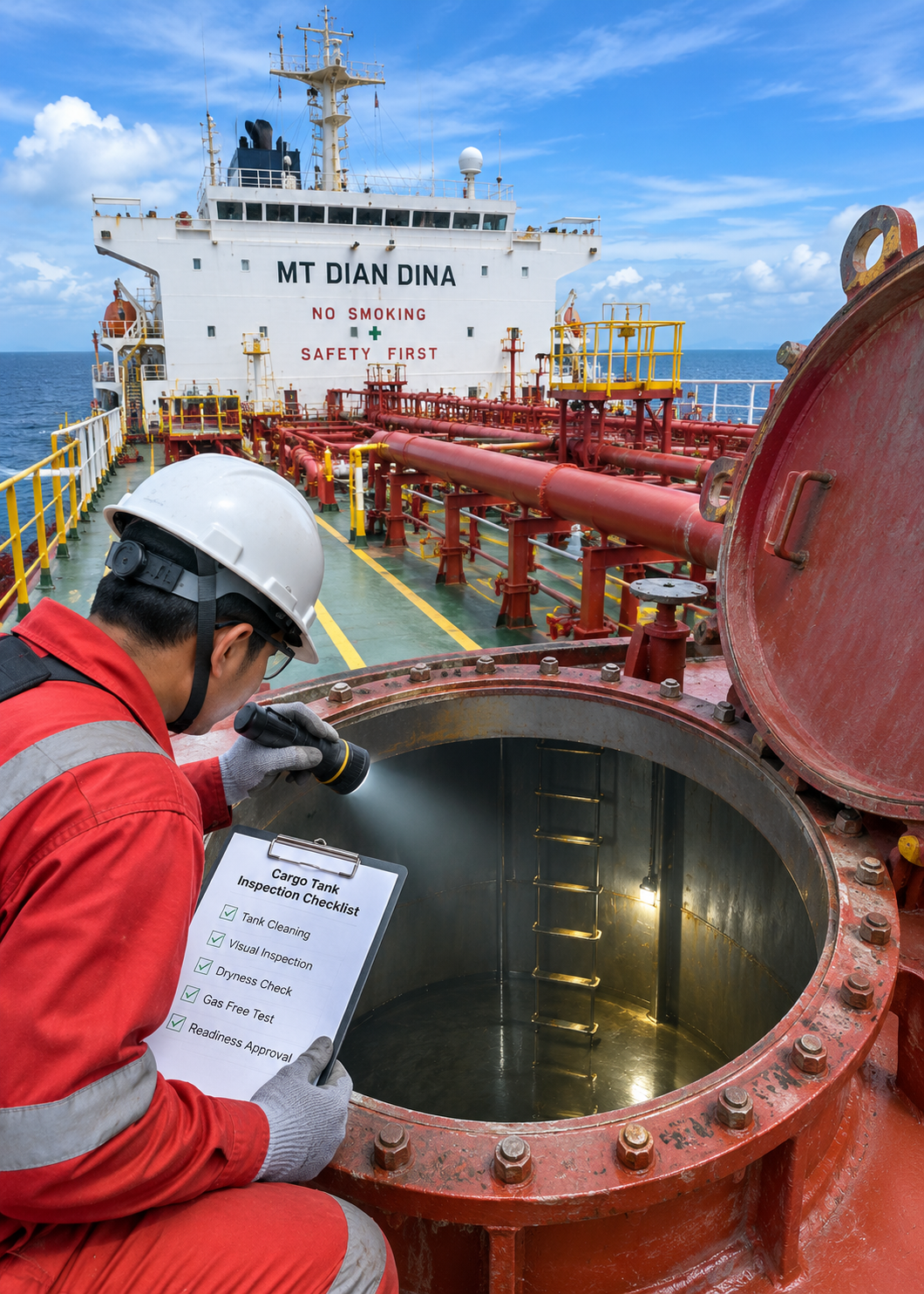
Analysis of Cargo Tank Preparation and Inspection to Support the Smooth Operation of Cargo Loading and Unloading on MT Dian Dina
Article Sidebar
Main Article Content
Abstract
The loading tanks is the main component of a tanker that must be properly prepared and thoroughly inspected before loading and unloading operations. Inadequate attention during these stages may cause residues, rags, or waste materials to remain inside the tank, obstruct cargo flow, and result in operational delays. This study aims to analyze the loading tank preparation process, the implementation of tank inspections, and the obstacles that affect the smooth operation of loading and unloading activities on MT. Dian Dina. This research employed a descriptive qualitative method. Data were collected through direct observation, interviews with the First Officer, Bosun, and Able Seaman, documentation, and literature studies. The data were analyzed through data collection, condensation, presentation, and conclusion drawing stages, while data validity was tested using source, technique, and time triangulation. The results showed that the loading tank preparation was carried out in accordance with the company’s Standard Operating Procedure (SOP), including work planning, work team formation, tank ventilation, gas freeing, tank cleaning, drying, tank condition inspection, and inspection of cargo handling systems consisting of cargo lines, cargo pumps, valves, manifolds, and cargo pump filters. However, the final inspection was not fully optimal because rags and waste materials were still found in the bottom areas and corners of the tank that were difficult to access. These foreign materials were carried by the cargo flow and caused blockage of the cargo pump filter, resulting in delays during loading and unloading operations. Improvement efforts were carried out through multi-level inspections, recording and controlling work equipment, increasing supervision during tank cleaning activities, and conducting evaluations after completion. The implementation of these measures is important to ensure tank cleanliness and readiness while minimizing the risk of operational disruptions.
Article Details
Section

This work is licensed under a Creative Commons Attribution 4.0 International License.
Allow anyone to modify, improve, and make derivative works, even for commercial purposes, as long as they credit to you for the original work.
How to Cite
References
[1] S. Magdalena, A. H. Tumanggor, H. Prasetyo, R. H. Irwansyah, and S. P. Mentari, “Efforts to prevent oil spills in bunker supply activities at Pertamina Trans Kontinental Plaju Branch,” Journal Marine Inside, vol. 6, no. 1, pp. 4–8, 2024.
[2] S. Anwar, A. Dwi, and N. Indriyanti, “Analisis Pengaruh Penggunaan Jenis Detektor Gas Metana terhadap Akurasi dan Waktu Respon di PT. Pertamina Hulu Mahakam,” 2025.
[3] S. S. Ii, “Analisis Prosedur Pembersihan Ruang Muat ( Tank Cleaning ) d i Kapal,” vol. 1, no. February, 2025.
[4] D. Ratnasari, “Pembongkaran Muatan Kapal Laut di Pelabuhan,” Costing: Journal of Economic, Business and Accounting, vol. 7, pp. 5–8, 2024.
[5] M. Azka, B. Amffa, and M. F. Arsy, “Analisis Dampak Oil Spill pada Kehidupan Masyarakat Lingkungan,” vol. 6, no. 1, pp. 86–89, 2023.
[6] L. P. Officer and P. West, “Tank Cleanliness Verification for Tankers: A Comprehensive Overview,” pp. 1–7, 2025.
[7] D. A. Faradisa, H. Setiawan, and F. M. Pongoh, “Upaya Mengatasi Keterlambatan Bongkar Muat di Kapal MV. Ayer Mas,” vol. 1, 2025.
[8] G. D. Alfathi and M. C. W. Wibowo, “Identifikasi Risiko,” Politeknik Ilmu Pelayaran Semarang, vol. 1, no. 0, pp. 1–16, 2025.
[9] R. A. Iskandar and A. M. Belawan, Produktivitas Bongkar Muat Peti Kemas pada Unit Usaha Terminal Peti Kemas Belawan PT (Persero) Pelabuhan Indonesia I, vol. 1. 2023.
[10] M. Andhika, W. B. Wantoro, F. Baskoro, J. P. Luhur, B. Duwur, and G. Mungkur, “Tank Cleaning Process dalam Menunjang Kelancaran,” vol. 7, no. 1, pp. 13–18, 2021.
[11] S. S. Ii, Analisis Prosedur Pembersihan Ruang Muat (Tank Cleaning) di Kapal, vol. 1. 2025.
[12] N. A. Farrahi, E. D. Lestari, and U. Widyaningsih, “Efforts to Reduce Cargo Residue After Tank Cleaning Last Cargo Palm Stearin to Next Cargo Palm Olein in MT Loading Tank,” Journal of Engineering Science and Technology, vol. 6, no. 1, 2026, doi: 10.31004/jestm.v6i1.330.
[13] Sugiyono, Metode Penelitian Kuantitatif Kualitatif dan R&D, 10th ed. Alfabeta, 2022.
[14] D. C. Maturbongs, O. C. Karubaba, and G. C. Permady, “Analisis Penanganan Dokumen Dan Hambatan Proses Bongkar Muat Di Kapal Km Ciremai Pada Pelabuhan Sorong,” Jurnal Patria Bahari, vol. 5, no. 1, pp. 15–22, 2025.
[15] U. Sulung and M. Muspawi, “Memahami Sumber Data Penelitian: Primer, Sekunder, dan Tersier,” Jurnal Edu Research Indonesian Institute For Corporate Learning And Studies (IICLS), vol. 5, pp. 110–116, 2024.
[16] T. Priatna, B. B. Nurfauji, D. Nuraeni, E. S. M. Sari, P. S. Agasha, and R. R. Ulum, “Teknik Pengumpulan Data dalam Pendekatan Kualitatif,” Merdeka Indonesia Jurnal International (MIJI), vol. 5, no. 2, pp. 707–713, 2025.
[17] M. B. Miles and A. M. Huberman, Qualitative Data Analysis Second Edition, 2nd ed. Sage Publications, 2014.
[18] P. Adiputra and C. Y. A. Nalle, “Analisis Efektivitas Pengawasan Bongkar Muat Di Km Lintas Bahari,” Jurnal Patria Bahari, vol. 5, no. 2, pp. 29–34, 2025.