
PLTN Terapung Analisis Respons Gerak Enam Derajat Kebebasan PLTN Terapung Tipe SPARdi Perairan Halmahera: Studi Konseptual Berbasis ANSYS-AQWA
Bilah Samping Artikel
Isi Artikel Utama
Abstrak
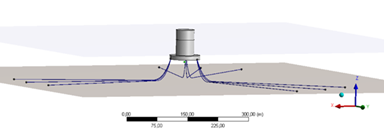
Reliable electricity supply for the archipelagic regions of Eastern Indonesia motivates the assessment of floating nuclear power plants (FNPPs) as low-carbon baseload sources. This study revises and expands a conceptual motion-response assessment of a 250 MWe spar-type FNPP proposed for Halmahera waters. The model base consists of a 45 m diameter cylindrical structure, a total height of 73 m, a draft of 48.5 m, a modeled water depth of 150 m, and a nine-line spread-mooring system. Hydrodynamic behavior is evaluated in the frequency domain using a six-degree-of-freedom framework and the ANSYS-AQWA outputs available from the original study. Regular-wave responses are interpreted through response amplitude operators (RAOs), while irregular-wave behavior is assessed through response spectra and stochastic amplitudes. Directional patterns are physically consistent: maximum surge is 1.825 m at 0° wave heading, maximum sway is 1.825 m at 90°, heave is 0.226 m for all headings, maximum roll is 0.532° at 90°, and maximum pitch is 0.532° at 0°. All responses remain below the adopted screening criteria of 12 m for surge/sway, 1.3 m for heave, and 45° for roll/pitch. Nevertheless, satisfying these thresholds demonstrates only preliminary hydrodynamic feasibility and does not constitute a nuclear safety case. Site-specific metocean validation, mooring-line tension and one-line-damaged analyses, nonlinear time-domain simulations, tsunami assessment, and qualification of safety-related equipment are required before advancing the concept to a technical pre-feasibility stage.
Rincian Artikel
Terbitan
Bagian
Cara Mengutip
Referensi
[1] Badan Pusat Statistik Kabupaten Halmahera Tengah, Kabupaten Halmahera Tengah Dalam Angka 2024. Halmahera Tengah, Indonesia: BPS, 2024.
[2] Kementerian Energi dan Sumber Daya Mineral Republik Indonesia, “Konsumsi listrik masyarakat meningkat, tahun 2023 capai 1.285 kWh/kapita,” Jakarta, Indonesia, Jan. 2024.
[3] International Atomic Energy Agency, Small Modular Reactors: Advances in SMR Developments 2024. Vienna, Austria: IAEA, 2024.
[4] International Atomic Energy Agency, Deployment of Floating Nuclear Power Plants: Benefits and Challenges. Vienna, Austria: IAEA, 2025.
[5] J. Buongiorno, J. Jurewicz, M. Golay, and N. Todreas, “The offshore floating nuclear plant concept,” Nuclear Technology, vol. 194, no. 1, pp. 1-14, 2016, doi: 10.13182/NT15-49.
[6] M. B. Strother, “Hydrodynamic analysis of the offshore floating nuclear power plant,” M.S. thesis, Massachusetts Institute of Technology, Cambridge, MA, USA, 2015.
[7] J. Cui, L. Li, M. Zhang, H. Liu, and X. Qu, “Dynamic response analysis of floating nuclear power plant containment under marine environment,” in Proc. 23rd Pacific Basin Nuclear Conf., vol. 1, Singapore: Springer, 2023, pp. 543-557, doi: 10.1007/978-981-99-1023-6_53.
[8] Y. Liu et al., “Dynamic response of a multi-point mooring cylindrical floating nuclear power platform carrying a small-scale reactor,” Ocean Engineering, vol. 267, art. no. 113121, 2023, doi: 10.1016/j.oceaneng.2022.113121.
[9] International Atomic Energy Agency, Site Evaluation for Nuclear Installations, IAEA Safety Standards Series No. SSR-1. Vienna, Austria: IAEA, 2019.
[10] International Atomic Energy Agency, Meteorological and Hydrological Hazards in Site Evaluation for Nuclear Installations, IAEA Safety Standards Series No. SSG-18. Vienna, Austria: IAEA, 2011.
[11] International Atomic Energy Agency, Seismic Hazards in Site Evaluation for Nuclear Installations, IAEA Safety Standards Series No. SSG-9. Vienna, Austria: IAEA, 2010.
[12] International Atomic Energy Agency, Legal and Institutional Issues of Transportable Nuclear Power Plants: A Preliminary Study, IAEA Nuclear Energy Series No. NG-T-3.5. Vienna, Austria: IAEA, 2013.
[13] Badan Pengawas Tenaga Nuklir, “Executive meeting perizinan PLTN dan perencanaan konsultasi 3S pra-perizinan,” Jakarta, Indonesia, Mar. 2023.
[14] International Organization for Standardization, ISO 19901-1:2015, Petroleum and Natural Gas Industries-Specific Requirements for Offshore Structures-Part 1: Metocean Design and Operating Considerations. Geneva, Switzerland: ISO, 2015.
[15] International Organization for Standardization, ISO 19901-7:2026, Specific Requirements for Offshore Structures-Part 7: Stationkeeping Systems for Floating Offshore Structures and Mobile Offshore Units. Geneva, Switzerland: ISO, 2026.
[16] DNV, DNV-RP-C205: Environmental Conditions and Environmental Loads. Høvik, Norway: DNV, 2021.
[17] DNV, DNV-OS-E301: Position Mooring. Høvik, Norway: DNV, 2021.
[18] American Petroleum Institute, API RP 2SK: Design and Analysis of Stationkeeping Systems for Floating Structures, 4th ed. Washington, DC, USA: API, 2015.
[19] O. M. Faltinsen, Sea Loads on Ships and Offshore Structures. Cambridge, U.K.: Cambridge University Press, 1990.
[20] J. N. Newman, Marine Hydrodynamics. Cambridge, MA, USA: MIT Press, 1977.
[21] T. I. Fossen, Handbook of Marine Craft Hydrodynamics and Motion Control, 2nd ed. Hoboken, NJ, USA: Wiley, 2021.
[22] J. M. J. Journée and W. W. Massie, Offshore Hydromechanics. Delft, The Netherlands: Delft University of Technology, 2001.
[23] Ansys, Inc., Ansys AQWA Theory Manual, Release 2024 R2. Canonsburg, PA, USA: Ansys, 2024.
[24] K. Hasselmann et al., “Measurements of wind-wave growth and swell decay during the Joint North Sea Wave Project (JONSWAP),” Deutsches Hydrographisches Institut, Hamburg, Germany, Ergänzungsheft Reihe A(8), no. 12, 1973.
[25] American Bureau of Shipping, Pathways to Low Carbon: Floating Nuclear Power Plants. Houston, TX, USA: ABS, 2024.
[26] International Maritime Organization, International Code for the Safe Carriage of Packaged Irradiated Nuclear Fuel, Plutonium and High-Level Radioactive Wastes on Board Ships (INF Code). London, U.K.: IMO, 2022.
[27] International Atomic Energy Agency, Safety of Nuclear Power Plants: Design, IAEA Safety Standards Series No. SSR-2/1 (Rev. 1). Vienna, Austria: IAEA, 2016.
[28] International Atomic Energy Agency, Safety of Nuclear Power Plants: Commissioning and Operation, IAEA Safety Standards Series No. SSR-2/2 (Rev. 1). Vienna, Austria: IAEA, 2016.
[29] Badan Pengawas Tenaga Nuklir, Laporan Kinerja BAPETEN Tahun 2023. Jakarta, Indonesia: BAPETEN, 2024.
[30] P. Minelli, J. Buongiorno, M. Golay, and N. Todreas, “Balance of plant and power transmission for the offshore floating nuclear plant,” in Proc. 16th Int. Topical Meeting on Nuclear Reactor Thermal Hydraulics (NURETH-16), Chicago, IL, USA, 2015.