
Floating Nuclear Power Plant Six-Degree-of-Freedom Motion Response Analysis of a SPAR-Type Floating Nuclear Power Plant in Halmahera Waters: A Conceptual Study Using ANSYS AQWA
Article Sidebar
Main Article Content
Abstract
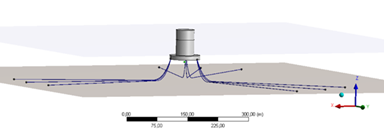
Reliable electricity supply for the archipelagic regions of Eastern Indonesia motivates the assessment of floating nuclear power plants (FNPPs) as low-carbon baseload sources. This study revises and expands a conceptual motion-response assessment of a 250 MWe spar-type FNPP proposed for Halmahera waters. The model base consists of a 45 m diameter cylindrical structure, a total height of 73 m, a draft of 48.5 m, a modeled water depth of 150 m, and a nine-line spread-mooring system. Hydrodynamic behavior is evaluated in the frequency domain using a six-degree-of-freedom framework and the ANSYS-AQWA outputs available from the original study. Regular-wave responses are interpreted through response amplitude operators (RAOs), while irregular-wave behavior is assessed through response spectra and stochastic amplitudes. Directional patterns are physically consistent: maximum surge is 1.825 m at 0° wave heading, maximum sway is 1.825 m at 90°, heave is 0.226 m for all headings, maximum roll is 0.532° at 90°, and maximum pitch is 0.532° at 0°. All responses remain below the adopted screening criteria of 12 m for surge/sway, 1.3 m for heave, and 45° for roll/pitch. Nevertheless, satisfying these thresholds demonstrates only preliminary hydrodynamic feasibility and does not constitute a nuclear safety case. Site-specific metocean validation, mooring-line tension and one-line-damaged analyses, nonlinear time-domain simulations, tsunami assessment, and qualification of safety-related equipment are required before advancing the concept to a technical pre-feasibility stage.
Article Details
Section
How to Cite
References
[1] Badan Pusat Statistik Kabupaten Halmahera Tengah, Kabupaten Halmahera Tengah Dalam Angka 2024. Halmahera Tengah, Indonesia: BPS, 2024.
[2] Kementerian Energi dan Sumber Daya Mineral Republik Indonesia, “Konsumsi listrik masyarakat meningkat, tahun 2023 capai 1.285 kWh/kapita,” Jakarta, Indonesia, Jan. 2024.
[3] International Atomic Energy Agency, Small Modular Reactors: Advances in SMR Developments 2024. Vienna, Austria: IAEA, 2024.
[4] International Atomic Energy Agency, Deployment of Floating Nuclear Power Plants: Benefits and Challenges. Vienna, Austria: IAEA, 2025.
[5] J. Buongiorno, J. Jurewicz, M. Golay, and N. Todreas, “The offshore floating nuclear plant concept,” Nuclear Technology, vol. 194, no. 1, pp. 1-14, 2016, doi: 10.13182/NT15-49.
[6] M. B. Strother, “Hydrodynamic analysis of the offshore floating nuclear power plant,” M.S. thesis, Massachusetts Institute of Technology, Cambridge, MA, USA, 2015.
[7] J. Cui, L. Li, M. Zhang, H. Liu, and X. Qu, “Dynamic response analysis of floating nuclear power plant containment under marine environment,” in Proc. 23rd Pacific Basin Nuclear Conf., vol. 1, Singapore: Springer, 2023, pp. 543-557, doi: 10.1007/978-981-99-1023-6_53.
[8] Y. Liu et al., “Dynamic response of a multi-point mooring cylindrical floating nuclear power platform carrying a small-scale reactor,” Ocean Engineering, vol. 267, art. no. 113121, 2023, doi: 10.1016/j.oceaneng.2022.113121.
[9] International Atomic Energy Agency, Site Evaluation for Nuclear Installations, IAEA Safety Standards Series No. SSR-1. Vienna, Austria: IAEA, 2019.
[10] International Atomic Energy Agency, Meteorological and Hydrological Hazards in Site Evaluation for Nuclear Installations, IAEA Safety Standards Series No. SSG-18. Vienna, Austria: IAEA, 2011.
[11] International Atomic Energy Agency, Seismic Hazards in Site Evaluation for Nuclear Installations, IAEA Safety Standards Series No. SSG-9. Vienna, Austria: IAEA, 2010.
[12] International Atomic Energy Agency, Legal and Institutional Issues of Transportable Nuclear Power Plants: A Preliminary Study, IAEA Nuclear Energy Series No. NG-T-3.5. Vienna, Austria: IAEA, 2013.
[13] Badan Pengawas Tenaga Nuklir, “Executive meeting perizinan PLTN dan perencanaan konsultasi 3S pra-perizinan,” Jakarta, Indonesia, Mar. 2023.
[14] International Organization for Standardization, ISO 19901-1:2015, Petroleum and Natural Gas Industries-Specific Requirements for Offshore Structures-Part 1: Metocean Design and Operating Considerations. Geneva, Switzerland: ISO, 2015.
[15] International Organization for Standardization, ISO 19901-7:2026, Specific Requirements for Offshore Structures-Part 7: Stationkeeping Systems for Floating Offshore Structures and Mobile Offshore Units. Geneva, Switzerland: ISO, 2026.
[16] DNV, DNV-RP-C205: Environmental Conditions and Environmental Loads. Høvik, Norway: DNV, 2021.
[17] DNV, DNV-OS-E301: Position Mooring. Høvik, Norway: DNV, 2021.
[18] American Petroleum Institute, API RP 2SK: Design and Analysis of Stationkeeping Systems for Floating Structures, 4th ed. Washington, DC, USA: API, 2015.
[19] O. M. Faltinsen, Sea Loads on Ships and Offshore Structures. Cambridge, U.K.: Cambridge University Press, 1990.
[20] J. N. Newman, Marine Hydrodynamics. Cambridge, MA, USA: MIT Press, 1977.
[21] T. I. Fossen, Handbook of Marine Craft Hydrodynamics and Motion Control, 2nd ed. Hoboken, NJ, USA: Wiley, 2021.
[22] J. M. J. Journée and W. W. Massie, Offshore Hydromechanics. Delft, The Netherlands: Delft University of Technology, 2001.
[23] Ansys, Inc., Ansys AQWA Theory Manual, Release 2024 R2. Canonsburg, PA, USA: Ansys, 2024.
[24] K. Hasselmann et al., “Measurements of wind-wave growth and swell decay during the Joint North Sea Wave Project (JONSWAP),” Deutsches Hydrographisches Institut, Hamburg, Germany, Ergänzungsheft Reihe A(8), no. 12, 1973.
[25] American Bureau of Shipping, Pathways to Low Carbon: Floating Nuclear Power Plants. Houston, TX, USA: ABS, 2024.
[26] International Maritime Organization, International Code for the Safe Carriage of Packaged Irradiated Nuclear Fuel, Plutonium and High-Level Radioactive Wastes on Board Ships (INF Code). London, U.K.: IMO, 2022.
[27] International Atomic Energy Agency, Safety of Nuclear Power Plants: Design, IAEA Safety Standards Series No. SSR-2/1 (Rev. 1). Vienna, Austria: IAEA, 2016.
[28] International Atomic Energy Agency, Safety of Nuclear Power Plants: Commissioning and Operation, IAEA Safety Standards Series No. SSR-2/2 (Rev. 1). Vienna, Austria: IAEA, 2016.
[29] Badan Pengawas Tenaga Nuklir, Laporan Kinerja BAPETEN Tahun 2023. Jakarta, Indonesia: BAPETEN, 2024.
[30] P. Minelli, J. Buongiorno, M. Golay, and N. Todreas, “Balance of plant and power transmission for the offshore floating nuclear plant,” in Proc. 16th Int. Topical Meeting on Nuclear Reactor Thermal Hydraulics (NURETH-16), Chicago, IL, USA, 2015.