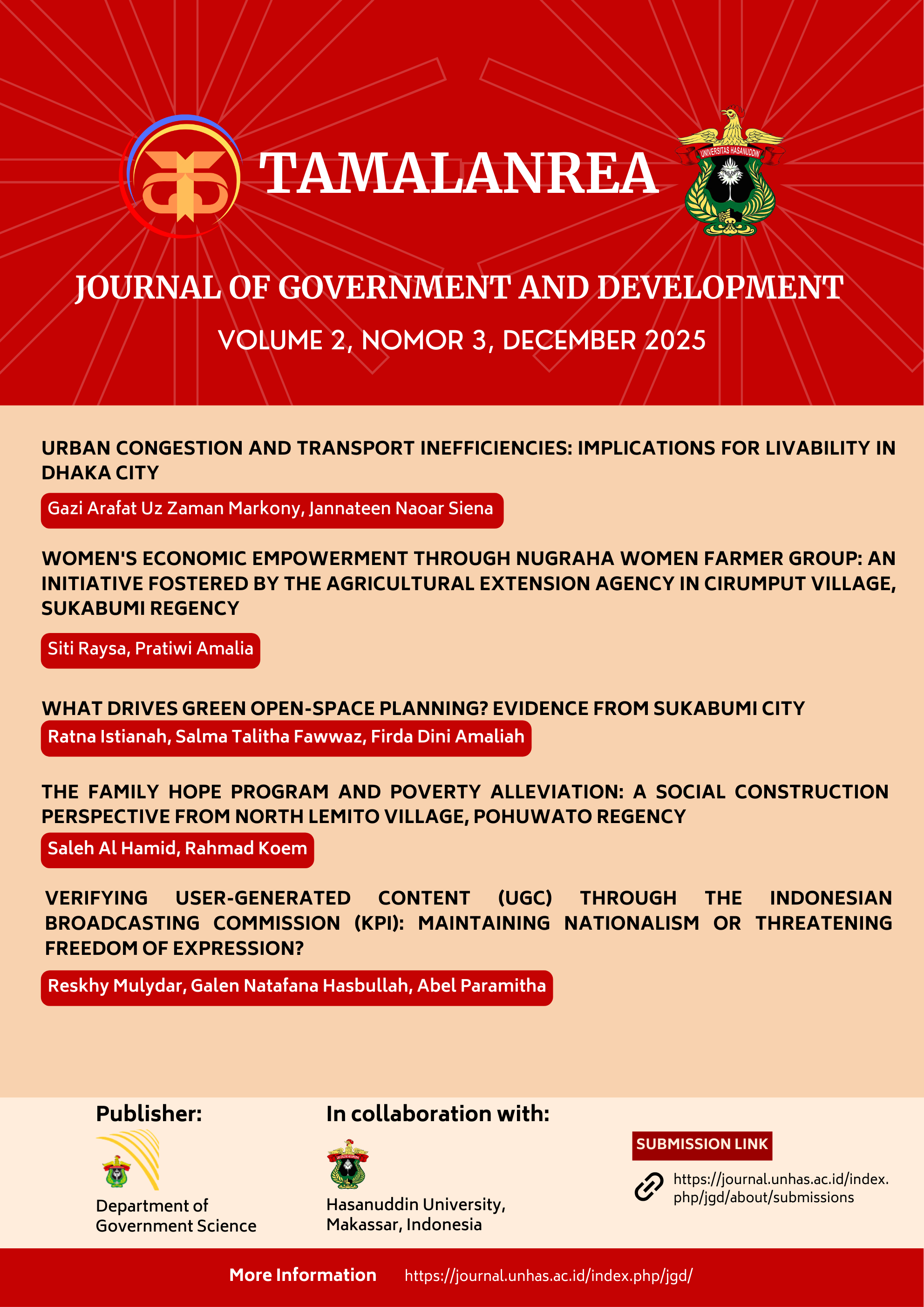
What drives green open-space planning? Evidence from Sukabumi City
DOI:
https://doi.org/10.69816/jgd.v2i3.45983Kata Kunci:
Green Open Space, Sustainable Development, Environment, Governance, Urban DevelopmentAbstrak
Green open spaces (RTH) are crucial for supporting sustainable urban development and maintaining environmental balance. In Sukabumi City, the planning and provision of RTH continue to face considerable challenges amid rapid urbanization, despite the mandate of Law No. 26 of 2007, which requires 30% of the city area to be allocated for RTH provision. This study aims to analyze the factors driving development administration planning in the provision of RTH, focusing on regulatory, social, community participation, economic, environmental, and institutional aspects of the same. Using a literature review method with a qualitative approach, this study identifies and synthesizes relevant findings regarding the dynamics of RTH planning. The results indicate that the city faces challenges related to limited land availability, low community participation, and budgetary constraints. To overcome these limitations, this study recommends strengthening regulatory frameworks, enhancing stakeholder collaboration, developing environmental education programs, and encouraging innovation in RTH management and funding. Overall, this analysis is expected to serve as a reference for policymakers in designing effective and sustainable strategies for RTH provision in Sukabumi.
Unduhan
Diterbitkan
Terbitan
Bagian
Lisensi
Hak Cipta (c) 2025 Ratna Istianah, Salma Talitha Fawwaz, Firda Dini Amaliah; Siti Raysa

Artikel ini berlisensi Creative Commons Attribution-NonCommercial-NoDerivatives 4.0 International License.