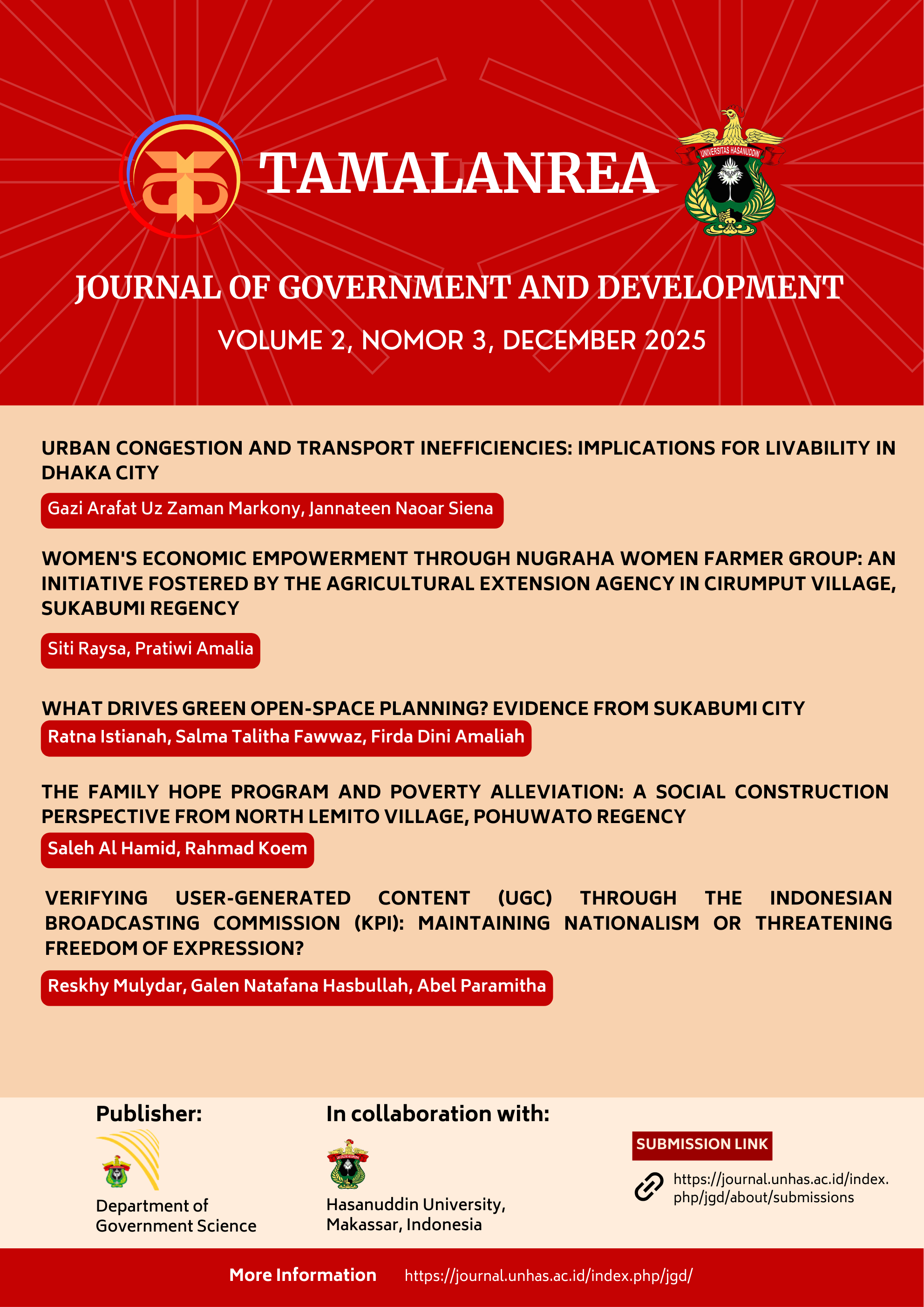
The family hope program and poverty alleviation: A social construction perspective from North Lemito Village, Pohuwato Regency
DOI:
https://doi.org/10.69816/jgd.v2i3.48880Keywords:
Social construction, Family Hope Program, Poverty alleviation, Social welfare, Rural study, IndonesiaAbstract
Poverty is increasingly understood as a multidimensional phenomenon that involves limited access to education, healthcare, and social welfare rather than merely low income. In Indonesia, the Family Hope Program (Program Keluarga Harapan/PKH), a conditional cash transfer initiative, has been implemented to alleviate poverty while promoting human capital development. However, beyond its economic contribution, the way beneficiaries interpret and socially construct the program remains insufficiently explored. This study aims to analyze how PKH is socially constructed as a poverty alleviation instrument at the community level. This research employed a qualitative case study approach conducted in North Lemito Village, Pohuwato Regency, Indonesia. Data were collected through in-depth interviews, observations, and documentation involving PKH beneficiaries, facilitators, and community representatives. The data were analyzed using an interactive qualitative analysis model to identify patterns of meaning, perceptions, and experiences related to the program’s implementation. The findings show that PKH is socially constructed as an important support mechanism that improves access to education, healthcare services, and basic household welfare. Beneficiaries perceive the program as reducing financial pressure, encouraging children’s school participation, promoting preventive health behavior, and stabilizing daily living conditions. Nevertheless, PKH is generally viewed as complementary support rather than a comprehensive solution to poverty, as structural economic constraints and rising living costs continue to shape household vulnerability. These findings suggest that strengthening PKH requires not only financial assistance but also integration with broader empowerment initiatives to support sustainable poverty reduction.
Downloads
Published
Issue
Section
License
Copyright (c) 2025 Saleh Al Hamid, Rahmad Koem

This work is licensed under a Creative Commons Attribution-NonCommercial-NoDerivatives 4.0 International License.