
Analisis Sensitivitas Frame 2d Tipe Portal terhadap Variasi Geometri dan Kondisi Batas dengan SAP2000 Analysis of 2d Portal-Type Frames
Article Sidebar
Main Article Content
Abstract
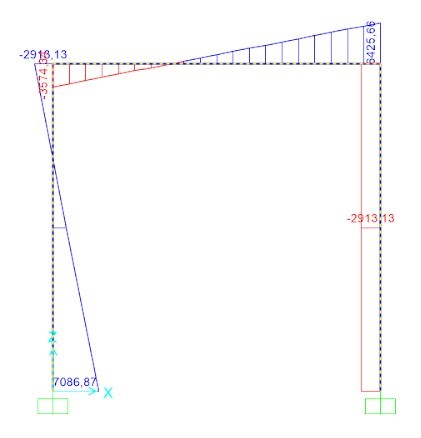
This study examines the stiffness sensitivity of 2D portal-type frames to variations in geometry and boundary conditions using finite element analysis in SAP2000. Structural stiffness plays a critical role in determining deformation responses and internal force distribution, particularly in portal systems that are highly influenced by changes in element dimensions and support restraints. The portal model is analyzed under vertical and horizontal distributed loads of 10 kN/m to evaluate shear forces, bending moments, axial forces, and displacements. The analysis shows that the maximum shear force reaches 7,086 kN at the base of the column, while the largest moment occurs at the fixed support with a value of 20,673 kN·m. The axial forces in both columns are dominated by compression and remain relatively constant along their height, reflecting the significant influence of vertical loading. The maximum lateral displacement is approximately 0.202 m, which remains within acceptable limits for sensitivity analysis but still requires consideration of drift criteria for real design applications. These findings indicate that small changes in geometry and boundary conditions can produce meaningful variations in structural response, highlighting the importance of sensitivity studies during early design stages to achieve a more efficient and stable structural configuration.
Keywords: 2D frame, structural stiffness, boundary conditions, SAP2000
Downloads
Article Details
References
API, API RP 2A-WSD: Planning, Designing and Constructing Fixed Offshore Platforms. Washington, DC, USA: American Petroleum Institute, 2007.
R. Bhattacharyya, Dynamics of Marine Structures. Hoboken, NJ, USA: Wiley, 2011.
S. L. Chan and P. P. T. Chui, Non-linear Static and Cyclic Analysis of Steel Frames. Oxford, U.K.: Elsevier, 2000.
R. D. Cook, D. S. Malkus, M. E. Plesha, and R. J. Witt, Concepts and Applications of Finite Element Analysis, 4th ed. New York, NY, USA: Wiley, 2002.
Computers and Structures Inc. (CSI), SAP2000: Structural Analysis Program, Version 22 – Analysis Reference Manual. Berkeley, CA, USA, 2020.
J. M. Gere and B. J. Goodno, Mechanics of Materials, 8th ed. Stamford, CT, USA: Cengage Learning, 2012.
R. R. Husaini, M. Yazid, A. D. Islami, T. J. Gunawan, and M. D. Wahyudi, “Analisis Struktur Rangka Batang 2D dengan Metode Matriks Kekakuan,” Jurnal Rab Construction Research, vol. 8, no. 2, pp. 322–338, 2023.
A. Kassimali, Matrix Analysis of Structures, 2nd ed. Stamford, CT, USA: Cengage Learning, 2012.
W. McGuire, R. H. Gallagher, and R. D. Ziemian, Matrix Structural Analysis, 2nd ed. New York, NY, USA: John Wiley & Sons, 2000.
S. Timoshenko and D. H. Young, Elements of Strength of Materials. Princeton, NJ, USA: D. Van Nostrand Company, 1965.
S. T. Zulfikar, Dasar-Dasar Metode Elemen Hingga untuk Teknik Mesin, Bab 3 Matriks Kekakuan. Universitas Muhammadiyah Ambarawa, pp. 22–29, 2019.
J. N. Reddy, An Introduction to the Finite Element Method, 3rd ed. New York, NY, USA: McGraw-Hill, 2006.
O. C. Zienkiewicz and R. L. Taylor, The Finite Element Method: Its Basis and Fundamentals, 7th ed. Oxford, U.K.: Elsevier, 2013.
T. H. G. Megson, Structural and Stress Analysis, 3rd ed. Oxford, U.K.: Butterworth-Heinemann, 2014.
J. F. Harvey, Theory and Design of Pressure Vessels, 2nd ed. New York, NY, USA: Van Nostrand Reinhold, 1985.
Y. C. Fung and P. Tong, Classical and Computational Solid Mechanics. Singapore: World Scientific, 2001.
W. F. Chen and E. M. Lui, Structural Stability: Theory and Implementation. New York, NY, USA: Elsevier, 1987.
S. S. Rao, The Finite Element Method in Engineering, 5th ed. Burlington, MA, USA: Butterworth-Heinemann, 2011.
D. J. Eyres and G. J. Bruce, Ship Construction, 7th ed. Oxford, U.K.: Butterworth-Heinemann, 2012.
B. M. Das and K. Sobhan, Principles of Geotechnical Engineering, 8th ed. Stamford, CT, USA: Cengage Learning, 2014.