
Evaluation of the Linear Elastic Response of a Three-Dimensional Frame in a Jacket Structure Leg System under Vertical Loading Using SAP2000
Article Sidebar
Main Article Content
Abstract
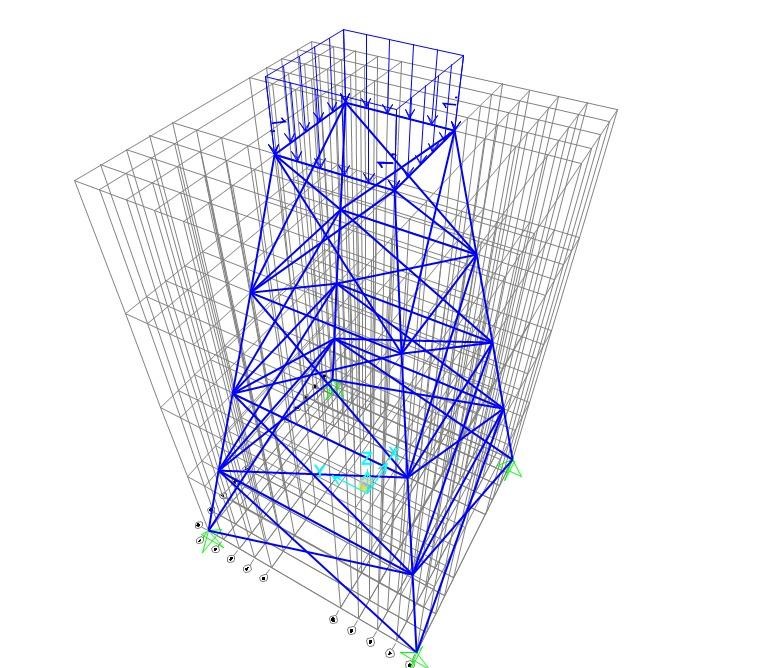
Jacket structures are three-dimensional steel framing systems that transfer top side loads to the foundation through legs, braces, and tubular joints. This study evaluates the linear-elastic response of a three-dimensional portal model representing a jacket leg system under vertical loading using SAP2000. The model consists of four legs connected by diagonal and horizontal braces, rigid joints, fixed base supports, and hollow circular sections. The analysis includes self-weight and four concentrated loads of 1 kN applied at the top. The revised study extends the original work through section-property calculations, load-path assessment, a unit-consistency audit, and a critical interpretation of the output contours. The SAP2000 displacement legends show an E-6 scale factor; assuming the model length unit is metre, the maximum Ux and Uy are 245×10⁻⁶ m or 0.245 mm, while Uz is 560×10⁻⁶ m or 0.560 mm. These values correct the initial metre-based interpretation. The reported axial response is compression-dominated, ranging from -1059.44 kN to +7.41 kN. The stress contour identifies the middle-brace region as a critical response zone; however, yielding cannot be concluded because the active stress unit was not documented. Reported torsion ranges from -4.60 to +3.42 kN·m, indicating internal coupling associated with the three-dimensional configuration. Linear static analysis is therefore useful for preliminary stiffness and load-path assessment, but unit verification, reaction equilibrium, member discretization, joint flexibility, soil-pile interaction, environmental loading, and nonlinear analysis are required before the model can support an offshore structural safety assessment.
Article Details
Section
How to Cite
References
[1] International Organization for Standardization, Petroleum and Natural Gas Industries—Fixed Steel Offshore Structures, ISO 19902:2020, Geneva, Switzerland, 2020.
[2] American Petroleum Institute, Planning, Designing, and Constructing Fixed Offshore Platforms—Working Stress Design, API RP 2A-WSD, 22nd ed., Washington, DC, USA, 2014.
[3] DNV, Environmental Conditions and Environmental Loads, DNV-RP-C205, Høvik, Norway, Apr. 2025, amended Mar. 2026.
[4] DNV, Determination of Structural Capacity by Non-linear Finite Element Analysis Methods, DNV-RP-C208, Høvik, Norway, Sep. 2019, amended Oct. 2022.
[5] DNV, Fatigue Design of Offshore Steel Structures, DNV-RP-C203, Høvik, Norway, Oct. 2024, amended Oct. 2025.
[6] American Institute of Steel Construction, Specification for Structural Steel Buildings, ANSI/AISC 360-22, Chicago, IL, USA, 2022.
[7] ASTM International, Standard Specification for Structural Steel Shapes, ASTM A992/A992M-22, West Conshohocken, PA, USA, 2022, doi: 10.1520/A0992_A0992M-22.
[8] American Petroleum Institute, Specification for the Fabrication of Structural Steel Pipe, API Spec 2B, 6th ed., Washington, DC, USA, 2021.
[9] Computers and Structures, Inc., CSI Analysis Reference Manual, Rev. 15, Berkeley, CA, USA, 2017.
[10] K. J. Bathe, Finite Element Procedures, 2nd ed. Watertown, MA, USA: Klaus-Jürgen Bathe, 2014.
[11] O. C. Zienkiewicz, R. L. Taylor, and J. Z. Zhu, The Finite Element Method: Its Basis and Fundamentals, 7th ed. Oxford, U.K.: Butterworth-Heinemann, 2013.
[12] R. D. Cook, D. S. Malkus, M. E. Plesha, and R. J. Witt, Concepts and Applications of Finite Element Analysis, 4th ed. New York, NY, USA: Wiley, 2002.
[13] W. McGuire, R. H. Gallagher, and R. D. Ziemian, Matrix Structural Analysis, 2nd ed. New York, NY, USA: Wiley, 2000.
[14] T. H. G. Megson, Structural and Stress Analysis, 4th ed. Oxford, U.K.: Butterworth-Heinemann, 2019.
[15] S. K. Chakrabarti, Ed., Handbook of Offshore Engineering. Amsterdam, The Netherlands: Elsevier, 2005.
[16] B. C. Gerwick, Jr., Construction of Marine and Offshore Structures, 3rd ed. Boca Raton, FL, USA: CRC Press, 2007.
[17] S. E. Abdel Raheem, “Nonlinear response of fixed jacket offshore platform under structural and wave loads,” Coupled Syst. Mech., vol. 2, no. 1, pp. 111–126, 2013, doi: 10.12989/csm.2013.2.1.111.
[18] N. A. Othman and M. H. Mohd, “Response of the offshore jacket platform at its ultimate strength under operating and extreme loads: A Malaysian waters case study,” Ships Offshore Struct., vol. 19, no. 11, pp. 1805–1826, 2024, doi: 10.1080/17445302.2024.2312726.
[19] Z. Wang, S. K. Mantey, and X. Zhang, “A numerical tool for efficient analysis and optimization of offshore wind turbine jacket substructure considering realistic boundary and loading conditions,” Mar. Struct., vol. 95, Art. no. 103605, 2024, doi: 10.1016/j.marstruc.2024.103605.
[20] E. Zavvar et al., “Analysis of tubular joints in marine structures: A comprehensive review,” Mar. Struct., vol. 99, Art. no. 103702, 2025, doi: 10.1016/j.marstruc.2024.103702.
[21] M. J. Mia, M. S. Islam, and M. M. Rahman, “Numerical analysis of tubular XT joint of jacket type offshore structures under static loading,” Bangladesh Marit. J., vol. 6, no. 1, pp. 299–318, 2022, doi: 10.70279/bmj-v6-i1-1057.
[22] A. Shittu, A. Kolios, and A. Mehmanparast, “A systematic review of structural reliability methods for deformation and fatigue analysis of offshore jacket structures,” Metals, vol. 11, no. 1, Art. no. 50, 2021, doi: 10.3390/met11010050.
[23] A. Motlagh, N. Shabakhty, and A. Kaveh, “Design optimization of jacket offshore platform considering fatigue damage using genetic algorithm,” Ocean Eng., vol. 227, Art. no. 108869, 2021, doi: 10.1016/j.oceaneng.2021.108869.
[24] Setiawan, D. M. Rosyid, and R. W. Prastianto, “Pushover analysis of ageing offshore jacket platform in shallow water under extreme storm and mitigation strategy for platform’s life extension,” Int. J. Mar. Eng. Innov. Res., vol. 10, no. 1, pp. 12–34, 2025.
[25] S. F. Sumardi and D. M. Rosyid, “Jacket structure design optimization to reach minimum construction cost,” Int. J. Mar. Eng. Innov. Res., vol. 10, no. 1, pp. 47–54, 2025, doi: 10.12962/j25481479.v10i1.22293.
[26] J. Häfele, M. Damiani, R. King, and P. Gebhardt, “A systematic approach to offshore wind turbine jacket predesign and optimization,” Wind Energy Sci., vol. 3, no. 2, pp. 553–572, 2018, doi: 10.5194/wes-3-553-2018.
[27] S. Zheng, Y. Wang, Z. Shi, and X. Zhang, “Efficient optimization design method of jacket structures for offshore wind turbines,” Mar. Struct., vol. 89, Art. no. 103372, 2023, doi: 10.1016/j.marstruc.2023.103372.
[28] M. A. Lotfollahi-Yaghin and H. Ahmadi, “Effect of geometrical parameters on SCF distribution along the weld toe of tubular KT-joints under balanced axial loads,” Int. J. Fatigue, vol. 32, no. 4, pp. 703–719, 2010, doi: 10.1016/j.ijfatigue.2009.10.008.