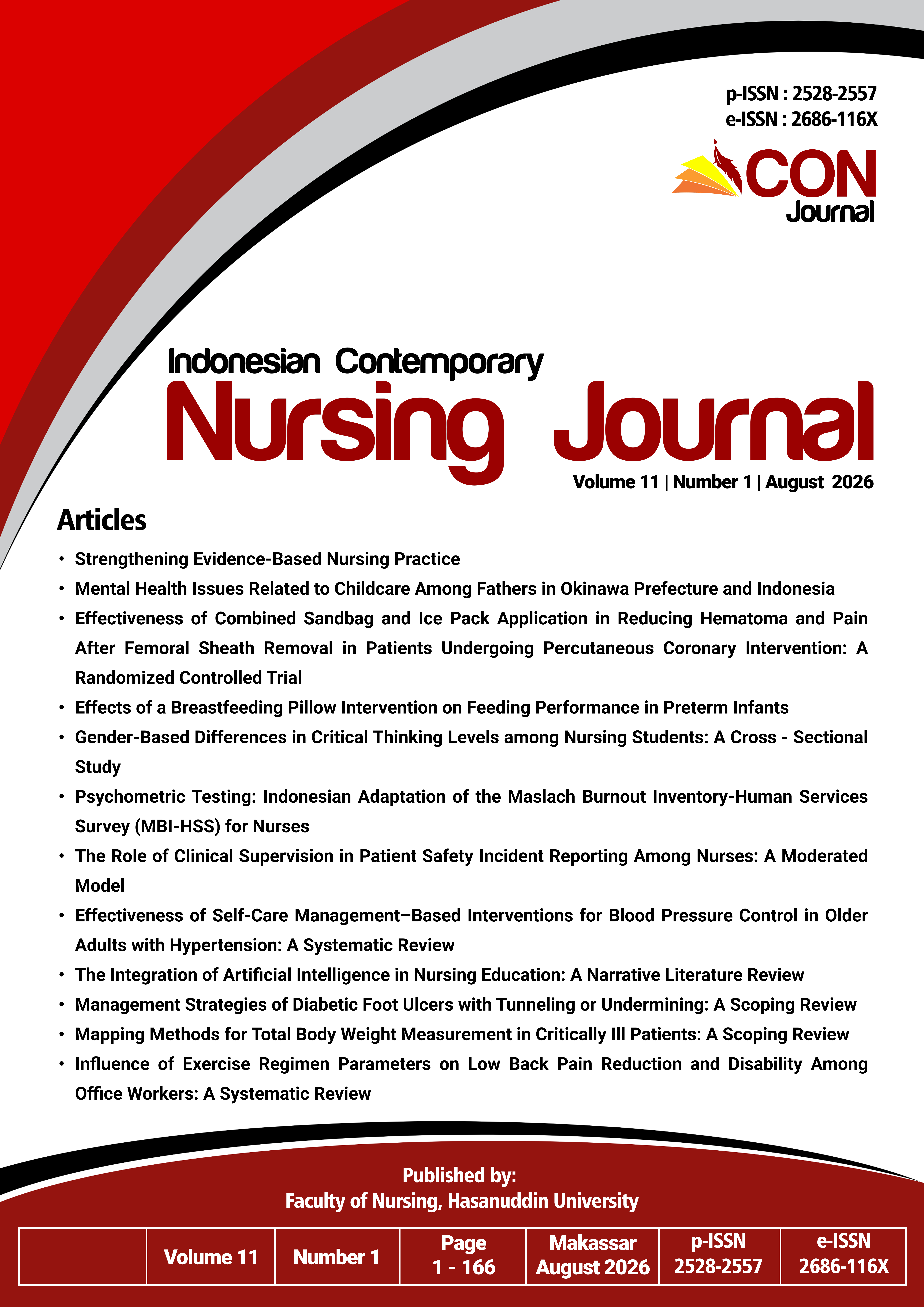
Gender-Based Differences in Critical Thinking Levels among Nursing Students: A Cross -Sectional Study
DOI:
https://doi.org/10.20956/2vvtg475Keywords:
critical thinking, gender, clinical learning, nursing studentsAbstract
Aims: This study aimed to examine gender-based differences in critical thinking levels among nursing students.
Methods: A quantitative descriptive-analytic study with a cross-sectional design was performed. A total of 267 nursing students were included as respondents using a total sampling technique. Data were collected using the Nursing Critical Thinking in Students Questionnaire (N-CT-4). Univariate analysis was used to describe the respondents’ characteristics and critical thinking levels. The Mann–Whitney U test was used to compare critical thinking domain scores between male and female students, while the Chi-square test was applied to compare the distribution of critical thinking levels by gender.
Results: The mean age of the respondents was 21.09±0.70 years, with the majority being female (86.9%). Most students demonstrated moderate critical thinking (50.9%). Male students showed higher median scores across all domains of critical thinking, including personal (130 vs. 123), intellectual (148 vs. 145), interpersonal (71 vs. 62), and technical (21 vs. 19) domains. However, the Mann–Whitney U test showed no statistically significant differences between male and female students in the personal (p = 0.396), intellectual (p = 0.759), interpersonal (p = 0.270), or technical (p = 0.523) domains. The Chi-square test showed a significant difference in the distribution of critical thinking levels by gender (χ²=6.276; p=0.043).
Conclusion: Nursing students generally demonstrated moderate critical thinking, with intellectual skills strongest and technical skills weakest. Gender influenced overall level distribution but not domain scores, highlighting the need for adaptive, inclusive, and student-centered learning.
References
Adelia, G., Alwi, F., Asyikin, N., Pérez, E. Z., Putri, V. D., Arfina, A., Locsin, R. C., & Yoder, L. H. (2026). Critical Thinking Skills Development Across Semesters in Nursing Students : A Cross-Sectional Study. Jurnal Berita Ilmu Keperawatan, 19(1), 83–94. https://doi.org/10.23917/bik.v19i1.12711
Adelia, G., Asyikin, N., Malfasari, E., Putri, V. D., & Arfina, A. (2024). Tingkat Berpikir Kritis Mahasiswa Keperawatan di Institusi Pendidikan Keperawatan Swasta. Jurnal Penelitian Perawat Profesional, 6(6), 3195–3200. https://jurnal.globalhealthsciencegroup.com/index.php/JPPP/article/view/7461/5022
Adelia, G., Pérez, E. Z., Malfasari, E., & Febtrina, R. (2026). How Demographic and Academic Factors Relate to Critical Thinking Skills among Indonesian Nursing Students. Journal of Nursing Practice, 9(3), 678–687. https://doi.org/10.30994/jnp.v9i3.1011
Aldiabat, K., Alsrayheen, E., Aquino-Russell, C., Al-Qadire, M., Al Rawajfah, O., & Al Sabei, S. D. (2021). Differences in critical thinking skills between nursing students on a fast-track versus traditional 4-year programme. British Journal of Nursing, 30(7), 434–439. https://doi.org/10.12968/bjon.2021.30.7.434
Ali-Abadi, T., Babamohamadi, H., & Nobahar, M. (2020). Critical thinking skills in intensive care and medical-surgical nurses and their explaining factors. Nurse Education in Practice, 45(April 2019), 102783. https://doi.org/10.1016/j.nepr.2020.102783
Basco-Prado, L., Biurrun-Garrido, A., Zuriguel-Pérez, E., Roldán-Merino, J., & Mestres-Soler, O. (2024). Critical thinking level in nursing degree students according to sociodemographic and academic variables: A correlational study. Nurse Education in Practice, 78, 103955. https://doi.org/10.1016/j.nepr.2024.103955
Esa, M., Karim, & Yaman. (2023). Critical Thinking Level among Nursing Students of Faculty of Medicine UKM. Medicine & Health, 19(1), 150–160. https://doi.org/10.17576/mh.2024.1901.10
Etlidawati, & Yulistika, D. (2022). Metode Pembelajaran Klinik pada Praktik Profesi Mahasiswa Keperawatan. Faletehan Health Journal, 9(1), 37–42. https://doi.org/10.33746/fhj.v9i01.382
Fernandez-Feito, A., S, B.-H., Palmeiro-Longo, M. R., & V, G.-D. (2019). Differences in professional values between nurses and nursing students : a gender perspective. International Council of Nurses, 577–589. https://doi.org/10.1111/inr.12543
Giofrè, D., Toffalini, E., Esposito, L., & Cornoldi, C. (2024). Sex / gender differences in general cognitive abilities : an investigation using the Leiter ‑ 3. Cognitive Processing, 25(4), 663–672. https://doi.org/10.1007/s10339-024-01199-9
Görücü, S., & Ünal, A. (2025). The effect of critical thinking education on nursing students ’ critical thinking dispositions , social intelligence levels , and nursing education stress : a quasi- experimental study.
Harrison, J. (2019). Student nurses’ gender role is a predictor of caring behaviours and critical thinking. Evidence-Based Nursing, 22(3), 89. https://doi.org/10.1136/ebnurs-2018-103029
Hashish, A. A., Ebtsam, & Bajbeir, E. F. (2018). Emotional Intelligence among Saudi Nursing Students and Its Relationship to Their Critical Thinking Disposition at College of Nursing- Jeddah, Saudi Arabia. American Journal of Nursing Research, 6(6), 350–358. https://doi.org/10.12691/ajnr-6-6-2
Joae, P., Nito, B., Ayu, O., Manto, D., & Wulandari, D. (2020). Pengaruh Program Mentoring Terhadap Peningkatan Kemampuan Berpikir Kritis Penggunaan Standardized Nursing Language Mahasiswa Keperawatan sebagai Metode Pembelajaran. 11(2).
Kurniawan, D. (2020). Faktor yang mempengaruhi terjadinya kesenjangan antara pengetahuan dan praktik klinik mahasiswa keperawatan di rumah sakit. Borneo Nursing Journal (BNJ), 2(1), 31–38.
Kusumawati, W., Kurniasari, N., & Zulfa, K. (2019). Pengaruh Integrasi Model Pembelajaran Siklus 5e Dengan Case Based Learning (CBL) Terhadap Kecenderungan Berfikir Kritis. JURNAL EDUNursing, 3(1).
Lager, E., Sorjonen, K., Melin, M., & Reilly, D. (2024). Gender differences in operational and cognitive abilities. October, 1–8. https://doi.org/10.3389/fpsyg.2024.1402645
Liu, N. Y., Hsu, W. Y., Hung, C. A., Wu, P. L., & Pai, H. C. (2019). The effect of gender role orientation on student nurses’ caring behaviour and critical thinking. International Journal of Nursing Studies, 89, 18–23. https://doi.org/10.1016/j.ijnurstu.2018.09.005
Martínez-Momblan, M. A., Aguilar, I. B., Alonso-Fernández, S., García, M. R., Zuriguel-Pérez, E., Falcó-Pegueroles, A., & Aracil, L. B. (2023). Critical thinking among institutional academic advisors and sociodemographic, professional and academic variables: A multicenter correlation study. Nurse Education in Practice, 71(April). https://doi.org/10.1016/j.nepr.2023.103713
Nabilah, M., Stepanus, S. S., & Hamdani. (2020). Analisis kemampuan kognitif peserta didik dalam menyelesaikan soal momentum dan impuls. 1(2017), 1–7.
Nemati-Vakilabad, R., Mojebi, M. R., Mostafazadeh, P., Jafari, M. J., Kamblash, A. J., Shafaghat, A., Abbasi, A. S., & Mirzaei, A. (2023). Factors associated with the critical thinking ability among nursing students: An exploratory study in Iran. Nurse Education in Practice, 73(June), 103814. https://doi.org/10.1016/j.nepr.2023.103814
Nes, A. A. G., Riegel, F., Martini, J. G., Zlamal, J., Bresolin, P., Mohallem, A. G. da C., & Steindal, S. A. (2023). Brazilian undergraduate nursing students’ critical thinking need to be increased: a cross-sectional study. Revista Brasileira de Enfermagem, 76(1), 1–8. https://doi.org/10.1590/0034-7167-2022-0315
Patmawati, T. A., Saleh, A., & Syahrul, S. (2018). Efektifitas Metode Pembelajaran Klinik Terhadap Kemampuan Berpikir Kritis Dan Kepercayaan Diri Mahasiswa Keperawatan : A Literature Review. Jurnal Keperawatan Muhammadiyah, 3(2), 88–94. https://doi.org/10.30651/jkm.v3i2.1823
Ruslan, A., & Ruslan, R. (2024). The Level of Critical Thinking Skills of Nursing Students at International Islamic University Malaysia (IIUM), Kuantan, Pahang. International Journal of Care Scholars, 7(3), 92–96. https://doi.org/10.31436/ijcs.v7i3.382
Santos, M. J. de O., Lopes, J. P., Imaginário, C. I., Silva, H. S., & Morais, E. E. V. A. (2025). Influence of Demographic and Academic Variables on Portuguese Nursing Undergraduate Students’ Critical Thinking. Enfermeria Global, 24(1), 1–14. https://doi.org/10.6018/eglobal.624341
Shirazi, F., & Heidari, S. (2019). The relationship between critical thinking skills and learning styles and academic achievement of nursing students. Journal of Nursing Research, 27(4), 1–7. https://doi.org/10.1097/jnr.0000000000000307
Sihaloho, R. W., Singarimbun, R. J., Napitupulu, S. M. O., Juliana, R., Grace, F., Tarigan, N., Tinggi, S., & Kesehatan, I. (2025). Strategi pembelajaran meningkatkan kemampuan berfikir kritis pada mahasiswa keperawatan: tinjauan literatur sistematis.
Sulaiman, A., & Azizah, S. (2020). Problem-Based Learning to Improve Critical Thinking Ability In Indonesia: A Systematic Literature Review. Jurnal Pedagogik, 07(01). https://ejournal.unuja.ac.id/index.php/pedagogik. https://doi.org/10.33650/pjp.v7i1.792?
Van Nguyen, T., & Liu, H. E. (2021). Factors associated with the critical thinking ability of professional nurses: A cross-sectional study. Nursing Open, 8(4), 1970–1980. https://doi.org/10.1002/nop2.875
Zarzycka, D., Gesek, M., Gesek, M., Integracyjny, P., & Piśmiennictwa, P. (2022). The factors aff ecting the critical thinking skills among nursing students – an integrative literature review PRACE POGLADOWE Review Papers. 174–180. https://doi.org/10.2478/pielxxiw-2022-0021
Zuriguel-Pérez, E., Falcó-Pegueroles, A., Agustino-Rodríguez, S., Gómez-Martín, M. del C., Roldán-Merino, J., & Lluch-Canut, M. T. (2019). Clinical nurses’s critical thinking level according to sociodemographic and professional variables (Phase II): A correlational study. Nurse Education in Practice, 41(July), 102649. https://doi.org/10.1016/j.nepr.2019.102649
Zuriguel-Pérez, E., Lluch-Canut, M. T., Puig-Llobet, M., Basco-Prado, L., Almazor-Sirvent, A., Biurrun-Garrido, A., Aguayo-González, M. P., Mestres-Soler, O., & Roldán-Merino, J. (2022). The nursing critical thinking in clinical practice questionnaire for nursing students: A psychometric evaluation study. Nurse Education in Practice, 65(June), 1–7. https://doi.org/10.1016/j.nepr.2022.103498
Downloads
Published
Issue
Section
License
Authors who publish with this journal agree to the following terms:Authors retain copyright and grant the journal right of first publication with the work simultaneously licensed under a Creative Commons Attribution License that allows others to share the work with an acknowledgement of the work's authorship and initial publication in this journal.
Authors are able to enter into separate, additional contractual arrangements for the non-exclusive distribution of the journal's published version of the work (e.g., post it to an institutional repository or publish it in a book), with an acknowledgement of its initial publication in this journal.
Authors are permitted and encouraged to post their work online (e.g., in institutional repositories or on their website) prior to and during the submission process, as it can lead to productive exchanges, as well as earlier and greater citation of published work (See The Effect of Open Access).