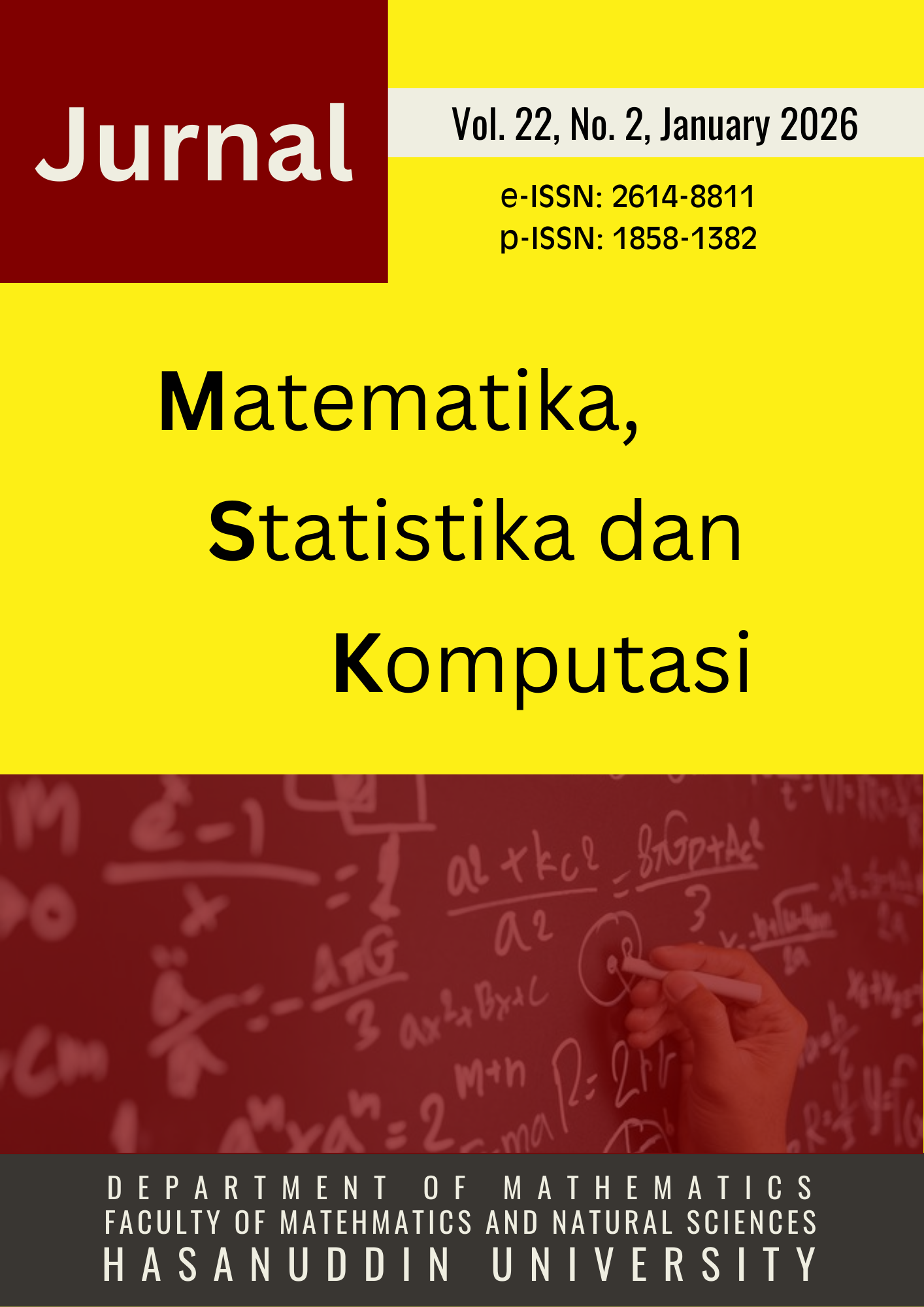
Mathematics Model SAHTR for the Number of Drug Abusers with Economic and Educational Factors
DOI:
https://doi.org/10.20956/j.v22i2.45976Keywords:
Mathematical Model, Drug Abuse, Economic Factor, Educational FactorAbstract
This study develops a mathematical model of drug abuse involving susceptible (S), light users (A), heavy users (H), treatment (T), and recovered (R) compartments, incorporating economic and educational factors. The analysis includes determining equilibrium points, assessing their stability, calculating the basic reproduction number, and performing numerical simulations using the Runge–Kutta Fehlberg method. Results show that the model yields two equilibrium points: drug-free and endemic. Both are stable when the inflow rate into the light-user compartment—affected by effective contact rate, anti-drug campaign effectiveness, and economic conditions—exceeds the outflow rate. Numerical simulations confirm the analytical findings and illustrate that reducing interactions between vulnerable individuals and drug users, strengthening anti-drug campaigns, and improving economic conditions can diminish the potential spread of drug abuse.
References
[1] Alfiniyah, C., Puspitasari, A., & Fatmawati, F., 2023. Mathematical Modelling of Drug Abuse Reduction Strategies taking into account the Treatment Type and Risks Level. Jambura Journal of Biomathematics, 4(1), 23–30.
[2] Andrawus, J., Muhammad, A. I., Denue, B. A., Abdul, H., Yusuf, A., & Salahshour, S., 2024. Unraveling the importance of early awareness strategy on the dynamics of drug addiction using mathematical modeling approach. Chaos: An Interdisciplinary Journal of Nonlinear Science, 34(8).
[3] Anggriani, N., Toaha, S., & Kasbawati, K., 2021. Optimal Control of Mathematical Models on The Dynamics Spread of Drug Abuse. Jurnal Matematika, Statistika dan Komputasi, 17(3), 339–348. https://doi.org/10.20956/j.v17i3.12467
[4] Asih, T. S. N., & Izzah, A. N., 2023. Mathematical model for the spread of drug abuse with the death rate by addiction. In The 8th International Conference on Mathematics, Science And Education 2021. AIP Publishing LLC. https://doi.org/10.1063/5.0125761
[5] Ayati, S., Branch, A., Amirahmadi, R., Branch, A., Esmaeili, A., & Branch, A., 2022. Effective Social and Economic Factors in Youth Dependence on Drug Abuse in Bojnourd ( Lived Experience ). Iranian Sociological Review, 12(1), 11–16.
[6] Badan Narkotika Nasional, 2021. War on Drugs Press Release Kinerja Tahun 2021. Jakarta.
[7] Badan Narkotika Nasional, 2022a. Indikator Kepulihan Pecandu pada Rehabilitasi Rawat Jalan.
[8] Badan Narkotika Nasional, 2022b. Indonesia Drugs Report 2022. Pusat Penilitian, Data, dan Informasi Badan Narkotika Nasional. Jakarta.
[9] Badan Narkotika Nasional., 2022c. Survei Nasional Penyalahgunaan Narkoba 2021. Jakarta: Pusat Penelitian, Data, dan Informasi BNN.
[10] Badan Narkotika Nasional., 2024a. Indonesia Drug Report 2024. Pusat Penilitian, Data, dan Informasi Badan Narkotika Nasional (Vol. 6). Jakarta.
[11] Badan Narkotika Nasional, 2024. Survei Nasional Penyalahgunaan Narkoba 2023. Jakarta: Pusat Penelitian, Data, dan Informasi BNN.
[12] Badan Pusat Statistik, 2022. Jumlah Penduduk Menurut Kelompok Umur dan Jenis Kelamin.
[13] Brauer, F., & Castillo-Chavez, C., 2012. Mathematical Models in Population Biology and Epidemiology. The American Mathematical Monthly (Second, Vol. 110). Springer. https://doi.org/10.1007/978-1-4614-1686-9
[14] Gumiyarna, H., 2021. Gambaran Kualitas Hidup Pasien Penyalahguna Narkoba dengan Metode WHOQOOI Setelah Menjalankan Program Konseling di Klinik Pratama BNN Kota Cimahi. Jurnal Kesehatan Kartika, 16(3), 95–98. https://doi.org/10.26874/jkkes.v16i3.189
[15] Hisyam, C. J., Lutfi, M., Bobsaid, Y., Putra, A. R., Noorhalisa, S., Richter, A. S. B., & Saputra, K., 2025. Pengaruh Relasi Dalam Lingkungan Sosial Terhadap Pelaku Penyalahgunaan Narkoba, 2(1), 1–9. https://doi.org/https://doi.org/10.61722/jirs.v2i1.3543
[16] Izma, H., Intannia, D., Lingga, H. N., Zainah, A., Wiratama, B., Rahmi, F., … Nahdiya, N., 2023. Edukasi Narkoba Kepada Kader dan Karang Taruna di Kelurahan Landasan Ulin Tengah. Jurnal Pengabdian Masyarakat Panacea, 1(3), 70–75. https://doi.org/10.20527/jpmp.v1i3.10191
[17] Kumalasari, K., Rahmah, L., & Hastuti, Y. D., 2022. Edukasi Bahaya Narkoba pada Remaja. Jurnal Inovasi, Pemberdayaan Dan Pengabdian Masyarakat, 2(1), 18–22. https://doi.org/https://doi.org/10.36990/jippm.v2i1.484
[18] Li, J., & Ma, M., 2018. The Analysis of a Drug Transmission Model with Family Education and Public Health Education. Infectious Disease Modelling, 3, 74–84. https://doi.org/10.1016/j.idm.2018.03.007
[19] Lukman, G. A., Alifah, A. P., Divarianti, A., & Humaedi, S., 2021. Kasus Narkoba Di Indonesia Dan Upaya Pencegahannya di Kalangan Remaja. Jurnal Penelitian dan Pengabdian Kepada Masyarakat (JPPM), 2(3), 405–417.
[20] Mamo, D. K., Kinyanjui, M. N., Teklu, S. W., & Hailu, G. K., 2024. Mathematical modeling and analysis of the co-dynamics of crime and drug abuse. Scientific Reports, 14(1), 1–15. https://doi.org/10.1038/s41598-024-75034-8
[21] Raharni, Idaiani, S., & Prihatini, N., 2020. Kekambuhan pada Pasien Penyalahguna Narkotika, Psikotropika, Zat Adiktif (Napza) Pasca Rehabilitasi: Kebijakan dan Program Penanggulangan. Media Penelitian dan Pengembangan Kesehatan, 30(2), 183–198. https://doi.org/10.22435/mpk.v30i2.2699
[22] Resmawan, R., Wijayanti, A. D., Yahya, L., & Nuha, A. R., 2020. Analisis Sensitivitas pada Model Matematika Transmisi Pengguna Narkoba dengan Faktor Edukasi. Jurnal Matematika Integratif, 16(2), 95–103. https://doi.org/10.24198/jmi.v16.n2.28804.95-103
[23] Siregar, R. A., 2021. Hukum Kesehatan Jilid II. (A. Wijayati, Ed.). Jakarta: UKI Press.
[24] Undang-Undang (UU) Nomor 35 Tahun 2009 tentang Narkotika, Pub. L. No. 143, 58, 2009. Indonesia: Lembaran Negara Republik Indonesia Tahun 2009 No. 143, Tambahan No. 5062.
[25] United Nations Office on Drugs and Crime., 2023. World Drug Report 2023. Vienna.
[26] van den Driessche, P., & Watmough, J., 2008. Further Notes on the Basic Reproduction Number. In Lecture Notes in Mathematics (Vol. 1945, pp. 159–178). Springer. https://doi.org/10.1007/978-3-540-78911-6_6
Downloads
Published
Issue
Section
License
Copyright (c) 2026 Jurnal Matematika, Statistika dan Komputasi

This work is licensed under a Creative Commons Attribution 4.0 International License.

This work is licensed under a Creative Commons Attribution 4.0 International License.
Jurnal Matematika, Statistika dan Komputasi is an Open Access journal, all articles are distributed under the terms of the Creative Commons Attribution License, allowing third parties to copy and redistribute the material in any medium or format, transform, and build upon the material, provided the original work is properly cited and states its license. This license allows authors and readers to use all articles, data sets, graphics and appendices in data mining applications, search engines, web sites, blogs and other platforms by providing appropriate reference.