Analysis of Personal Protective Equipment (PPE) Usage in Enhancing Occupational Safety on Board KM. Pantokrator
Article Sidebar
Main Article Content
Abstract
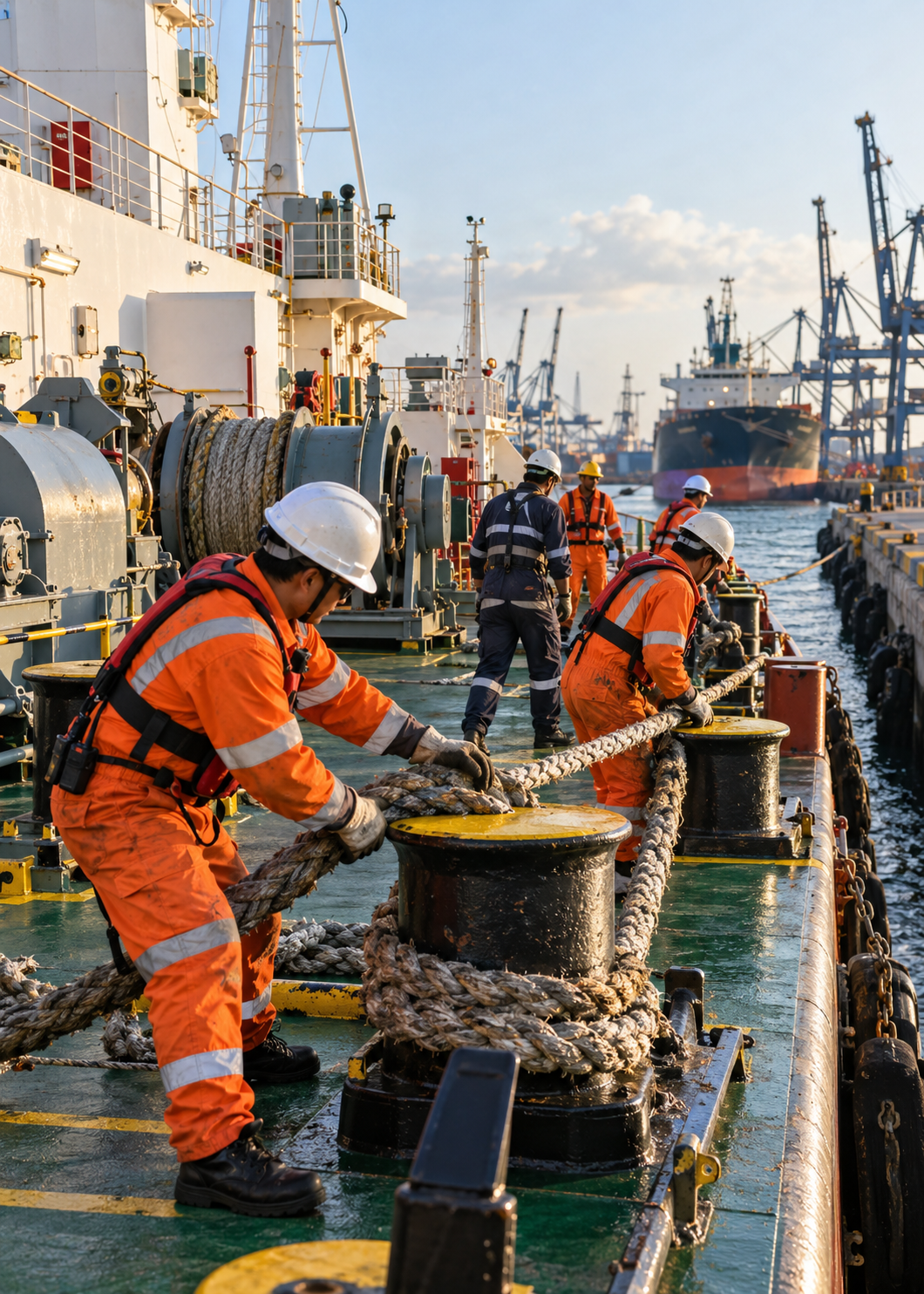
This study examines Personal Protective Equipment (PPE) compliance during ship docking activities on board KM. Pantokrator and identifies factors influencing its implementation. A qualitative descriptive approach was employed during a 12-month sea-practice period from August 2024 to August 2025, with primary observations conducted during the vessel’s docking and maintenance activities at JMI II Semarang from October to December 2024. Data were collected through direct observation, semi-structured interviews with four informants comprising a Third Officer, Bosun, Able Seaman, and Kasap, and supporting documentation. The data were analyzed through qualitative coding supported by NVivo and validated through triangulation of observation, interview, and documentary evidence. The findings show that PPE compliance was inconsistent across work activities, particularly during maintenance tasks such as chipping, painting, grinding, cleaning, and work at height. PPE use was influenced by personal awareness, comfort, supervision, equipment availability, and work culture. Documentary evidence also indicated limitations in PPE availability and procurement fulfillment. Compliance tended to improve when supervision was present but was less consistent during routine work without direct monitoring. The study concludes that improving PPE compliance requires more than providing equipment; it requires systematic supervision, adequate PPE stock management, timely procurement, and reinforcement of a safety culture in shipboard work practices.
Article Details
Issue
Section

This work is licensed under a Creative Commons Attribution 4.0 International License.
How to Cite
References
[1] T.-O. Nævestad, “Safety culture, working conditions and personal injuries in Norwegian maritime transport,” Mar. Policy, vol. 84, pp. 251–262, Oct. 2017, doi: 10.1016/j.marpol.2017.07.019.
[2] Ö. Uğurlu, S. Kum, and Y. V. Aydoğdu, “Analysis of occupational accidents encountered by deck cadets in maritime transportation,” Maritime Policy and Management, vol. 44, no. 3, pp. 304–322, 2017, doi: 10.1080/03088839.2016.1245449.
[3] R. Islam, F. Khan, R. Abbassi, and V. Garaniya, “Human Error Probability Assessment During Maintenance Activities of Marine Systems,” Saf. Health Work, vol. 9, no. 1, pp. 42–52, Mar. 2018, doi: 10.1016/j.shaw.2017.06.008.
[4] M. N. Chowdhury et al., “Navigating Human Factors in Maritime Safety: A Review of Risks and Improvements in Engine Rooms of Ocean-Going Vessels,” International Journal of Safety and Security Engineering, vol. 14, no. 1, pp. 1–14, Feb. 2024, doi: 10.18280/ijsse.140101.
[5] R. Tjahjanto and I. Azis, “Analisis Penyebab Terjadinya Kecelakaan Kerja Di Atas Kapal MV. CS BRAVE,” Kapal, vol. 13, no. 1, Jan. 2016, doi: 10.12777/kpl.13.1.13-18.
[6] I. M. O. (IMO), ISM Code, 2018 Editi. London, United Kingdom: International Maritime Organization, 2018. doi: 10.62454/KD117E.
[7] Occupational Safety and Health Administration (OSHA), “Personal Protective Equipment,” 2023. [Online]. Available: https://www.osha.gov/sites/default/files/publications/OSHA3151.pdf
[8] I. Husna, W. Handoko, Sarifudin, and A. Wijinurhayati, “Effectiveness of the Use of Personal Protective Equipment (Ppe) by Cadet on Board,” 2019. doi: 10.2991/apte-18.2019.31.
[9] I. El Husna, A. Azise, and Sarifuddin, “The Use of Personal Protective Equipment for Reducing Accidental Risk on Board,” 2020. doi: 10.2991/aer.k.200220.031.
[10] A. C. V. Parawansa, N. Cimera, A. R. Y. Prayogi, and D. N. Haqi, “The Relationship between Personal Factors and Behavior of Using Personal Protective Equipment on Workers,” The Indonesian Journal of Occupational Safety and Health, vol. 11, no. 1, pp. 63–71, Mar. 2022, doi: 10.20473/ijosh.v11i1.2022.63-71.
[11] F. Yutimura and M. Haris, “Influence Of Perceptions Of Safety And Programs Occupational Health (POH) On Work Achievement Wear Personal Protective Equipment (PPE) Maritime Task,” The Kalimantan Social Studies Journal, vol. 5, no. 1, p. 44, 2023, doi: 10.20527/kss.v5i1.8477.
[12] Y. Xi, Z. Wang, S. Hu, B. Han, and J. Yin, “The effect of safety culture on the safety behavior of ship deck officers- empirical evidence from shipping industry,” Front. Mar. Sci., vol. 12, no. May, pp. 1–12, 2025, doi: 10.3389/fmars.2025.1599455.
[13] L. Barasa, M. Simanjuntak, and B. W. Syafitra, “Factors affecting the safety climate of the ship’s crew: Empirical