Technical and Financial Evaluation of Marine Seawater Reverse Osmosis (SWRO) Installation on the Tourism Phinisi Vessel KLM GT 255
Article Sidebar
Main Article Content
Abstract
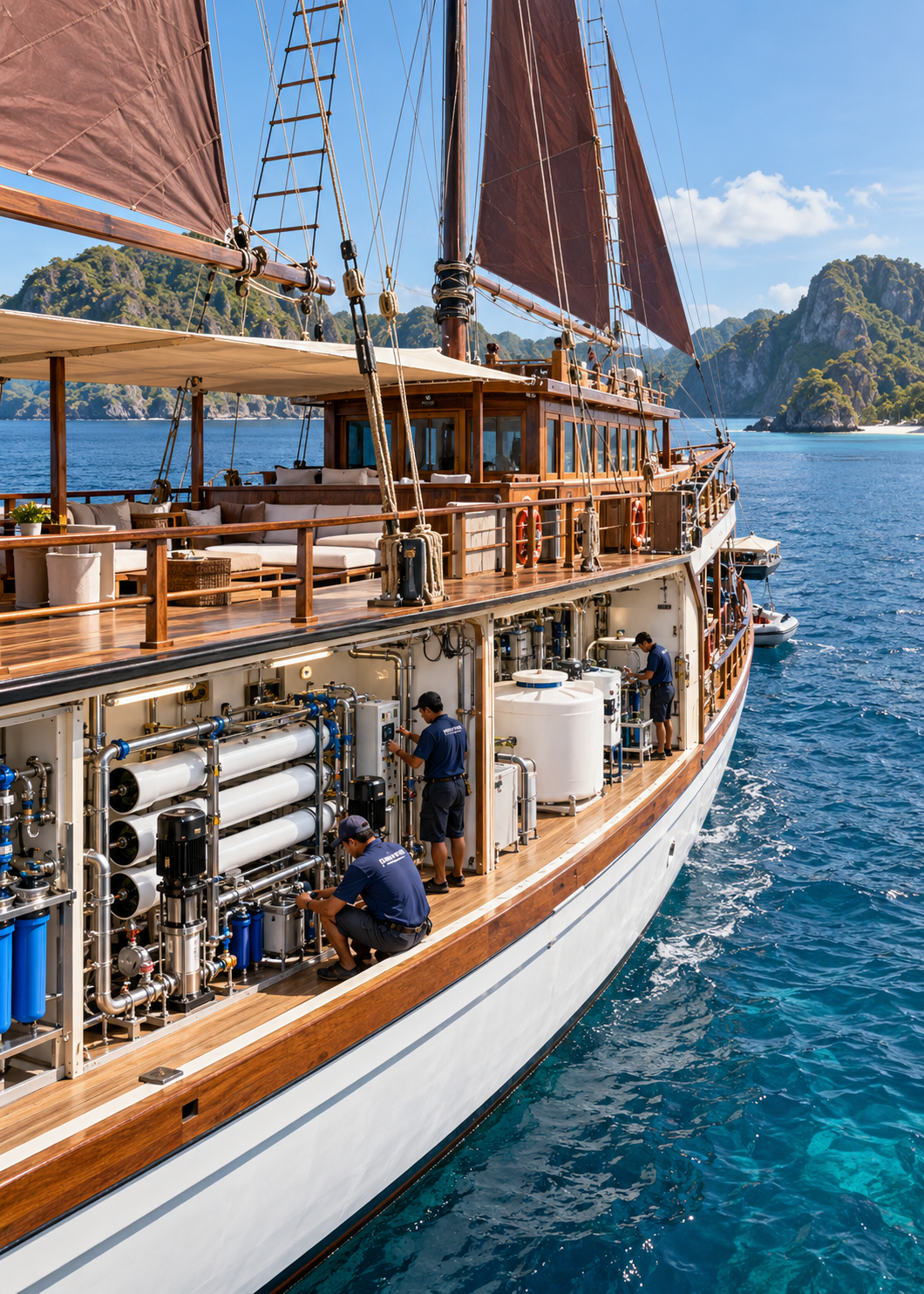
Freshwater availability is a critical operational requirement for liveaboard phinisi vessels, particularly on routes where shore-based supply is limited or costly. This study evaluates the technical feasibility, financial viability, and business-model implications of installing a 15 m³/day marine seawater reverse osmosis (SWRO) system on the tourism phinisi vessel KLM GT 255. The assessment integrates seven-day freshwater balance analysis, engine-room integration and risk assessment using a 5 × 5 risk matrix and Bow-Tie method, financial evaluation using NPV, IRR, BCR, and Payback Period, and strategic analysis using the Business Model Canvas. The results show that the SWRO system can meet the vessel’s estimated freshwater demand of 4.7 m³/day and eliminate deficits during seven-day trips under controlled operation. Product-water TDS was measured at 450 mg/L, while identified integration risks can be reduced to acceptable levels through appropriate operational controls. With a CAPEX of Rp214 million, the Sorong-plus-delivery scenario produced an NPV of Rp344.49 million, an IRR of 41.1%, a BCR of 2.61, and a payback period of 2.35 years. However, financial performance is strongly route dependent and becomes less attractive where low-cost port freshwater is readily available. The BMC analysis indicates that SWRO primarily strengthens operational self-sufficiency, freshwater security, and service continuity rather than creating a new revenue stream. Overall, onboard SWRO is technically feasible and economically attractive for liveaboard operations exposed to high freshwater logistics costs.
Article Details
Issue
Section

This work is licensed under a Creative Commons Attribution 4.0 International License.
How to Cite
References
Rijal, S., Hasan, L.D. & Badollahi, M.Z., 2021. Ekosistem Wisata Budaya Perahu Pinisi. "Melalui Kearifan Lokal Kita Bangkitkan Wisata Budaya".
Arif Fadillah, A., Bondan, K.A.I. & Manullang, S., 2020. Desain Kapal Wisata Jenis Pinisi di Perairan Indonesia Timur.
Syarif, N.F.A., 2023. Revitalisasi Fungsi Pinisi (Dari Usaha Perdagangan ke Pariwisata Maritim).
Gunawan, G. (2020). Modularization of Ship Engine Room Using Design. Engineering Journal, Indonesia.
Khaqiqi, A.S. & Dwianto, A.H., 2020. Desain Kapal Tradisional Pinisi untuk Jaringan Tujuan Wisata Berkelanjutan: Studi Kasus Gugus Kepulauan Selayar.
Ragetisvara, A.A. & Titah, H.S., 2021. Studi Kemampuan Desalinasi Air Laut Menggunakan Sistem Sea Water Reverse Osmosis (SWRO) pada Kapal Pesiar.
Calvo, A.R., Castro, G.A.S., Osorio, F., López, J.G. & Calvo, C., 2014. Reverse Osmosis seawater desalination: current status of membrane systems. Desalination and Water Treatment.
Bahar, R. & Hawlader, M.N.A., 2013. Desalination: Conversion of Seawater to Freshwater. 2nd International Conference on Mechanical, Automotive and Aerospace Engineering (ICMAAE) - Energy, 9, pp.1-8.
Heru Sudibyo, 1996. Perencanaan Sistem Penyediaan Air Tawar di Kapal dengan cara Reverse Osmosis.
Suryadi, 2020. Analisa Teknis Ekonomis Perencanaan Sistem Reverse Osmosis untuk Kebutuhan Air Tawar (Domestic Fresh Water System) pada Kapal Niaga (MT. Avila).
Al-Karaghouli, A., & Kazmerski, L. L. (2013). Energy consumption and water production cost of conventional and renewable-energy-powered desalination processes. Renewable and Sustainable Energy Reviews, 24, 343-356.
Guler, E., Onkal Engin, G., Celen, M., & Sari Erkan, H. (2015). Cost analysis of seawater desalination using an integrated reverse osmosis system on a cruise ship. Global NEST Journal, 17(2), 3.
Marichal Plasencia, G. N., et al. (2021). Energy analysis of a seawater reverse osmosis desalination system for small marine vessels.
World Health Organization (WHO) (2017). Guidelines for Drinking-water Quality, 4th Edition, incorporating the first addendum. Geneva: WHO Press.
Gittinger, J.P. (1982). Economic Analysis of Agricultural Projects. 2nd ed. Baltimore: Johns Hopkins University Press.
Wijaksani, T.T., Nurmalina, R. & Burhanuddin (2019). Analisis kelayakan investasi kapal khusus angkutan ternak di Indonesia: skenario rute Celukan Bawang-Tanjung Priok-Cirebon. Jurnal Transportasi Laut Indonesia.
Nurmalina, R., Sari, D.K. & Karyani, T. (2018). Studi Kelayakan Bisnis. Bogor: IPB Press.
Ardalan, A. (2012). Economic & Financial Analysis for Engineering & Project Management. Graduate School of Management & Technology.
Berk, J. and DeMarzo, P. (2020). Corporate Finance. 5th edn. Boston: Pearson.
Boardman, A.E., Greenberg, D.H., Vining, A.R. and Weimer, D.L. (2018). Cost-Benefit Analysis: Concepts and Practice. 5th edn. Cambridge: Cambridge University Press.
Brealey, R.A., Myers, S.C. and Allen, F. (2020). Principles of Corporate Finance. 13th edn. New York: McGraw-Hill Education.
Damodaran, A. (2015). Applied Corporate Finance. 4th edn. Hoboken, NJ: Wiley.
Ross, S.A., Westerfield, R.W. and Jordan, B.D. (2019). Fundamentals of Corporate Finance. 12th edn. New York: McGraw-Hill Education.
Sullivan, W.G., Wicks, E.M. and Koelling, C.P. (2015). Engineering Economy. 16th edn. Boston: Pearson.
Nazligul, Y.E., Yazir, D. and Sahin, B. (2021). Selection of desalination system for commercial vessels by implementing improved intuitionistic fuzzy TOPSIS method. Journal of Marine Science and Engineering, 9(9), 1-17.
Dagkinis, I.K., Tzannatos, E. & Papadopoulos, A.I., 2023. Modelling of the availability for the ship integrated control system sensors.
American Bureau of Shipping. (2020). Guidance Notes on Risk Assessment Applications for the Marine and Offshore Industries. ABS, Houston.
International Organization for Standardization (ISO). (2018). ISO 31000: Risk management - Guidelines. Geneva: ISO.
Fiksdahl, M. & Wamstad, M.G., 2016. Business models in the maritime industry: A study of how Norwegian maritime actors apply and innovate their business models. Master's Thesis. Trondheim: Norwegian University of Science and Technology (NTNU).
Osterwalder, A. & Pigneur, Y., 2010. Business model generation: A handbook for visionaries, game changers, and challengers. Hoboken, NJ: John Wiley & Sons.