
Accumulation, Composition, Density, and Volume of Marine Litter on Palu Bay
Article Sidebar
Main Article Content
Abstract
Marine litter poses an increasing threat to the coastal ecosystem of Palu Bay, Indonesia, driven by contrasting land-based
human activities. This study assessed the accumulation, composition, density, and volume of macro-debris (>2.5 cm) at
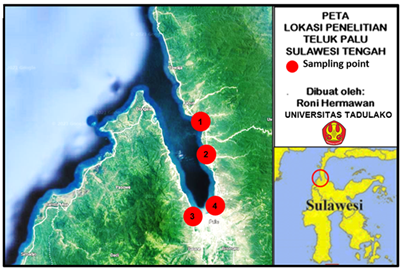
four coastal stations representing residential, river-influenced, and tourism-dominated areas. Surveys were conducted
from June to September 2025 using a line transect method. The results showed marked spatial differences in marine litter
characteristics. Residential and river-influenced sites (Baiya and Mamboro Beaches) recorded the highest debris weights
(4003.67–4378.22 g/m²), dominated by heavier household waste transported via river systems. In contrast, tourism areas
(Taman Ria and Kampung Nelayan Beaches) exhibited lower debris weights (1697.67–1892.37 g/m²) but significantly
higher item densities (14.46–17.28 items/m²) and volumes, reflecting the dominance of lightweight, single-use plastics
from recreational activities. Plastic debris dominated all stations, exceeding 94% in tourism zones. These findings
demonstrate a clear dichotomy in litter sources and characteristics between tourism and residential areas, underscoring
the need for targeted management strategies. Effective mitigation should prioritize single-use plastic restrictions, adequate
waste facilities, and visitor awareness in tourism areas, alongside improved household waste collection and riverine waste
control in residential watersheds. Such source-specific approaches are essential for sustainable coastal management in
Palu Bay and comparable semi-enclosed bays.
Downloads
Article Details

This work is licensed under a Creative Commons Attribution 4.0 International License.
Allow anyone to modify, improve, and make derivative works, even for commercial purposes, as long as they credit to you for the original work.
Accepted 2026-02-21
Published 2026-03-28
References
[1] C. Small and R. J. Nicholls, “A global analysis of human settlement in coastal zones,” J. Coast. Res., pp. 584–599, 2003.
[2] L. Reimann, A. T. Vafeidis, and L. E. Honsel, “Population development as a driver of coastal risk: Current trends and future pathways,” Cambridge Prism. Coast. Futur., vol. 1, p. e14, 2023.
[3] K. MacManus, D. Balk, H. Engin, G. McGranahan, and R. Inman, “Estimating population and urban areas at risk of coastal hazards, 1990–2015: how data choices matter,” Earth Syst. Sci. Data, vol. 13, no. 12, pp. 5747–5801, 2021.
[4] E. M. Lansu et al., “A global analysis of how human infrastructure squeezes sandy coasts,” Nat. Commun., vol. 15, no. 1, p. 432, 2024.
[5] B. A. Williams et al., “Global rarity of intact coastal regions,” Conserv. Biol., vol. 36, no. 4, p. e13874, 2022.
[6] G. Anfuso, M. Postacchini, D. Di Luccio, and G. Benassai, “Coastal sensitivity/vulnerability characterization and adaptation strategies: A review,” J. Mar. Sci. Eng., vol. 9, no. 1, p. 72, 2021.
[7] R. Hermawan et al., “Analisis Cemaran Mikroplastik Di Pesisir Teluk Palu, Sulawesi Tengah,” JAGO TOLIS J. Agrokompleks Tolis, vol. 3, no. 2, p. 68, 2023, doi: 10.56630/jago.v3i2.294.
[8] K. L. Nash et al., “Oceans and society: feedbacks between ocean and human health,” Rev. Fish Biol. Fish., vol. 32, no. 1, pp. 161–187, 2022.
[9] M. Iamkovaia, M. Arcila, F. Cardoso Martins, and A. Izquierdo, “Sustainable development of coastal food services,” Sustainability, vol. 11, no. 13, p. 3728, 2019.
[10] I. Kusumawati, M. Setyowati, and I. Y. Salena, “Identifikasi komposisi sampah laut di pesisir Aceh Barat,” J. Perikan. Trop., vol. 5, no. 1, pp. 59–69, 2018.
[11] J. Jambeck et al., “Plastic waste inputs from land into the ocean,” Science (80-. )., vol. 347, no. 6223, pp. 768–771, 2015.
[12] Y. Liang, Q. Tan, Q. Song, and J. Li, “An analysis of the plastic waste trade and management in Asia,” Waste Manag., vol. 119, pp. 242–253, 2021, doi: 10.1016/j.wasman.2020.09.049.
[13] K. K. La Daana, H. Asmath, and J. F. Gobin, “The status of marine debris/litter and plastic pollution in the Caribbean Large Marine Ecosystem (CLME): 1980–2020,” Environ. Pollut., vol. 300, p. 118919, 2022.
[14] S. Katsanevakis, “Marine debris, a growing problem: Sources, distribution, composition, and impacts,” Mar. Pollut. New Res. Nov. Sci. Publ. New York, pp. 53–100, 2008.
[15] A. Vahmanetta, “The impact of economic factors on annual waste generation in Indonesia,” in IOP Conference Series: Earth and Environmental Science, IOP Publishing, 2025, p. 12031.
[16] KLHK, “Pemantauan Sampah Laut Indonesia Tahun 2017,” pp. 1–46, 2017.
[17] M. Liro, A. Zielonka, and T. H. M. van Emmerik, “Macroplastic fragmentation in rivers,” Environ. Int., vol. 180, no. May, p. 108186, 2023, doi: 10.1016/j.envint.2023.108186.
[18] S. Lippiatt, O. Sarah, and A. Courtney, “NOAA (National Oceanic and Atmospheric Administration) Marine Debris Monitoring and Assessment: Recommendations for Monitoring Debris Trends in the Marine Environment,” NOAA Tech. Memo, no. November, pp. 1–88, 2013.
[19] R. Hermawan, A. Damar, and S. Hariyadi, “Daily Accumulation and Impacts of Marine Litter on The Shores of Selayar Island Coast, South Sulawesi,” Waste Technol., vol. 5, no. 1, pp. 15–20, 2017, doi: 10.12777/wastech.5.1.
[20] L. J. J. Meijer, T. Van Emmerik, R. Van Der Ent, C. Schmidt, and L. Lebreton, “More than 1000 rivers account for 80% of global riverine plastic emissions into the ocean,” Sci. Adv., vol. 7, no. 18, p. eaaz5803, 2021.
[21] C. Schmidt, T. Krauth, and S. Wagner, “Export of plastic debris by rivers into the sea,” Environ. Sci. Technol., vol. 51, no. 21, pp. 12246–12253, 2017.
[22] M. Strokal, P. Vriend, M. P. Bak, C. Kroeze, J. van Wijnen, and T. van Emmerik, “River export of macro-and microplastics to seas by sources worldwide,” Nat. Commun., vol. 14, no. 1, p. 4842, 2023.
[23] B. R. Suseno, P. Gatra, R. M. D. Daulay, and W. B. Serworwora, “THE problem of waste in rivers and seas and their effects on water quality using the dpsir method,” J. Ekon., vol. 12, no. 01, pp. 647–659, 2023.
[24] H. Herdiansyah, H. G. Saiya, K. I. I. Afkarina, and T. L. Indra, “Coastal community perspective, waste density, and spatial area toward sustainable waste management (Case study: Ambon bay, Indonesia),” Sustainability, vol. 13, no. 19, p. 10947, 2021.
[25] F.-C. Mihai et al., “Plastic pollution, waste management issues, and circular economy opportunities in rural communities,” Sustainability, vol. 14, no. 1, p. 20, 2021.
[26] E. Sutrisno, “The study of river pollution related to domestic waste in the perspective of community legal culture,” South East Asia J. Contemp. Business, Econ. Law, vol. 12, no. 4, p. 134, 2017.
[27] A. L. Wynne, P. M. Nieves, V. M. Vulava, H. N. Qirko, and T. J. Callahan, “A community-based approach to solid waste management for riverine and coastal resource sustainability in the Philippines,” Ocean Coast. Manag., vol. 151, pp. 36–44, 2018.
[28] D. Chikodzi, K. Dube, and N. Ngcobo, “Rethinking harbours, beaches and urban estuaries waste management under climate-induced floods in South Africa,” in The increasing risk of floods and tornadoes in Southern Africa, Springer, 2021, pp. 127–140.
[29] A. Damar and S. Hariyadi, “Current Source and Distribution Pattern of Plastic Waste Leakage in the Estuary of Jakarta Bay,” in IOP Conference Series: Earth and Environmental Science, IOP Publishing, 2022, p. 12057.
[30] Y. Mellink et al., “Overcoming oceans of ignorance: What you should know about plastic waste before it enters the sea,” in Plastic pollution in the global ocean, 2023, pp. 47–75.
[31] B. Nyberg, P. T. Harris, I. Kane, and T. Maes, “Leaving a plastic legacy: Current and future scenarios for mismanaged plastic waste in rivers,” Sci. Total Environ., vol. 869, p. 161821, 2023.
[32] C. N. Gideran, “Indonesia Tourism Pandemic Coastal Plastic Waste: a Compre-hensive Review: Indonesia Tourism Pandemic Coastal Plastic Waste: a Compre-hensive Review,” J. Oceanogr. Aquat. Sci., vol. 1, no. 1, pp. 14–19, 2023.
[33] M. Grelaud and P. Ziveri, “The generation of marine litter in Mediterranean island beaches as an effect of tourism and its mitigation,” Sci. Rep., vol. 10, no. 1, p. 20326, 2020.
[34] H. Hailuddin, M. Suryatni, I. Yuliadi, S. Canon, S. Syaparuddin, and E. Endri, “Beach area development strategy as the prime tourism area in Indonesia,” J. Environ. Manag. Tour., vol. 13, no. 2, pp. 414–426, 2022.
[35] P. Hindayani, A. Khosihan, and A. R. Pratama, “Can marine debris pollution cause the loss of tourism revenue in Indonesia? An empirical study,” in Promoting Creative Tourism: Current Issues in Tourism Research, Routledge, 2021, pp. 289–296.
[36] A. S. Jayantri and M. A. Ridlo, “Strategi pengelolaan sampah di kawasan pantai,” J. Kaji. Ruang, vol. 1, no. 2, 2021.
[37] L. Puspita and M. Karmini, “PENANGANAN SAMPAH DI TEMPAT WISATA PANTAI X TAHUN 2023,” J. Ris. Kesehat. POLTEKKES DEPKES BANDUNG, vol. 16, no. 2, pp. 411–421, 2024.
[38] I. W. K. Suryawan, “Kontribusi Limbah Kayu Daratan terhadap Sampah Laut di Pesisir Selatan Bali: Tinjauan Antropogenik dan Strategi Adaptasi Berbasis Ekosistem,” J. Serambi Eng., vol. 10, no. 2, 2025.
[39] K. HALAWA and H. LISTYORINI, “Provision and Development of Tourism Amenities in the Context of Tourist Comfort and Sustainability in Economic, Socio-Cultural and Environmental Identity of Tourism Villages,” J. Tour. Econ. Policy, vol. 5, no. 3, pp. 373–384, 2025.
[40] M. F. Rahmatika and A. Suman, “Improving the economy of local communities through innovation of the potential of shariah-based natural tourism in East Java,” Int. J. Relig. Tour. Pilgr., vol. 8, no. 4, p. 8, 2020.
[41] I. A. Kurnia and N. K. Pandjaitan, “Peranan Modal Sosial Dalam Resiliensi Komunitas Rawan Bencana Tsunami,” J. Sains Komun. Dan Pengemb. Masy. [JSKPM], vol. 5, no. 1, pp. 85–104, 2021.
[42] Y. Pramudika, “KAJIAN KEBIJAKAN TATA RUANG PASCA BENCANA : STUDI DI DESA TOMPE , DONGGALA , SULAWESI TENGAH POST DISASTER SPATIAL PLANNING POLICY STUDY : A STUDY IN TOMPE VILLAGE , DONGGALA , CENTRAL SULAWESI,” pp. 81–90, 2024.
[43] T. M. Mathew and S. P. Thampi, “The Level of Awareness and the Impact of Age Factor on the Awareness of Visitor Management”.
[44] J. McAllister, “Factors influencing solid-waste management in the developing world,” 2015.