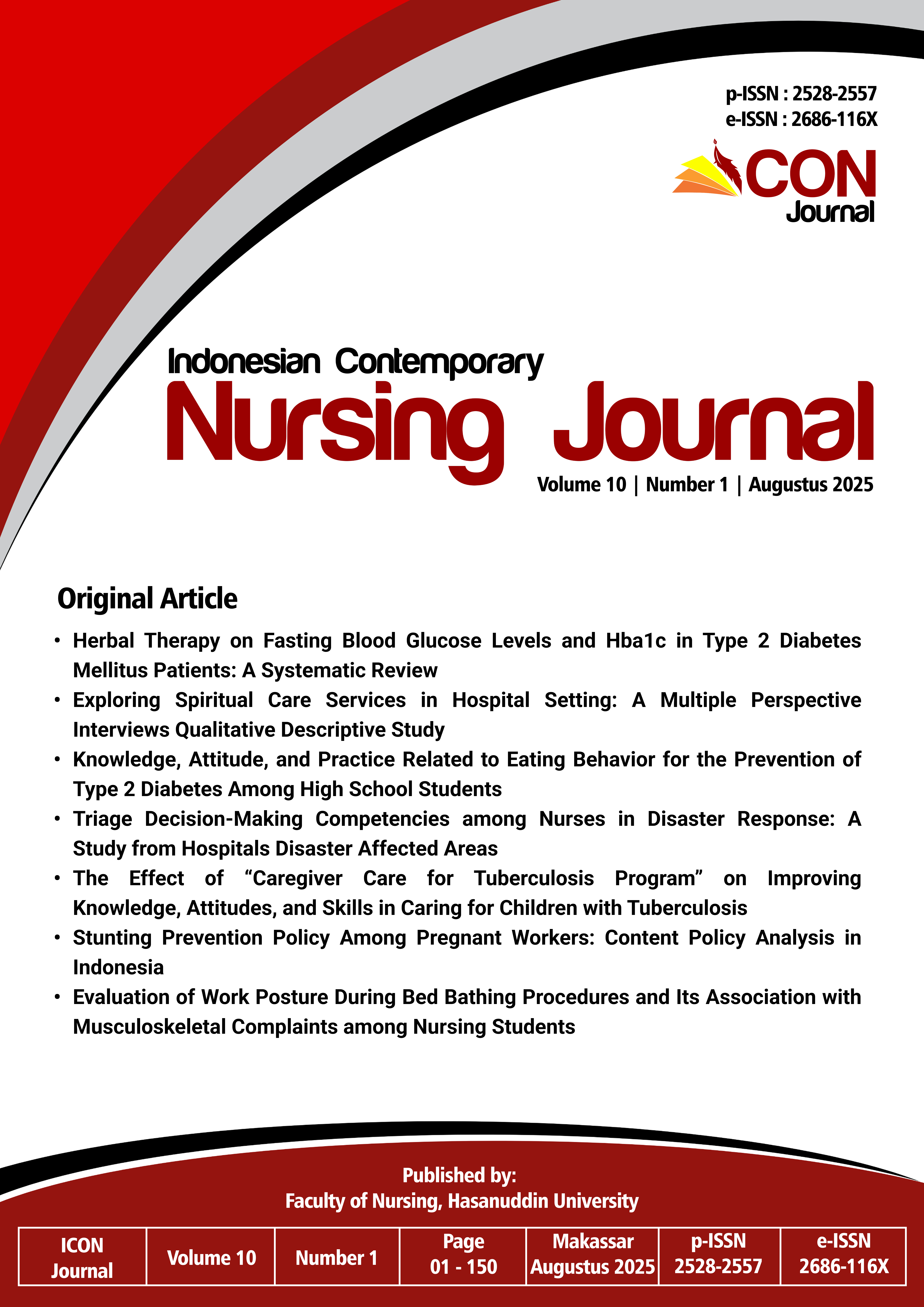
Exploring Spiritual Care Services in Hospital Settings: A Multiple-Perspective Interviews Qualitative Descriptive Study
DOI:
https://doi.org/10.20956/icon.v10i1.43577Keywords:
barriers and challenges, health services, regulation, spiritual care, spiritual knowledgeAbstract
Aims: This study explored spiritual care services in a hospital setting from multiple perspectives.
Methods: We used a descriptive qualitative method based on a social-ecological model. Participants were selected using purposive sampling and classified into intrapersonal (five patients), interpersonal (five family members), community (five nurses in charge), institutional (three nurse leaders and managers), and regulation (protocol or spiritual care guidelines). Data were collected through semi-structured in-depth interviews. Data analysis was performed to identify themes using Colaizzi’s method.
Results: Themes were extracted according to the socio-ecological model, which was classified into intrapersonal, interpersonal, community, institutional, and public policy-related themes. These themes are patients’ spiritual care needs, spiritual care barriers, spiritual care facilities, spiritual care support, and spiritual care regulation.
Conclusion: Current study offers insights into spiritual care services, particularly in hospitals located in rural areas. We suggest that providing spiritual care among patients and family members is crucial as part of the patients’ needs while they are in the hospital. Thus, spiritual care should be considered as a priority in healthcare services by providing spiritual care facilities, support, and policies. However, many challenges in providing spiritual care must be addressed.
References
Adib-Hajbaghery, M., Zehtabchi, S., & Fini, I. A. (2017). Iranian nurses' professional competence in spiritual care in 2014. Nurs Ethics, 24(4), 462-473. https://doi.org/10.1177/0969733015600910
Ann Cutler, N., Halcomb, E., & Sim, J. (2021). A naturalistic inquiry was used to inform the qualitative description. Nurse Res, 29(3), 29-33. https://doi.org/10.7748/nr.2021.e1788
Asadzandi, M., Mazandarani, H. A., Saffari, M., & Khaghanizadeh, M. (2022). Effect of spiritual care based on the sound heart model on spiritual experiences of hemodialysis patients. J Relig Health, 61(3), 2056-2071. https://doi.org/10.1007/s10943-021-01396-2
Bakir, E., Samancioglu, S., & Kilic, S. P. (2017). Spiritual experiences of muslim critical care nurses. J Relig Health, 56(6), 2118-2128. https://doi.org/10.1007/s10943-017-0382-4
Braun, V., & Clarke, V. (2023). Is thematic analysis used well in health psychology? A critical review of published research, with recommendations for quality practice and reporting. Health Psychol Rev, 17(4), 695-718. https://doi.org/10.1080/17437199.2022.2161594
Colaizzi, P. F. (1978). Psychological research as the phenomenologist views it. In R. S. Valle & M. E. King (Eds.), Existential-phenomenological alternatives for psychology (pp. 48–710). Oxford University Press.
Cruz, J. P., Alquwez, N., Albaqawi, H. M., Alharbi, S. M., & Moreno-Lacalle, R. C. (2018). Nurses' perceived spiritual climate of a hospital in Saudi Arabia. Int Nurs Rev, 65(4), 559-566. https://doi.org/10.1111/inr.12481
Dündar, M., & Aslan, H. (2022). Association Between Nurses' Spirituality and Frequency of Spiritual Therapeutic Care in Turkey. J Relig Health, 61(3), 1922-1935. https://doi.org/10.1007/s10943-022-01499-4
Herlianita, R., Yen, M., Chen, C. H., Fetzer, S. J., & Lin, E. C. (2018). Perception of spirituality and spiritual care among muslim nurses in Indonesia. J Relig Health, 57(2), 762-773. https://doi.org/10.1007/s10943-017-0437-6
Hvidt, N. C., Nielsen, K. T., Kørup, A. K., Prinds, C., Hansen, D. G., Viftrup, D. T., Assing Hvidt, E., Hammer, E. R., Falkø, E., Locher, F., Boelsbjerg, H. B., Wallin, J. A., Thomsen, K. F., Schrøder, K., Moestrup, L., Nissen, R. D., Stewart-Ferrer, S., Stripp, T. K., Steenfeldt, V.,…Wæhrens, E. E. (2020). What is spiritual care? Professional perspectives on the concept of spiritual care identified through group concept mapping. BMJ Open, 10(12), e042142. https://doi.org/10.1136/bmjopen-2020-042142
Khezri, E., Bagheri-Saveh, M. I., Kalhor, M. M., Rahnama, M., Roshani, D., & Salehi, K. (2022). Nursing care based on the Support-Based Spiritual Care Model increases hope among women with breast cancer in Iran. Supportive Care in Cancer, 30, 423-429. https://doi.org/10.1007/s00520-021-06413-4
Kincheloe, D. D., Stallings Welden, L. M., & White, A. (2018). A Spiritual Care Toolkit: An evidence‐based solution to meet spiritual needs. Journal of Clinical Nursing, 27(7-8), 1612-1620. https://doi.org/10.1111/jocn.14265
Kırca, K., Özveren, H., & Bağcı, S. (2024). Evaluation of the spiritual care needs of patients with cancer in a chemotherapy unit in turkey. J Relig Health, 63(2), 1457-1474. https://doi.org/10.1007/s10943-023-01876-7
Komalasari, R., Wilson, S., & Haw, S. (2021). A social ecological model (SEM) to exploring barriers of and facilitators to the implementation of opioid agonist treatment (OAT) programmes in prisons. Int J Prison Health, 17(4), 477-496. https://doi.org/10.1108/ijph-04-2020-0020
Mahilall, R., & Swartz, L. (2021). Spiritual care: Motivations and experiences through the lenses and voices of a cohort of spiritual care workers at an established hospice in Cape Town, South Africa. Journal of Religion and Health, 60(4), 2906-2924. https://doi.org/10.1007/s10943-021-01232-7
McLeroy, K. R., Bibeau, D., Steckler, A., & Glanz, K. (1988). An ecological perspective on health promotion programs. Health Educ Q, 15(4), 351-377. https://doi.org/10.1177/109019818801500401
Memaryan, N., Ghaempanah, Z., Aghababaei, N., & Koenig, H. G. (2020). Integration of spiritual care in hospital care system in Iran. Journal of Religion and Health, 59(1), 82-95. https://doi.org/10.1007/s10943-019-00864-0
Moosavi, S., Rohani, C., Borhani, F., & Akbari, M. E. (2019). Factors affecting spiritual care practices of oncology nurses: a qualitative study. Supportive Care in Cancer, 27, 901-909. https://doi.org/10.1007/s00520-018-4378-8
Nuridah, N., Burhanuddin, Y. E., & Yodang, Y. (2022). Hambatan Pelayanan Ibadah Dalam Spiritual Care Pada Perspektif Sosioecological Model: Studi Fenomenologi. Jurnal Endurance: Kajian Ilmiah Problema Kesehatan, 7(3), 634-642. https://doi.org/10.22216/jen.v7i3.1678
Nuridah, N., & Yodang, Y. (2020). Hambatan penerapan pelayanan asuhan keperawatan spritual di rumah sakit. Jurnal Endurance: Kajian Ilmiah Problema Kesehatan, 5(3), 615-623. https://doi.org/10.22216/jen.v5i3.4735
Özveren, H., Karabey, T., & Gülnar, E. (2022). Spiritual Care Needs of Patients with Urinary Incontinence and Affecting Factors: A Cross-Sectional Descriptive Study in Turkey. J Relig Health, 61(6), 4433-4449. https://doi.org/10.1007/s10943-022-01613-6
Polit, D. F., & Beck, C. T. (2017). Nursing research: Generating and assessing evidence for nursing practice (10 ed.). Wolters Kluwer.
Rhyu, K., Lee, G., & Baek, H. (2023). Association among workplace spirituality, spiritual well-being, and spiritual care in practice with multiple mediators for clinical nurses. The Journal of Continuing Education in Nursing, 54(2), 89-96. https://doi.org/10.3928/00220124-20230113-08
Rushton, L. (2014). What are the barriers to spiritual care in a hospital setting? Br J Nurs, 23(7), 370-374. https://doi.org/10.12968/bjon.2014.23.7.370
Sandelowski, M. (2010). What's in a name? Qualitative description revisited. Res Nurs Health, 33(1), 77-84. https://doi.org/10.1002/nur.20362
Seid, K., & Abdo, A. (2022). Nurse’s spiritual care competence in Ethiopia: A multicenter cross-sectional study. PLoS ONE, 17(3), e0265205. https://doi.org/10.1371/journal.pone.0265205
Taylor, J. J., Hodgson, J. L., Kolobova, I., Lamson, A. L., Sira, N., & Musick, D. (2015). Exploring the phenomenon of spiritual care between hospital chaplains and hospital based healthcare providers. Journal of Health Care Chaplaincy, 21(3), 91-107. https://doi.org/10.1080/08854726.2015.1015302
Toker, K., & Çınar, F. (2018). Perceptions of spirituality and spiritual care of health professionals working in a state hospital. Religions, 9(10), 312. https://doi.org/10.3390/rel9100312
Willemse, S., Smeets, W., Van Leeuwen, E., Janssen, L., & Foudraine, N. (2018). Spiritual care in the ICU: Perspectives of Dutch intensivists, ICU nurses, and spiritual caregivers. Journal of Religion and Health, 57, 583-595. https://doi.org/10.1007/s10943-017-0457-2
Wirihana, L., Welch, A., Williamson, M., Christensen, M., Bakon, S., & Craft, J. (2018). Using Colaizzi's method of data analysis to explore the experiences of nurse academics teaching on satellite campuses. Nurse Res, 25(4), 30-34. https://doi.org/10.7748/nr.2018.e1516
World_Medical_Association. (2025). World Medical Association Declaration of Helsinki: Ethical Principles for Medical Research Involving Human Participants. JAMA, 333(1), 71-74. https://doi.org/10.1001/jama.2024.21972
Zambezi, M., Emmamally, W., & Mooi, N. (2022). Spiritual care: A description of family members' preferences of spiritual care nursing practices in intensive care units in a private hospital in Kwa-Zulu Natal, South Africa. Healthcare (Basel), 10(4), 595-604. https://doi.org/10.3390/healthcare10040595
Downloads
Published
Issue
Section
License
Authors who publish with this journal agree to the following terms:Authors retain copyright and grant the journal right of first publication with the work simultaneously licensed under a Creative Commons Attribution License that allows others to share the work with an acknowledgement of the work's authorship and initial publication in this journal.
Authors are able to enter into separate, additional contractual arrangements for the non-exclusive distribution of the journal's published version of the work (e.g., post it to an institutional repository or publish it in a book), with an acknowledgement of its initial publication in this journal.
Authors are permitted and encouraged to post their work online (e.g., in institutional repositories or on their website) prior to and during the submission process, as it can lead to productive exchanges, as well as earlier and greater citation of published work (See The Effect of Open Access).