
Reef-Associated Demersal Fishes Caught by Bottom Gillnets in The Coastal Waters of Kaleheng Beach, Kuma 1 Village, Sangihe Regency
Article Sidebar
Main Article Content
Abstract
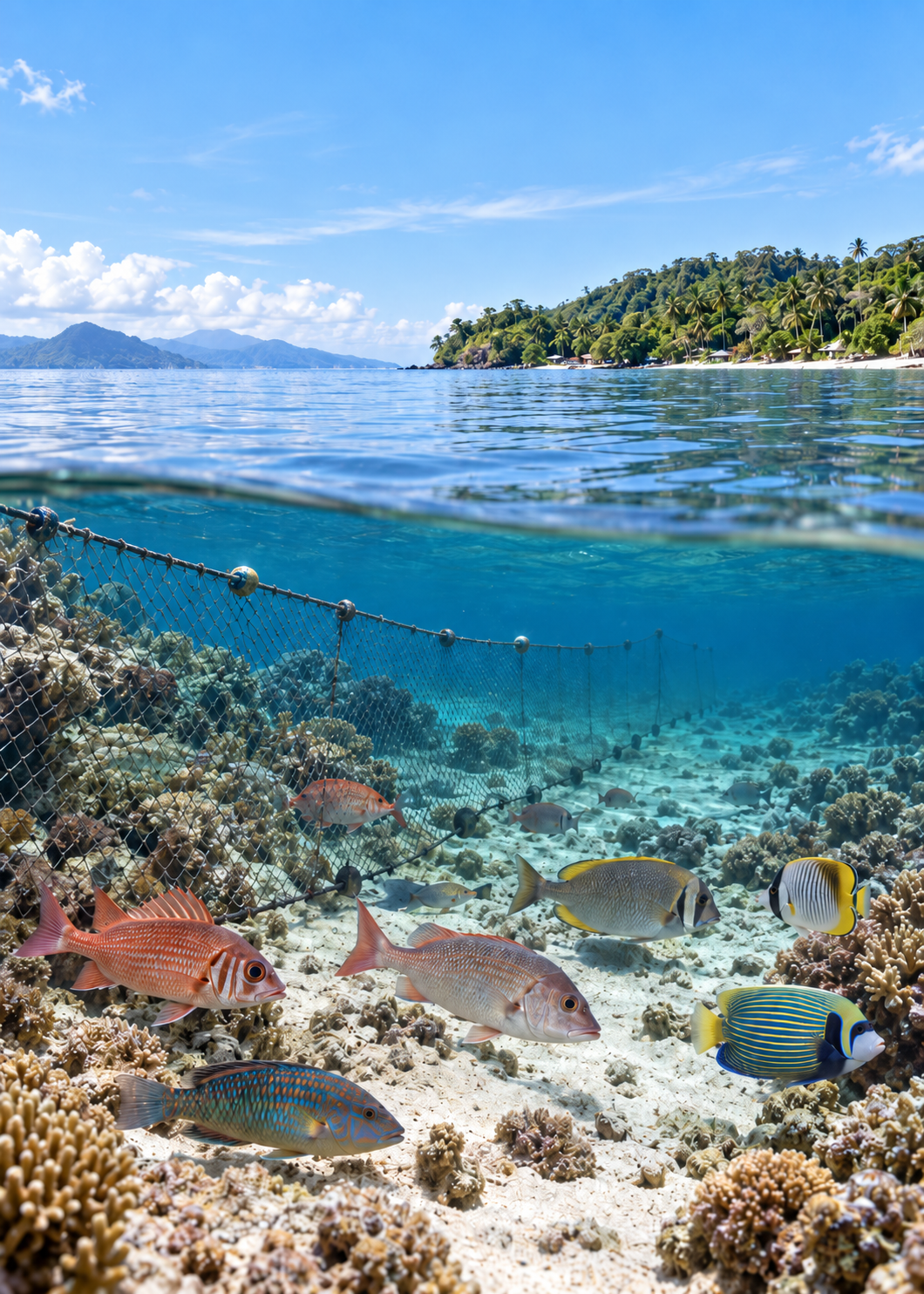
Set bottom gillnets are a selective fishing gear widely used by traditional fishers in the coastal waters of the Sangihe Islands. This study aims to identify the species composition of Reef-associated demersal fishes caught by set bottom gillnets and to analyze the catching mechanisms based on fish morphology and behavioral characteristics. The study was conducted using an experimental fishing method by operating four units of set bottom gillnets locally known as Soma Tataing in the coastal waters of Kaleheng Beach, Kuma 1 Village, Tabukan Tengah District, from July to November 2025. A descriptive quantitative approach was applied through direct observation of fishing operation time, fishing ground location, water depth, species composition, abundance, and catching mechanisms of the fish. The results showed that the set bottom gillnets caught 59 individual fishes comprising 16 genera and 26 demersal fish species. The family Holocentridae dominated the catch, accounting for 26% of the total catch, while Zebrasoma velifer was the least captured species. Analysis of catching mechanisms revealed four main capture modes, namely snagged, gilled, wedged, and entangled. These mechanisms were strongly influenced by fish body shape, protruding body parts, and fish behavioral responses to the presence of the gillnet. The findings indicate that the effectiveness and selectivity of set bottom gillnets are closely related to the suitability of fishing ground characteristics with demersal fish habitats and their movement patterns. This study provides important insights into the development of environmentally friendly and sustainable fishing technologies in small island coastal waters.
Article Details
Issue
Section

This work is licensed under a Creative Commons Attribution 4.0 International License.
How to Cite
References
[1] H. Sudirman and A. Mallawa, Teknik Penangkapan Ikan, rev. ed. Jakarta, Indonesia: Rineka Cipta, 2012.
[2] Najamuddin, Rancang Bangun Alat Penangkapan Ikan. Makassar, Indonesia: Arus Timur, 2012.
[3] S. Martasuganda, Jaring Insang (Gillnet): Teknologi Penangkapan Ikan Berwawasan Lingkungan. Bogor, Indonesia: Fakultas Perikanan dan Ilmu Kelautan, Institut Pertanian Bogor, 2002.
[4] M. Syahdan, Kajian Tingkah Laku Ikan terhadap Alat Tangkap Gillnet. Bogor, Indonesia: Institut Pertanian Bogor, 2002.
[5] M. M. K. Fahmi, “Komposisi hasil tangkapan jaring insang (gillnet) berdasarkan cara tertangkapnya di Instalasi Pelabuhan Perikanan Puger Kabupaten Jember Jawa Timur,” Skripsi, Fakultas Perikanan dan Ilmu Kelautan, Universitas Brawijaya, Malang, Indonesia, 2016.
[6] J. Tamarol, A. Luasunaung, and J. Budiman, “Dampak perikanan tangkap terhadap sumberdaya ikan dan habitatnya di perairan Pantai Tabukan Tengah Kepulauan Sangihe,” Jurnal Perikanan dan Kelautan Tropis, vol. 8, no. 1, 2012.
[7] G. Allen, Marine Fishes of South-East Asia: A Field Guide for Anglers and Divers. Hong Kong: Periplus Editions, 1999.
[8] M. Bergbauer and M. Kirschner, Reef Fishes of the Indo-Pacific. Oxford, U.K.: John Beaufoy Publishing Limited, 2014.
[9] M. Baskoro and A. A. Taurusman, Tingkah Laku Ikan: Hubungannya dengan Ilmu dan Teknologi Perikanan Tangkap. Bandung, Indonesia: Lubuk Agung, 2011.
[10] H. Latuconsina, R. Affandi, M. M. Kamal, and N. A. Butet, “Distribusi spasial ikan beronang Siganus canaliculatus Park, 1797 pada habitat padang lamun berbeda di Teluk Ambon Dalam,” Jurnal Ilmu dan Teknologi Kelautan Tropis, vol. 12, no. 1, pp. 89–106, 2020, doi: 10.29244/jitkt.v12i1.27908.
[11] S. A. Fakhri, I. Riyantini, D. P. Juliandri, and H. Hamdani, “Korelasi kelimpahan ikan beronang (Siganus spp.) dengan ekosistem padang lamun di perairan Pulau Pramuka Taman Nasional Kepulauan Seribu,” Jurnal Perikanan dan Kelautan, vol. 7, no. 1, 2016.
[12] N. Muandri, Asriyanto, and T. Yulianto, “Hubungan jenis umpan dan ukuran mata pancing alat tangkap rawai dasar terhadap hasil tangkapan ikan kakap (Lutjanus spp.) di perairan Pasir, Kebumen,” Journal of Fisheries Utilization Management and Technology, vol. 2, no. 3, pp. 82–89, 2013.