
Risk Analysis of Tugboat Cooling System Using FSA and FMEA Based on Accident Data
Article Sidebar
Main Article Content
Abstract
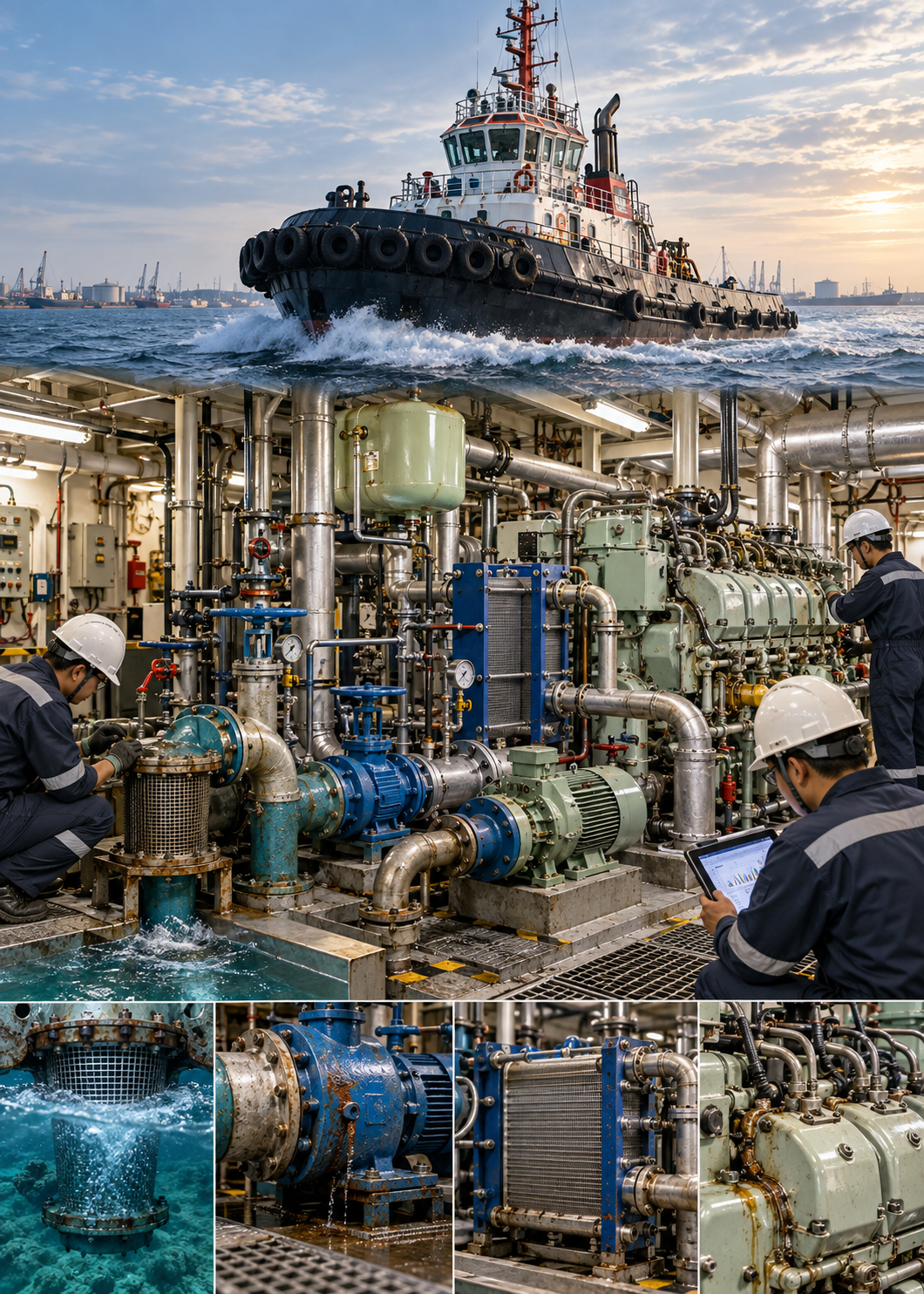
Tugboats play an essential role in port activities, but their cooling systems are vulnerable to failures that can potentially trigger serious accidents. This study aims to analyze the risks of tugboat cooling systems through a Formal Safety Assessment (FSA) using the Failure Mode and Effects Analysis (FMEA) method based on field surveys and accident data. Data collection was conducted via questionnaires to 12 engine room crew (including the Chief Engine Room Officer, Engineer, and Technician) and the accident investigation report of TB. Kawan Kita XI (2025), which was used as external validation by cross-refencing the documented failure causes with the high-priority FMEA result. This study identified 14 failure modes in 9 key components of the cooling system, assessed based on severity (Severity), frequency (Occurrence), and detection (Detection) on a scale of 1–10. The average value of the 12 respondents was used to calculate the Risk Priority Number (RPN) and Pareto analysis. Key findings revealed six priority risks: mechanical seal leakage (RPN=405), cylinder head cooling jacket cracking (RPN=300), freshwater pump bearing failure (RPN=243), sea chest strainer corrosion (RPN=216), temperature control valve sticking (RPN=216), and internal cooler leakage (RPN=168). These six modes accounted for 82.6% of the total risk, consistent with the Pareto principle. The uniqueness of this study lies in the integration of multi-vessel survey data, a more accurate 1–10 rating scale, and validation from actual accidents. Recommendations include preventive seal replacement, installation of leak sensors, regular valve maintenance, and anti-corrosion protection. This study contributes to strengthening the operational safety of tugboats in Indonesia.
Article Details
Issue
Section

This work is licensed under a Creative Commons Attribution 4.0 International License.
How to Cite
References
[1] D. Priyanta, N. Siswantoro, and M. N. Pratiwi, “Implementation of Reliability Centered Maintenance Method for the Main Engine of Tugboat X to Select the Maintenance Task and Schedule,” Int. J. Mar. Eng. Innov. Res., vol. 5, no. 2, pp. 102–110, 2020, doi: 10.12962/j25481479.v5i2.7031.
[2] A. S. N, S. Klara, and M. I. Nikmatullah, “Efektivitas Keel Cooler pada Sistem Pendingin Mesin Penggerak Utama Kapal,” vol. 28, no. 1, pp. 26–31, 2024, doi: 10.25042/jpe.052024.05.
[3] M. Fmea, “Proceeding Maritime Business Management Conference Program Studi D4 Manajemen Bisnis – Politeknik Perkapalan Negeri Surabaya,” vol. 03, no. 01, 2024.
[4] M. Badrus, T. Pitana, N. Siswantoro, and F. Hanugrah, “Application Of Reliability -Centered Maintenance For Tugboat Kresna 315 Cooling Systems,” 2020, doi: 10.35741/issn.0258-2724.55.4.51.
[5] W. REZKY, “ANALISIS KEGAGALAN SISTEM PENDINGIN KAPAL TUGBOAT MENGGUNAKAN PRELIMINARY HAZARD ANALYSIS (PHA) DAN FAULT TREE ANALYSIS (FTA),” Universitas Hasanuddin, 2024.
[6] T. P. Lindyawati, N. Arumsari, and A. Sa, “Perbandingan Model Peluang Kegagalan Pada Sistem Pendingin Main engine Crew Boat 41 GT,” no. 2655, 2025, doi: 10.33863/cmea.v6i1.2632.
[7] E. Science, “Failure Mode and Effect Criticality Analysis ( FMECA ) Fuzzy to Evaluate Critical Level on Main Engine Supporting System Failure Mode and Effect Criticality Analysis ( FMECA ) Fuzzy to Evaluate Critical Level on Main Engine Supporting System,” 2020, doi: 10.1088/1755-1315/557/1/012036.
[8] R. I. Yaqin, Z. Z. Zamri, J. P. Siahaan, Y. E. Priharanto, M. S. Alirejo, and M. L. Umar, “Pendekatan FMEA dalam Analisa Risiko Perawatan Sistem Bahan Bakar Mesin Induk: Studi Kasus di KM. Sidomulyo,” J. Rekayasa Sist. Ind., vol. 9, no. 3, pp. 189–200, 2020, doi: 10.26593/jrsi.v9i3.4075.189-200.
[9] M. C. Gasca-mantilla and L. L. Camargo-ariza, “Identificación de riesgos en barcos remolcadores mediante el análisis de efecto y modo de falla,” vol. 11, no. 22, pp. 162–174, 2021.
[10] G. Samet and M. Ada, “Brodogradnja Risk assessment to improve reliability in towing system of tugboats using fuzzy based FMEA,” vol. 76, no. 4, 2025.
[11] R. Guidelines et al., “Formal Safety Assessment (FSA) Guidelines,” vol. 44, no. 0, 2018.
[12] D. I. Situngkir, G. Gultom, and D. R. S. Tambunan, “Pengaplikasian FMEA untuk Mendukung Pemilihan Strategi Pemeliharaan pada Paper Machine,” vol. V, no. 2, pp. 39–43, 2019.
[13] A. Saefullah, A. Fadli, I. Agustina, and F. Abas, “Implementasi Prinsip Pareto Dan Penentuan Biaya Usaha Seblak Naha Rindu,” pp. 1–13, 2023, doi: ISSN 1693-4091 E-ISSN 2622-1845.
[14] P. T. Kaltim et al., “Rubber Tyred Gantry ( RTG ) Failure Analysis Using FMEA Method at,” vol. 2, no. 2, pp. 92–101, 2024, doi: https://doi.org/10.35718/ismatech.v2i2.1261 00 Rubber.
[15] H. Choi and J. Lee, “MASS engine room FMEA using evidential reasoning method,” vol. 48, no. 5, pp. 0–6, 2024.
[16] R. D. Kurniawan, M. Gerada, and S. Rudi, “Aplikasi Failure Mode Effect Analisys (FMEA) untuk Mempermudah Perawatan dan Perbaikan Sitem Pendingin Main Engine Di Kapal,” Mar. Sci. …, vol. 3, no. 1, pp. 19–26, 2022, doi: https://doi.org/10.31331/maristec.v3i1.