
Identification and Mitigation of Wear Risks in Ladder Suction Pipe of a Cutter Suction Dredger Using the Hazard and Operability Study Method
Article Sidebar
Main Article Content
Abstract
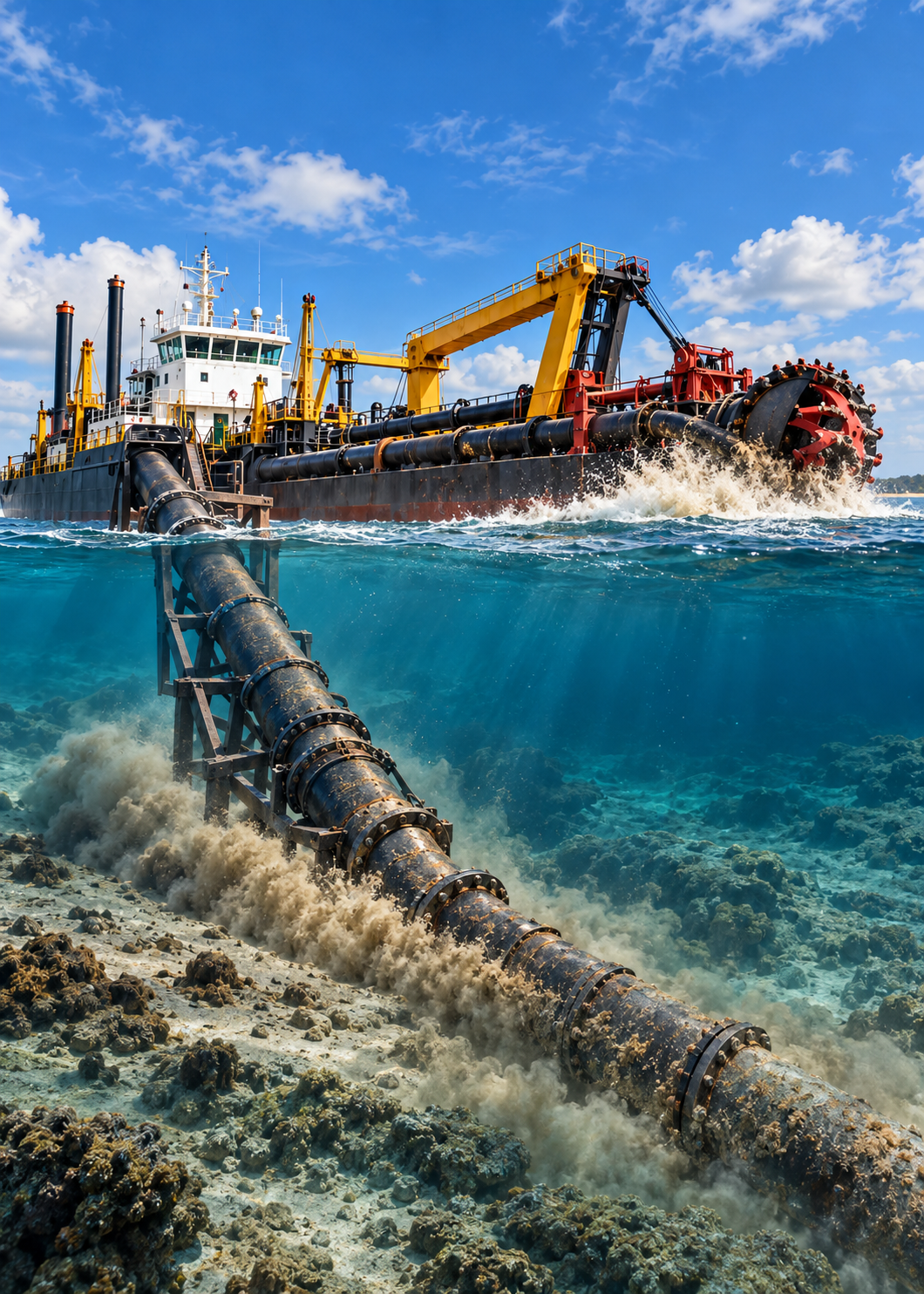
Accelerated wear of ladder suction pipes on the Anugerah Production Suction Vessels (KIP, Kapal Isap Produksi) poses a critical operational and safety risk in offshore tin mining activities in Bangka Belitung, Indonesia. This study presents a HAZOP-informed risk assessment covering five system nodes of the Anugerah KIP suction pipe: the inlet (Node 1), main suction pipe (Node 2), joint (Node 3), suction pump (Node 4), and spiral pipe (Node 5). Risk scores were obtained by multiplying median likelihood and consequence ratings from structured expert questionnaires completed by fifteen respondents with direct field and technical experience. Node 2 received the highest risk score of 25, placing it in the Extreme category. Node 1, 4 and 5 each scored 12 (High), while Node 3 scored 9 (Moderate). The dominant degradation mechanisms are particle erosion from abrasive slurry and electrochemical corrosion driven by the tropical marine environment. Among the priority mitigation measures identified are material substitution with wear-resistant alloys, installation of a pressure relief valve, periodic ultrasonic thickness monitoring, and replacement of the pump impeller with Ni-hard material. Wear rates drawn from the literature on comparable slurry conditions are used as order-of-magnitude benchmarks only. Post-mitigation residual risk at Node 2 is estimated to fall from Extreme to Moderate when engineering controls are applied in combination. A full life-cycle cost analysis is proposed as a next step for future work.
Article Details
Issue
Section

This work is licensed under a Creative Commons Attribution 4.0 International License.
How to Cite
References
[1] U.S Geological Survey, “Tin,” in Mineral Commodity Summaries 2024, 2024, pp. 174–175. doi: 10.3133/mcs2024.
[2] S. Sulista and F. A. Rosyid, “The Economic Impact of Tin Mining in Indonesia During an Era of Decentralisation, 2001–2015: A Case Study of Kepulauan Bangka Belitung Province,” Extr. Ind. Soc., vol. 10, no. 101069, pp. 1–11, 2022, doi: 10.1016/j.exis.2022.101069.
[3] M. Rozaq and H. Mirmanto, “Impeller Design and Slurry Pump Selection on Cutter Suction Dredger Project,” in Smart Innovation in Mechanical Engineering Select Proceedings of ICOME 2023, Springer, Singapore, 2025, pp. 207–219. doi: 10.1007/978-981-97-7898-0_24.
[4] Endrizal, E. Barlian, I. Dewata, and R. R. Joni, “Determining control in production suction vessels ( KIP ) 16 Bangka Ocean mining units PT Timah ( Persero ) Tbk,” Int. J. Health Sci. (Qassim)., vol. 6, no. S2, pp. 7649–7661, 2022, doi: 10.53730/ijhs.v6nS2.6878.
[5] Hariyono and A. A. Mubarak, “Analisis Kekuatan Pengaruh Model Bracing Terhadap Pondasi Katrol Ladder Pada Kapal Isap Produksi (KIP),” Constr. Mater. J., vol. 4, no. 3, 2022, doi: 10.32722/cmj.v4i3.5084.
[6] Z. B. Wang and Y. G. Zheng, “Critical flow velocity phenomenon in erosion-corrosion of pipelines: determination methods, mechanisms and applications,” J. Pipeline Sci. Eng., vol. 1, no. 1, pp. 63–73, 2021, doi: 10.1016/j.jpse.2021.01.005.
[7] O. Parkash and B. S. Sikarwar, “CFD modeling of slurry flow erosion wear rate through mitre pipe bend,” Mech. Eng. Sci., vol. 236, no. 5, pp. 2256–2267, 2022, doi: 10.1177/09544062211026353.
[8] M. Azzam, “Failure Analysis of Pipelines in the Oil and Gas Industry,” in Recent Advances in Pipeline Engineering and Failure Analysis, London: IntechOpen, 2022, pp. 1–23. doi: 10.5772/intechopen.108140.
[9] Q. Li and B. Liu, “Erosion-Corrosion of Gathering Pipeline Steel in Oil-Water-Sand Multiphase Flow,” Met., vol. 13, no. 80, p. 14, 2023, doi: 10.3390/met13010080.
[10] M. T. Abdu, W. Khalifa, and M. S. Abdelrahman, “Investigation of erosion‑corrosion failure of API X52 carbon steel pipeline,” Sci. Rep., vol. 13, 2023, doi: 10.1038/s41598-023-42556-6.
[11] X. Li, Y. Fang, Y. Guo, and X. Li, “Slurry Discharge Pipeline Damage and Wear Due to Transporting Rock Particles during Slurry Shield Tunneling : A Case Study Based on In Situ Observed Results,” Appl. Sci., vol. 13, no. 7103, pp. 1–20, 2023, doi: 10.3390/app13127103.
[12] P. Mocellin et al., “Experimental methods in chemical engineering : Hazard and operability analysis HAZOP,” Can. J. Chem. Eng., vol. 100, no. 12, pp. 3450–3469, 2022, doi: 10.1002/cjce.24520.
[13] P. K. Marhavilas, M. Filippidis, G. K. Koulinas, and D. E. Koulouriotis, “A HAZOP with MCDM Based Risk-Assessment Approach: Focusing on the Deviations with Economic / Health / Environmental Impacts in a Process Industry,” Sustainability, vol. 12, no. 3, p. 29, 2020, doi: 10.3390/su12030993.
[14] E. Elhosary, O. Moselhi, and I. Engineering, “Automation for HAZOP Study : A State-of-the-Art Review and Future Research Directions,” J. Inf. Technol. Constr., vol. 29, pp. 750–777, 2024, doi: 10.36680/j.itcon.2024.033.
[15] D. A. Mukharror, D. Budhi, W. Andi, N. Sommeng, S. Kartohardjono, and H. Hermansyah, “Assessing the completeness of safeguard identification in hazards and operability (HAZOP) studies for oil and gas facilities as a quality metric : An Indonesian case study,” Process Saf. Prog., vol. 44, no. 3, pp. 379–393, 2025, doi: 10.1002/prs.70004.
[16] J. Choi and S.-H. Byeon, “HAZOP Methodology Based on the Health, Safety, and Environment Engineering,” Int. J. Environ. Res. Public Health, vol. 17, no. 3236, p. 19, 2020, doi: 10.3390/ijerph17093236.
[17] L. P. Adnyani, D. L. Putri, and M. K. Wirawan, “Risk Analysis and Mitigation of Occupational Safety Accidents in the Maintenance Process of Units,” Indones. J. Marit. Technol., vol. 03, no. 01, pp. 19–26, 2025, doi: 10.35718/ismatech.v3i1.1334.
[18] A. Rachmianty et al., “Analysis of Work Accident Risk in Welding Process for Pipe Repair on Utility Boat PT LSM,” Indones. J. Marit. Technol., vol. 2, no. 2, pp. 82–91, 2024, doi: 10.35718/ismatech.v2i2.1263.
[19] Y. Hu, P. Jiang, C. Cao, and H. Li, “Discrete element method analysis of cutter forces and cutter tooth wear in cutter suction dredgers,” Mech. Sci., vol. 16, pp. 931–945, 2025, doi: 10.5194/ms-16-931-2025.
[20] F. Antonelli, M. Yang, and V. Cozzani, “Enhancing pipeline system resilience: a reliability-centric approach,” J. Pipeline Sci. Eng., vol. 5, no. 3, p. 100252, 2025, doi: 10.1016/j.jpse.2024.100252.
[21] R. A. Pratiwi, Y. Thamrin, A. Wahyu, and M. F. Naiem, “Analysis of Factors Influencing Work Accidents in the Production Section at PT Industri Kapal Indonesia ( PERSERO ),” J. Law Sustain. Develompment, vol. 12, no. 1, pp. 1–17, 2024, doi: 10.55908/sdgs.v12i1.2166.
[22] F. A. Garza and M. V Launico, “Mean,” in StatPearls, StatPearls Publishing LLC, 2026. [Online]. Available: https://www.ncbi.nlm.nih.gov/books/NBK546702/
[23] International Electrotechnical Commission, Hazard and operability studies (HAZOP studies) - Application guide, IEC Standa. Geneva, Switzerland, 2016. [Online]. Available: https://webstore.iec.ch/en/publication/24321
[24] G. K. Koulinas, O. E. Demesouka, K. A. Sidas, and D. E. Koulouriotis, “A TOPSIS Risk Matrix and Monte Carlo Expert System for Risk Assessment in Engineering Projects,” Sustainability, vol. 13, no. 20, p. 11277, 2021, doi: 10.3390/su132011277.
[25] V. D. Kalyankar and S. P. Wanare, “Comparative Investigations on Microstructure and Slurry Abrasive Wear Resistance of NiCrBSi and NiCrBSi-WC Composite Hardfacings Deposited on 304 Stainless Steel,” Tribol. Ind., vol. 44, no. 2, pp. 199–211, 2022, doi: 10.24874/ti.1075.03.21.05.
[26] J. Sade, “Nano Material Innovation in Enhancing Corrosion Resistance of Offshore Structures,” Marit. Technol. Soc., vol. 3, no. 3, pp. 139–144, 2024, doi: 10.62012/mp.v3i3.39554.
[27] A. Kutej, S. Rass, and R. W. Alexandrowicz, “Comparing Traditional and Graphical Risk Matrices : A Case Study in Healthcare,” Risk Anal., pp. 3758–3780, 2025, doi: 10.1111/risa.70104.