
Static Strength Analysis of a Top-Tensioned Riser in the Gendalo–Gehem Oil and Gas Field
Article Sidebar
Main Article Content
Abstract
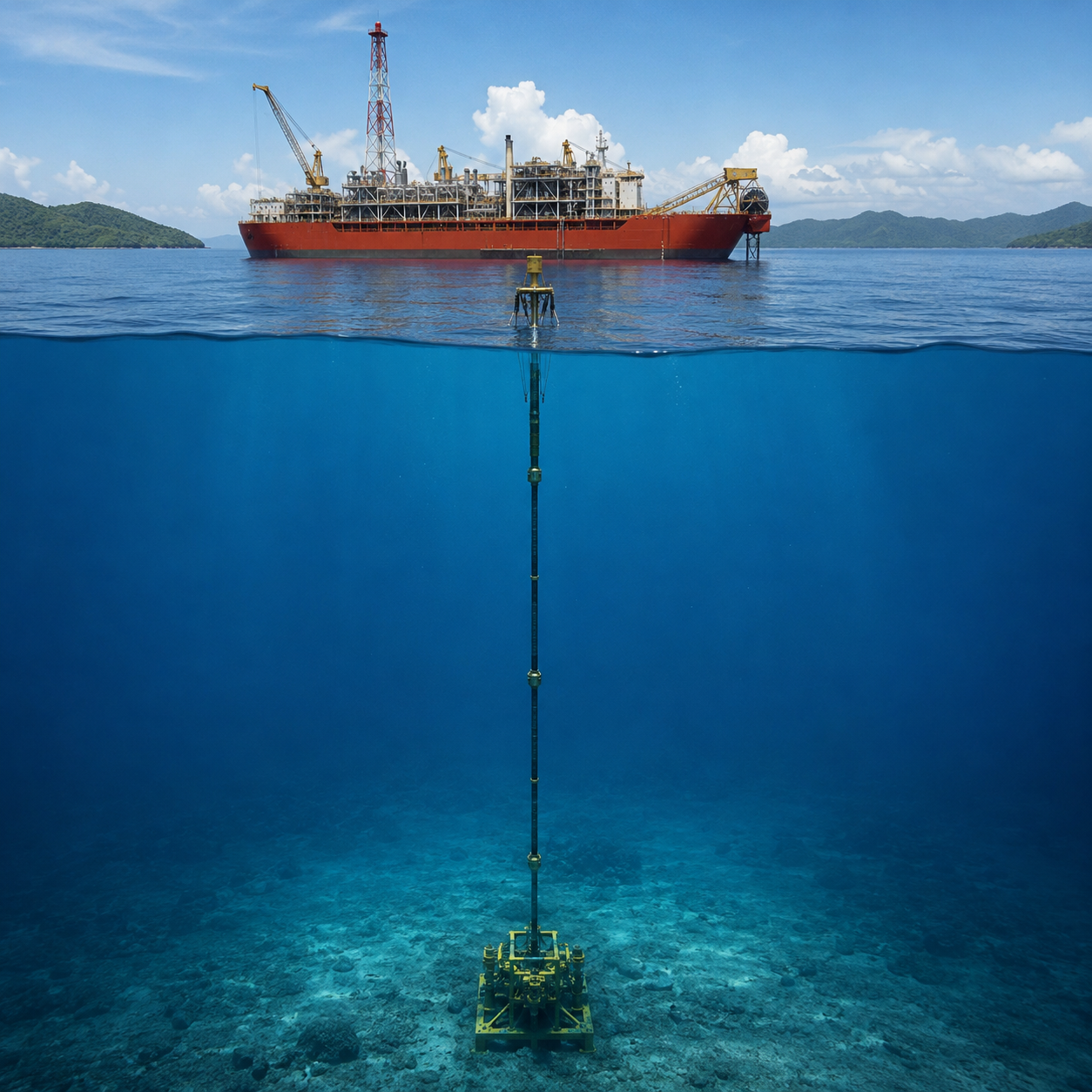
A Top-Tensioned Riser (TTR) is a key structural component that connects subsea facilities to floating production platforms and plays an essential role in ensuring production continuity in deepwater oil and gas exploitation systems. To maintain structural integrity, a TTR must satisfy the design requirements specified in API ST 2RD, particularly with respect to its ability to withstand hydrostatic pressure, internal fluid pressure, ocean current loads, and axial forces generated by top tension. This study aims to analyze the static strength of a TTR under deepwater conditions in the Gendalo–Gehem Field using a numerical approach based on the finite element method. The environmental loads considered include hydrostatic pressure at a water depth of 1,823 m, internal operating pressure, and hydrodynamic forces induced by ocean currents. The riser model was analyzed to determine stress distribution, deformation, and safety performance, which were then evaluated against the allowable stress limits defined in API ST 2RD. The analysis results indicate that the TTR exhibits a stable structural response, with the maximum stress remaining below the material yield strength. Although the maximum stress approaches the operational stress limit under conservative loading conditions, the riser still satisfies the ultimate limit state requirement. This study provides a preliminary basis for evaluating the feasibility of TTR design for deepwater operations in Indonesia and may serve as a reference for vertical riser design in floating production facilities.
Downloads
Article Details

This work is licensed under a Creative Commons Attribution 4.0 International License.
Allow anyone to modify, improve, and make derivative works, even for commercial purposes, as long as they credit to you for the original work.
Accepted 2026-07-04
Published 2026-07-21
References
[1] American Petroleum Institute, API RP 2RD: Design of Risers for Floating Production Systems and Tension-Leg Platforms, 2nd ed. Washington, DC: API Publishing Services, 2010.
[2] Bannantine, J. A., Comer, J. J., and Handrock, J. L., Fundamentals of Metal Fatigue Analysis. New Jersey: Prentice Hall, 1990.
[3] Det Norske Veritas, DNV-RP-C203: Fatigue Design of Offshore Steel Structures. Høvik, Norway: DNV GL, 2016.
[4] Cai, Q., Li, Z., Hu, J., Huang, B., Pan, Y., Wu, H., and Ren, Z., “Fatigue study of unbonded flexible risers for ocean thermal energy conversion based on the joint distribution of wind, wave, and current,” Applied Ocean Research, vol. 154, p. 104306, 2025.
[5] Huang, K., “Riser VIV induced fatigue assessment by a CFD approach.”
[6] Li, Y., Zhou, X., Dou, Y., Zhang, X., and Li, W., “Numerical analysis of dynamic and fatigue characteristics of deep-sea mining riser considering irregular waves and currents,” Ocean Engineering, vol. 311, p. 118910, 2024.
[7] Li, Z., Luo, W., Wang, Y., Wang, M., Li, Y., Hu, Y., and Yao, W., “A method for the fatigue-life assessment of subsea wellhead connectors considering riser wave-induced vibration,” Ocean Engineering, vol. 306, p. 118044, 2024.
[8] Pan, Y., Zheng, L., Yang, S., and Wang, Y., “A review of fatigue analysis of marine flexible risers,” Geoenergy Science and Engineering, vol. 246, p. 213555, 2025.
[9] Wijayanto, A. A., “Analisa tension pada bagian ujung atas riser akibat vortex induced vibration (VIV),” Undergraduate thesis, Jurusan Teknik Kelautan, Fakultas Teknologi Kelautan, Institut Teknologi Sepuluh Nopember, Surabaya, 2016.
[10] Zhang, L., and Zhao, T., “Dynamic reconstruction and weld fatigue evaluation of top-tensioned riser based on strain monitoring,” Ocean Engineering, vol. 315, p. 119648, 2025.
[11] Det Norske Veritas, DNV-ST-F101: Submarine Pipeline Systems. Høvik, Norway: DNV GL, 2017.