
Technical Feasibility Assessment of Seaplane Operations at Tinabo Besar Island, Taka Bonerate National Park, Indonesia
Article Sidebar
Main Article Content
Abstract
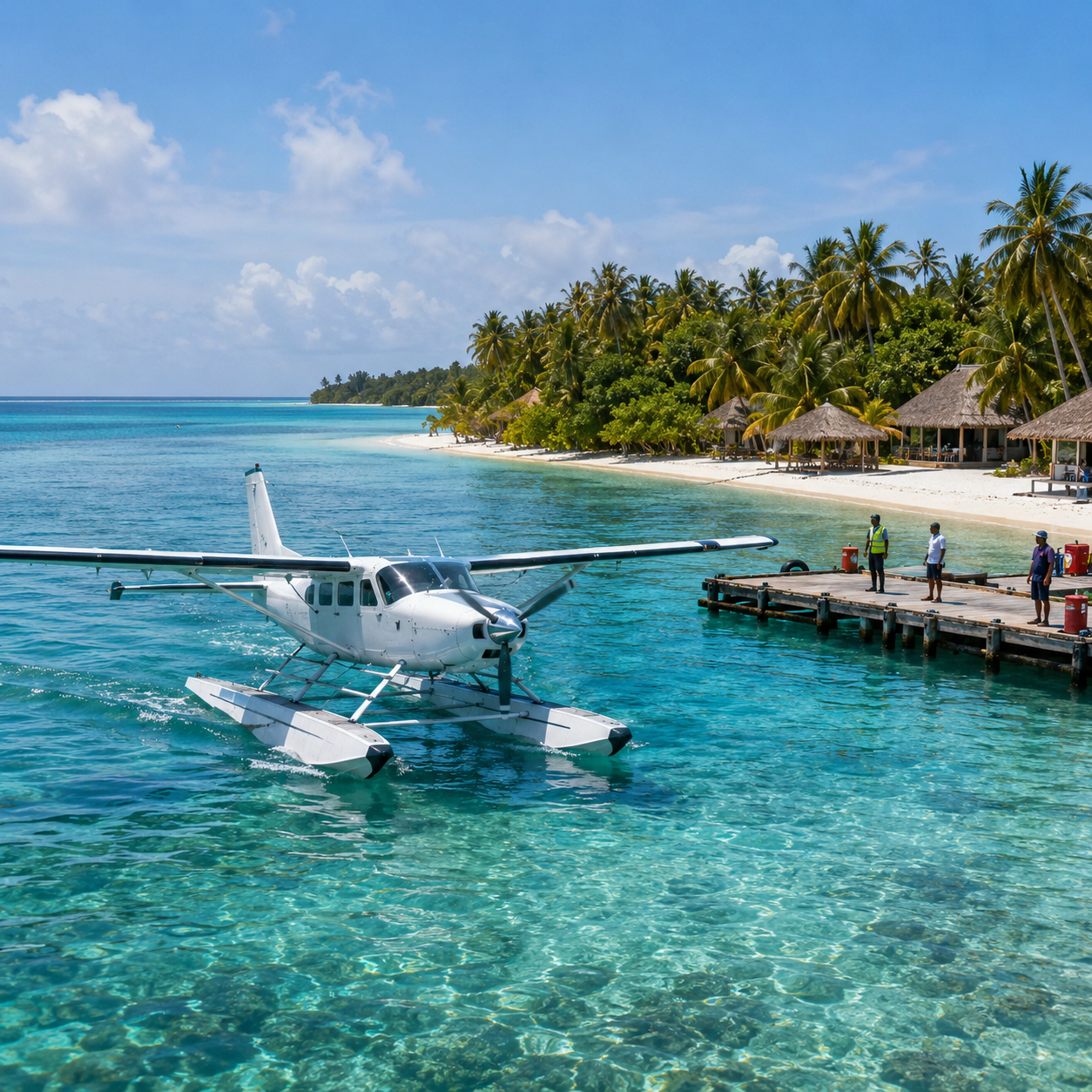
Taka Bonerate National Park (TBNP) is one of the largest marine conservation areas in Indonesia, renowned for its unique atoll ecosystem and high marine tourism potential. However, limited accessibility remains a major constraint for tourism development. This study aims to assess the technical feasibility of seaplane operations at Tinabo Besar Island as a potential waterbase. The research employed hydro-oceanographic analysis (wind, currents, waves, and bathymetry), measurement of aerial distance and travel time between Makassar and Tinabo, as well as a technical review of four seaplane types (Kodiak 100, Cessna 208 Caravan, Dornier Seastar, and DHC-6 Twin Otter). The results indicate that the hydro-oceanographic conditions around Tinabo Besar are predominantly safe for seaplane operations, with 90.34% of days in a year classified as suitable for flights, 7.31% as marginal, and 2.34% as critical. The lagoon bathymetry, ranging from –2 to > –40 m, supports safe water landings. The Makassar–Tinabo route, approximately 245 km, can be covered in 1.5–2 hours by seaplane, which is significantly more efficient compared to sea travel (12–15 hours). From a technical perspective, the Kodiak 100 and Cessna Caravan are considered the most efficient for regular operations, while the Twin Otter is more suitable for higher passenger demand. Thus, Tinabo Besar Island is deemed feasible as a seaplane operational site, although risk mitigation during the west monsoon and coral reef conservation efforts remain essential, given that the reef ecosystem is the main tourism attraction of Taka Bonerate National Park.
Downloads
Article Details

This work is licensed under a Creative Commons Attribution 4.0 International License.
Allow anyone to modify, improve, and make derivative works, even for commercial purposes, as long as they credit to you for the original work.
References
[1] ICAO, APAC Water Aerodrome Working Group Draft Model Regulation, Montreal, Canada, 2018.
[2] International Civil Aviation Organization (ICAO), Annex 14 to the Convention on International Civil Aviation – Aerodromes, Vol. I, 9th ed., Montreal, Canada, 2022.
[3] Civil Aviation Safety Authority (CASA), Manual of Standards Part 139—Seaplane Bases, Canberra, Australia, 2020.
[4] R. Pradana, A. Setiawan, and M. Hidayat, "Hydro-oceanographic assessment for water aerodrome planning in archipelagic regions," Journal of Marine Science and Engineering, vol. 11, no. 8, pp. 1–18, 2023.
[5] Federal Aviation Administration, Engineering Brief No. 93, Water Landing Areas for Seaplane Operations, Washington DC, 2021.
[6] Ministry of Transportation Republic of Indonesia, Civil Aviation Safety Regulation (CASR) Part 139 Volume III: Water Aerodrome, Jakarta, Indonesia, 2010.
[7] Balai Taman Nasional Taka Bonerate, Statistik Balai Taman Nasional Taka Bonerate 2024, Benteng, Indonesia, 2024.
[8] S. Yusyarif, S. Wunas, and G. Sitepu, "Pengembangan Bandara Waterbase untuk Pesawat Terbang Laut," Journal of Infrastructure and Transportation, vol. 6, no. 2, pp. 43–49, 2023.
[9] South Sulawesi Transportation Agency, Transportation Statistics of Selayar Islands Regency, Makassar, Indonesia, 2023.
[10] Federal Aviation Administration (FAA), Advisory Circular AC 150/5395-1B Seaplane Bases, Washington DC, USA, 2018.
[11] M. Fennell, Sustainable Tourism: Principles, Contexts and Practices, 2nd ed., Routledge, 2020.