
Agroforestry rubber networks and farmers groups in Phatthalung area in Southern Thailand: A potential for an innovation platform?
DOI:
https://doi.org/10.24259/fs.v6i2.12481Keywords:
Agroforestry, Innovation platform, Group, Network, Interactions, Knowledge and know-how transmission, RubberAbstract
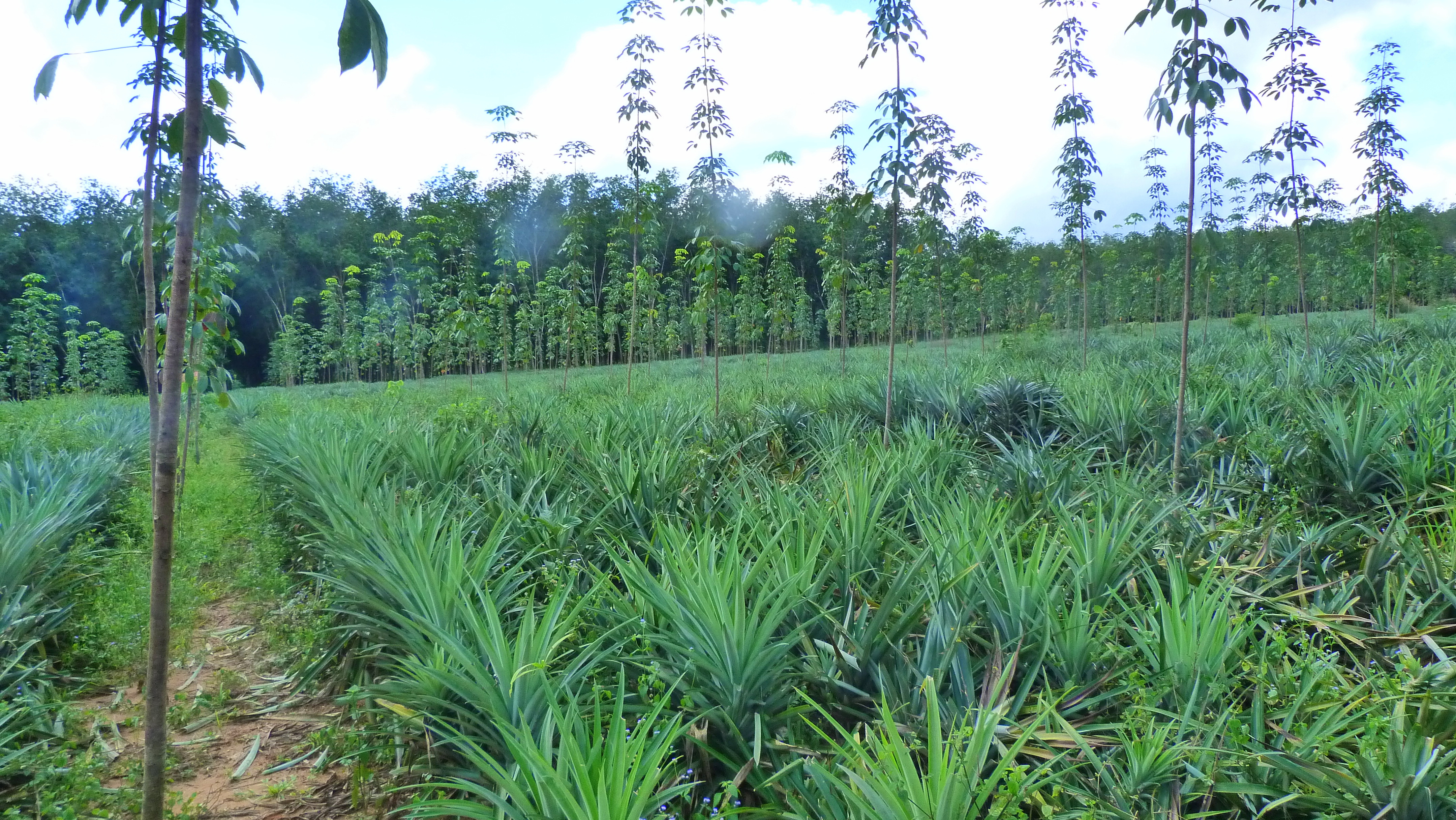
The study took place in southern Thailand, in Phatthalung province, and is part of “Heveadapt,” a Franco-Thai research project. The aim of this project was to show how smallholder rubber plantations can adapt and remain sustainable in the face of variable climatic conditions and deep changes in socio-economic context. Among the various types of cropping systems, agroforestry practices were identified as promising. Rubber agroforestry systems (AFS) are economically more productive than rubber monocrop plantations and give more flexibility to smallholders, in particular when rubber prices are low, which has been the case since 2013. However, adoption of AFS during the mature period of the plantations is very low in Thailand. The policy to boost rubber agroforestry practices still needs to be developed with all local stakeholders. The objectives of the study were to identify the possibilities and capacities to use current AFS dynamic networks as a basis to set up a rubber agroforestry innovation platform. The research team studied: i) farmers’ collective organizations, groups or networks with rubber AFS partially or entirely and ii) the social dynamic enabling the sharing of knowledge and know-how. An individual producer’s grid, with original farmers or strong knowledge with ease of sharing, was also studied. The role of local institutions involved in the promotion of rubber AFS was also analyzed. This allowed us to design an innovation platform and to define activities that suit the socio-economic context of Phatthalung province. The main aims of the platform are to promote cooperation among innovative producers and the transmission between them of knowledge and know-how about rubber AFS. This could an efficient tool that Thai rubber institutions could set up to encourage the adoption of rubber AFS by farmers.
References
Adekunle A.A, A.O Fatunbi and M.P Jones (2010). How to set up an Innovation Platform. A concept guide for the Sub-Saharan African Challenge Program (SSA CP). Forum for Agricultural Research in Africa
Andriesse, E., & Tanwattana, P. (2018). Coping with the end of the commodities boom: rubber smallholders in southern Thailand oscillating between near-poverty and middle-class status. Journal of Developing Societies, 34(1), 77-102. https://doi.org/10.1177%2F0169796X17752420
Charernjiratragul S. (1991). Le système productif agricole à base d'hévéaculture dans l'économie thaïlandaise du caoutchouc naturel [Doctoral disseration] Université de Montpellier.
Chambon, B., Bosc, P. M., Gaillard, C., & Tongkaemkaew, U. (2021). Using labour to characterise forms of agriculture: A thai family rubber farming Case Study. Journal of Contemporary Asia, 1-25. https://doi.org/10.1080/00472336.2021.1901958
Delarue, J., & Chambon, B. (2012). La Thaïlande: premier exportateur de caoutchouc naturel grâce à ses agriculteurs familiaux. Économie rurale. Agricultures, alimentations, territoires, (330-331), 191-213. https://doi.org/10.4000/economierurale.3571
IRSG, (2015). Rubber statistical bulletin. July - September 2015 edition. Available at: http://www.rubberstudy.com/documents/WebSiteData_Aug2015.pdf
Jongrungrot, V. (2015). Social Security of Rubber-based Agroforestry System towards Strengthening Rural Communities in Southern Thailand/ความ มั่นคง ทาง สังคม ของ ระบบ วน เกษตร ยางพารา สู่ ความ เข้มแข็ง ของ ชุมชน ชนบท ภาค ใต้ ของ ประเทศไทย. Journal of Community Development Research (Humanities and Social Sciences), 8(2), 8-15. https://doi.org/10.14456/jcdr.v8i2.1019
Jongrungrot, V., Thungwa, S., & Snoeck, D. (2014). Tree-crop diversification in rubber plantations to diversity sources of income for small-scale rubber farmers in Southern Thailand. Bois et Forets des Tropiques, 68(321), 21-32. http://dx.doi.org/10.19182/bft2014.321.a31214
Kheowvongsri, P. (1996). Analyse de quelques systèmes agroforestiers traditionnels de Thaïlande. Apport de l'agroforesterie à la solution des problèmes forestiers en Thaïlande [Doctoral dissertation].
Kilelu, C. W., Klerkx, L., & Leeuwis, C. (2013). Unravelling the role of innovation platforms in supporting co-evolution of innovation: Contributions and tensions in a smallholder dairy development programme. Agricultural systems, 118, 65-77.
Lazega, E. (1994). Analyse de réseaux et sociologie des organisations. Revue française de sociologie, 35(2), 293-320. https://doi.org/10.2307/3322036
Lehoux, H., Peroches, A., Poline, L., Penot, E., & Sainte-Beuve, J. (2019). Rubber growing throughout the World. Overview of production dynamics, market and value-chain sustainability challenges. AFT Research Programme Report.
Longpichai, O. (2012). Concept of Sustainable Agriculture and its link to Agroforestry System. Department of Agricultural Economic, Faculty of Economics Prince Songkla University, songkhla, 9012.
Merton, R. K. (1973). The sociology of science: Theoretical and empirical investigations. University of Chicago press.
Matthey, L. (2005). Éthique, politique et esthétique du terrain: cinq figures de l'entretien compréhensif. Cybergeo: European Journal of Geography.
Nicod, T., Bathfield, B., Bosc, P. M., Promkhambut, A., Duangta, K., & Chambon, B. (2020). Households' livelihood strategies facing market uncertainties: How did Thai farmers adapt to a rubber price drop?. Agricultural Systems, 182, 102846. https://doi.org/10.1016/j.agsy.2020.102846
Nyikahadzoi, K., Pali, P., Fatunbi, A. O., Olarinde, L. O., Njuki, J., & Adekunle, A. O. (2012). Stakeholder participation in innovation platform and implications for Integrated Agricultural Research for Development (IAR4D). International Journal of Agriculture and Forestry, 2(3), 92-100.
Nyikahadzoi, K., Pali, P., Fatunbi, A. O., Olarinde, L. O., Njuki, J., & Adekunle, A. O. (2012). Stakeholder participation in innovation platform and implications for integrated agricultural research for development (IAR4D). International Journal of Agriculture and Forestry, 2(3), 92-100. https://doi.org/10.5923/j.ijaf. 20120203.03
Onanong, L.(2012). KKU Research Journal. Vol.2 No3.October – December 2012, pp312 336. Concept of sustainable agriculture and its link to agroforestery system.
Penot, E. (2001). Stratégies paysannes et évolution des savoirs : l'hévéaculture agro-forestière indonésienne [Thèse de doctorat]. Faculté des Sciences Economiques Université Montpellier.
Penot, É., & Ollivier, I. (2009). L’hévéa en association avec les cultures pérennes, fruitières ou forestières: quelques exemples en Asie, Afrique et Amérique latine. Bois et forêts des tropiques, 301(3), 67-82. https://doi.org/10.19182/bft2009. 301.a20407
Penot, E., Stroesser, L., Michel, I., Tongkaemkaew, U., & Chambon, B. (2016). Agroforestry practices to overcome prices volatility: the case of rubber in Phatthalung province, Thailand. Abstract number 92.
Rodrigo, V. H. L., Stirling, C. M., Naranpanawa, R. M. A. K. B., & Herath, P. H. M. U. (2001). Intercropping of immature rubber in Sri Lanka: present status and financial analysis of intercrops planted at three densities of banana. Agroforestry systems, 51(1), 35-48. https://doi.org/10.1023/A:1006449230436
Schut, M., Klerkx, L., Sartas, M., Lamers, D., Mc Campbell, M., Ogbonna, I., ... & Leeuwis, C. (2016). Innovation platforms: experiences with their institutional embedding in agricultural research for development. Experimental Agriculture, 52(4), 537-561
Simien, A. (2005). Caractérisation socio-économique et modélisation des exploitations hévéicoles du sud de la Thaïlande. Montpellier, ENSAM/ISTOM, INH, PSU/Hat Yai Thailande. Stage Thématique et méthodologique de 2ème année.
Somboonsuke, B., Wetayaprasit, P., Chernchom, P., & Pacheerat, K. (2011). Diversification of smallholding rubber agroforestry system (SRAS) Thailand. Kasetsart journal of social sciences, 32(2), 327-339.
Somboonsuke, B., and P. Wettayaprasit. (2013). Agricultural system of natural Para Rubber smallholding sector in Thailand: system, technology, organization, economy, and policy implication. Department of Agricultural Development, Prince of Songkla University.
Stroesser, L., Penot, É., Michel, I., Tongkaemkaew, U. & Chambon, B. (2018). Income Diversification for Rubber Farmers Through Agroforestry Practices: How to Withstand Rubber Price Volatility in Phatthalung Province, Thailand. Revue internationale des études du développement, 235, 117-145. https://doi.org/10.3917/ried.235.0117
Tenywa, M. M., Rao, K. P. C., Tukahirwa, J. M. B., Buruchara, R. A., Adekunle, A. A., Mugabe, J., ... & Mulema, A. A. (2011). Agricultural innovation platform as a tool for development oriented research: Lessons and challenges in the formation and operationalization. Journal of Agriculture and Environmental Studies 2(1):117-146. https://hdl.handle.net/10568/3562
Theriez, M. (2017). La production hévéicole de Phatthalung : quel potentiel d’émergence d’une plateforme d’innovation régionale pour la co-conception de systèmes agroforestiers innovants. Mémoire de fin d’études. Diplôme d’ingénieur agronome, Développement Agricole et Durable au Sud (DARS), Ressources, Systèmes Agricoles et Développement (RESAD)n IRC, Montpellier.
Tittonell, P., Scopel, E., Andrieu, N., Posthumus, H., Mapfumo, P., Corbeels, M., ... & Mkomwa, S. (2012). Agroecology-based aggradation-conservation agriculture (ABACO): Targeting innovations to combat soil degradation and food insecurity in semi-arid Africa. Field Crops Research, 132, 168-174. https://doi.org/10.1016/j.fcr.2011.12.011
Tongkaemkaew U, E. Penot and B. Chambon. (2020). Rubber Agroforestry Systems in Mature Plantations in Phatthalung Province, Southern Thailand. ASEAN Journal of Scientific and Technological Reports (AJSTR), 23(1), 79-85.
Torquebiau, E., & Penot, E. (2000). Ecology versus economics in tropical multistrata agroforests. In Tropical Homegardens (pp. 269-282). Springer Netherlands.
RRIT, 2015. Thai rubber statistics. Available at http://www.rubberthai.com/statistic/ eng/eng_stat.htm
Wibawa, G., Joshi, L., Van Noordwijk, M., & Penot, E. A. (2006). Rubber based Agroforestry Systems (RAS) as Alternatives for Rubber Monoculture System. In IRRDB annual conference.
Additional Files
Published
Issue
Section
Categories
License
Copyright (c) 2022 Forest and Society

This work is licensed under a Creative Commons Attribution 4.0 International License.
This is an open access journal which means that all contents is freely available without charge to the user or his/her institution. Users are allowed to read, download, copy, distribute, print, search, or link to the full texts of the articles in this journal without asking prior permission from the publisher or the author. This is in accordance with the BOAI definition of open access.
Submission of an article implies that the work described has not been published previously (except in the form of an abstract or as part of a published lecture or academic thesis), that it is not under consideration for publication elsewhere, that its publication is approved by all authors and tacitly or explicitly by the responsible authorities where the work was carried out, and that, if accepted, will not be published elsewhere in the same form, in English or in any other language, without the written consent of the Publisher. An article based on a section from a completed graduate dissertation may be published in Forest and Society, but only if this is allowed by author's(s') university rules. The Editors reserve the right to edit or otherwise alter all contributions, but authors will receive proofs for approval before publication.
Forest and Society operates a CC-BY 4.0 © license for journal papers. Copyright remains with the author, but Forest and Society is licensed to publish the paper, and the author agrees to make the article available with the CC-BY 4.0 license. Reproduction as another journal article in whole or in part would be plagiarism. Forest and Society reserves all rights except those granted in this copyright notice