
Between Hopes and Threats: New Migratory Birds Records on the Sawala Mandapa Education and Training Forest, Indonesia
DOI:
https://doi.org/10.24259/fs.v6i1.19160Keywords:
Bird migration, Migratory birds, Education forest, Training forest, Wintering habitat, Stopover areaAbstract
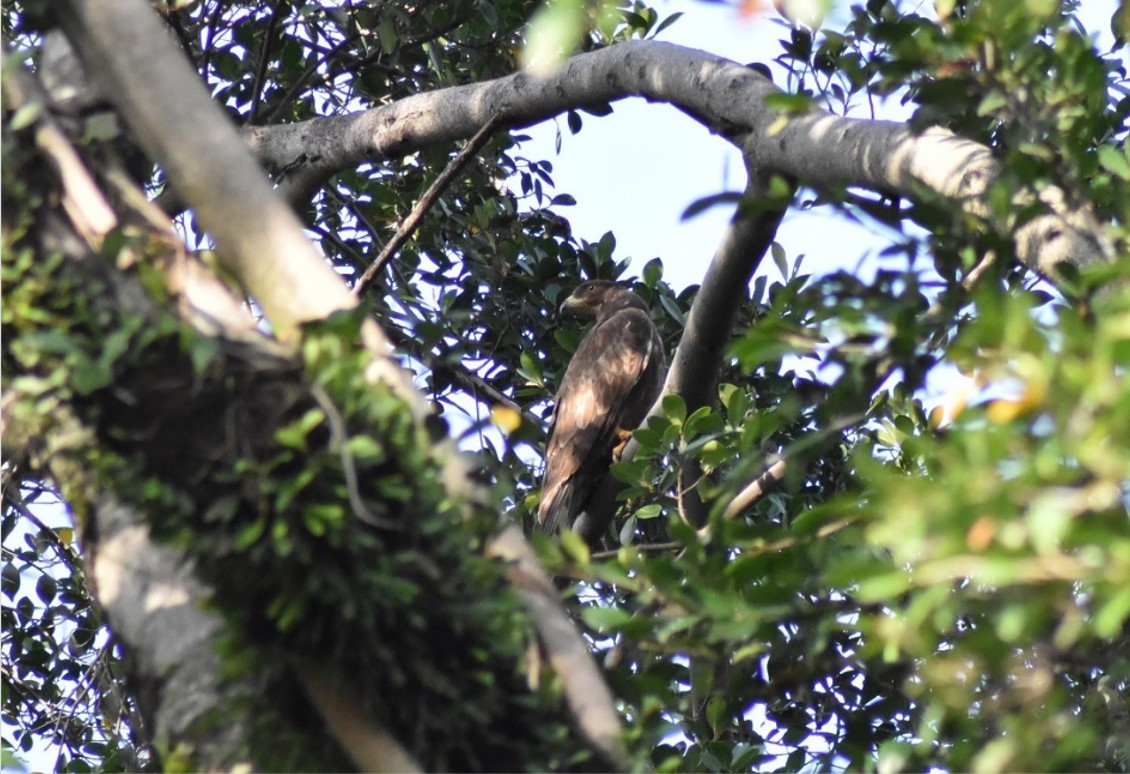
Java Island is one of the tropical areas for bird migration, especially the Asian-Australian flyway of migratory birds. The SMETF is one of the protected forest areas that migratory birds can visit in Java. This research aims to identify migratory birds in SMETF. Transect and point count methods are used to observe migratory bird movements and their activities. In the research area, four migratory birds were identified: Ficedula zanthopygia, Agropsar sturninus, Pernis ptilorhynchus o., and Accipiter soloensis. The first and second species showed many activities for four months from October 2020 to January 2021, and this is an indication that both are using the research site as a wintering habitat. The activities of the Pernis ptilorhynchus o., Accipiter soloensis were dominated by flying “flock” over the forest. Only the Pernis ptilorhynchus was observed carrying out hunting activities, indicating that this bird uses the area as a stopover area. This research also identified illegal hunting techniques, such as ngaleugeut and mikat, as severe threats to migratory birds in the SMETF.
References
Albuquerque, U. P., Cunha, L. V. F. C. da, Lucena, R. F. P., & Alves, R. R. N. (Eds.) (2017). Methods and Techniques in Ethnobiology and Ethnoecology. Springer. https://link.springer.com/book/10.1007/978-1-4614-8636-7
Atlas Burung Indonesia. (2020). Atlas Burung Indonesia: wujud karya peneliti amatir dalam memetakan burung. Yayasan Atlas Burung Indonesia.
Bibby, C., Jones, M., & Marsden, S. (2000). Bird surveys. Birdlife International.
Bierwagen, B. G. (2007). Connectivity in urbanizing landscapes: The importance of habitat configuration, urban area size, and dispersal. Urban Ecosystems, 10(1), 29–42. https://doi.org/10.1007/s11252-006-0011-6
BirdLife International. (2016a). Agropsar sturninus (Vol. 8235). BirdLife International. https://doi.org/http://dx.doi.org/10.2305/IUCN.UK.2016- 3.RLTS.T22710870A94264888.en
BirdLife International. (2016b). Ficedula zanthopygia (Vol. 8235). BirdLife International. https://doi.org/http://dx.doi.org/10.2305/IUCN.UK.2016- 3.RLTS.T22709325A94202549.en
BirdLife International. (2021a). Accipiter soloensis (Vol. 8235). BirdLife International. https://doi.org/https://dx.doi.org/10.2305/IUCN.UK.2021- 3.RLTS.T22695503A154677417.en
BirdLife International. (2021b). Pernis ptilorhynchus (Vol. 8235). BirdLife International. https://doi.org/https://dx.doi.org/10.2305/IUCN.UK.2021- 3.RLTS.T22694995A199637824.en
Césard, N. (2004). Harvesting and commercialisation of kroto (Oecophylla smaragdina) in the Malingping area, West Java, Indonesia. In Kusters, K., & Belcher, B. (Eds.), Forest products, livelihoods and conservation: case studies of non-timber forest product systems (pp. 61-77). CIFOR.
Chan, B. P. L., & Chan, V. W. K. (2019). New and significant bird records from bintan island, riau archipelago, indonesia. Kukila, 22, 10–20.
Chng, S. C., Shepherd, C. R., & Eaton, J. A. (2018). In the market for extinction: birds for sale at selected outlets in Sumatra. Traffic Bulletin, 30(1), 15-22.
Choi, C.-Y., Nam, H.-Y., & Lee, W.-S. (2015). Growth of Chinese Sparrowhawk Accipiter soloensis nestlings. Forktail, 31, 110–113.
Das, M., & Debata, S. (2018). First record of Yellow-Rumped Flycatcher Ficedula zanthopygia (Hay, 1845) (Aves: Passeriformes: Muscicapidae) in eastern India. Journal of Threatened Taxa, 10(10), 12422–12424. https://doi.org/10.11609/jott.4222.10.10.12422-12424
Decandido, R., Siponen, M., Smit, H., Pierce, A., & Allen, D. (2015). Flight identification and migration pattern of the Oriental Honey Buzzard Pernis ptilorhynchus orientalis in southern Thailand, 2007–2014. BirdingASIA, 23, 27–33.
del Hoyo, J., & Collart, N. J. (2019). Handbook of the Birds of the World and BirdLife International digital checklist of the birds of the world. Lynx Editions and BirdLife International.
Dimyati. (2018). Pengembangan Hutan Diklat Sawala Mandapa. SAWALA Press.
Fetene, A., Yeshitela, K., & Gebremariam, E. (2019). The effects of anthropogenic landscape change on the abundance and habitat use of terrestrial large mammals of Nech Sar National Park. Environmental Systems Research, 8(1), 1-16. https://doi.org/10.1186/s40068-019-0147-z
García, D., Miñarro, M., & Martínez-Sastre, R. (2018). Birds as suppliers of pest control in cider apple orchards: Avian biodiversity drivers and insectivory effect. Agriculture, Ecosystems and Environment, 254, 233–243. https://doi.org/10.1016/j.agee.2017.11.034
Germi, F., & Waluyo, D. (2006). Additional information on the autumn migration of raptors in east Bali, Indonesia. Forktail, 22, 71–76.
Germi, F., Salim, A., & Minganti, A. (2013). First records of chinese sparrowhawk accipiter soloensis wintering in papua (indonesian new guinea). Forktail, 29, 43–47.
Germi, F., Young, G. S., Salim, A., Pangimangen, W., & Schellekens, M. (2009). Over-ocean raptor migration in a monsoon regime: Spring and autumn 2007 on Sangihe, North Sulawesi, Indonesia. Forktail, 25, 104–116.
Gunawan, Paridi, A., & Noske, R. A. (2017). The illegal trade of Indonesian raptors through social media. Kukila, 20, 1–11.
Hakim, L., Abdoellah, O. S., Parikesit, & Withaningsih, S. (2020). Impact of agricultural crop type and hunting on bird communities of two villages in bandung, West Java, Indonesia. Biodiversitas, 21(1), 57–66. https://doi.org/10.13057/biodiv/d210109
Harris, J. B. C., Tingley, M. W., Hua, F., Yong, D. L., Adeney, J. M., Lee, T. M., Marthy, W., Prawiradilaga, D. M., Sekercioglu, C. H., Suyadi, C. H., Winarni, N., & Wilcove, D. S. (2017). Measuring the impact of the pet trade on Indonesian birds. Conservation Biology, 31(2), 394–405. https://doi.org/10.1111/cobi.12729
Harrison, R. D., Sreekar, R., Brodie, J. F., Brook, S., Luskin, M., O'Kelly, H., ... & Velho, N. (2016). Impacts of hunting on tropical forests in Southeast Asia. Conservation Biology, 30(5), 972-981. https://doi.org/10.1111/cobi.12785
Husodo, T., Febrianto, P., Megantara, E. N., Shanida, S. S., & Pujianto, M. P. (2019). Diversity of mammals in forest patches of cisokan, Cianjur, West Java, Indonesia. Biodiversitas, 20(5), 1281–1288). https://doi.org/10.13057/biodiv/d200518
Imron, M. A., & Djuwantoko, D. (2003). A New Possibility for Biodiversity Conservation on Totally Fragmented Forest: A Case Study in the Menoreh Hills Community Forest, Central Java, Indonesia. World Forestry Congress.
Iskandar, B., Iskandar, J., & Partasasmita, R. (2019). Hobby and business on trading birds: Case study in bird market of Sukahaji, Bandung, West Java and Splendid, Malang, East Java (Indonesia). Biodiversitas, 20(5), 1316–1332. https://doi.org/10.13057/biodiv/d200522
Iskandar, J., Iskandar, B. S., & Partasasmita, R. (2016). The local knowledge of the rural people on species, Role and hunting of birds: Case study in Karangwangi Village, West Java, Indonesia. Biodiversitas, 17(2), 435–446. https://doi.org/10.13057/biodiv/d170206
Iswandaru, D., Febryano, I. G., Santoso, T., Kaskoyo, H., Winarno, G. D., Hilmanto, R., ... & Zulfiani, D. (2020). Bird community structure of small islands: a case study on the Pahawang Island, Lampung Province, Indonesia. Silva Balcanica, 21(2), 5-18. https://doi.org/10.3897/silvabalcanica.21.e56108
Iswandaru, D., Novriyanti, N., Banuwa, I. S., & Harianto, S. P. (2020). Distribution of bird communities in university of lampung, indonesia. Biodiversitas, 21(6), 2629–2637. https://doi.org/10.13057/biodiv/d210634
Kiros, S., Afework, B., & Legese, K. (2018). A preliminary study on bird diversity and abundance from Wabe fragmented forests around Gubre subcity and Wolkite town, Southwestern Ethiopia. International Journal of Avian & Wildlife Biology, 3(5), 333-340. https://doi.org/10.15406/ijawb.2018.03.00116
Lindell, C. A., & Thurston, G. M. (2013). Bird pollinator visitation is equivalent in island and plantation planting designs in tropical forest restoration sites. Sustainability 5(3), 1177–1187. https://doi.org/10.3390/su5031177
MacKinnon, J., Phillipps K, & Van Belen B. (2010). Burung-burung di Sumatera, Jawa, Bali dan Kalimantan. Burung Indonesia.
Mazumder, M. K. (2014). Diversity, habitat preferences, and conservation of the primates of Southern Assam, India: The story of a primate paradise. Journal of Asia-Pacific Biodiversity, 7(4), 347–354. https://doi.org/10.1016/j.japb.2014.10.001
McInerny, C. J., & Shaw, K. D. (2019). The honey-buzzard in Scotland: a rare, secretive and elusive summer visitor and breeder. The Glasgow Naturalist, 27(1), 20–26. https://doi.org/10.37208/tgn27103
Mingju, E., Gong, Y., Yu, J., Zhang, S., Fan, Q., Jiang, Y., & Wang, H. (2017). Low level of extra-pair paternity between nearest neighbors results from female preference for high-quality males in the yellow-rumped flycatcher (Ficedula zanthopygia). PLoS ONE, 12(3), 1–14. https://doi.org/10.1371/journal.pone.0172713
Mittermeier, J. C., Rosyadi, I., & David Bishop, K. (2015). The status of Oriental Honey Buzzard Pernis ptilorhynchus in Wallacea, with a description of the first record for Ternate. Kukila, 18(2), 75–78.
Mori, D., 2019. Observations at a nest of the Oriental Honey Buzzard Pernis ptilorhynchus. Indian BIRDS 15(2): 49–52
Nandy, S., Singh, C., Das, K. K., Kingma, N. C., & Kushwaha, S. P. S. (2015). Environmental vulnerability assessment of eco-development zone of Great Himalayan National Park, Himachal Pradesh, India. Ecological Indicators, 57, 182–195. https://doi.org/10.1016/j.ecolind.2015.04.024
Newing, H., Eagle, C. M., Puri, R. K., & Watson, C. W. (Eds.) (2010). Conducting research in conservation: Social science methods and practice. Routledge. https://doi.org/10.4324/9780203846452
Nijman, V. (2001). Autumn migration of raptors on java, indonesia: Composition, direction and behaviour. Ibis, 143(1), 99–106. https://doi.org/10.1111/j.1474-919x.2001.tb04174.x
Nijman, V. (2005). Magnitude and timing of migrant raptors in Central Java, Indonesia. Ardea, 92(2), 161–168.
Nijman, V., & Nekaris, K. A. I. (2017). The Harry Potter effect: The rise in trade of owls as pets in Java and Bali, Indonesia. Global Ecology and Conservation, 11, 84-94. https://doi.org/10.1016/j.gecco.2017.04.004
Nijman, V., Germi, F., & Van Balen, S. (2006). Relative status of two species of migrant sparrowhawks on Java and Bali, Indonesia. Emu, 106(2), 157–162. https://doi.org/10.1071/MU05016
Ning, L. I., Wang, Z., Zhang, S., Yan, C., Xinhai, L. I., & Changhu, L. U. (2019). Importance of bird traits for seed dispersal patterns of co-fruiting trees in a patchy forest. Integrative Zoology, 14(5), 470–478. https://doi.org/10.1111/1749-4877.12374
Pramono, H., Mulyani, Y. A., Syartinilia, & Higuchi. (2015). Modelling of Stopover Habitat Suitability Distribution Oriental Honey Buzzard (Pernis ptilorhynchus) in Rupat Island Based on Satellite-Tracking Data. Media Konservasi, 20(1), 61–68.
Prasetyo, L. B., Wijaya, C. I., & Setiawan, Y. (2011). Spatial Model Approach for Deforestation: Case Study in Java Island, Indonesia. In Y. Trisurat, R. Shrestha, & R. Alkemade (Eds.), Land Use, Climate Change and Biodiversity Modeling: Perspectives and Applications (pp. 376-387). IGI Global. https://doi.org/10.4018/978-1-60960-619-0.ch018
Purwanto, A. A. D. I., Pramono, H., Qadrie, A. A. L., Indonesia, R., Tumenggung, J., No, W., & Utara, B. (2015). First record of Eastern Buzzard Buteo japonicus for Kalimantan, Indonesia. Kukila, 18(2), 1997–1998.
Ramachandran, V., & Ganesh, T. (2012). Habitat Structure and Its Effect on Bird Assemblages in the Kalakad-Mundathurai Tiger Reserve (KMTR), India. Journal of the Bombay Natural History Society, 109, 87–95.
Scanes, C. G. (2018). Human activity and habitat loss: Destruction, fragmentation, and degradation. In Scanes, C. G., & Toukhsati, S. R. (Eds.), Animals and Human Society (pp. 451–482). Academic Press. https://doi.org/10.1016/B978-0-12-805247-1.00026-5
Setiyono, J., Diniarsih, S., Mufti, F., & Untung, M. (2013). Large communal roost of “wintering” purple-backed starlings Sturnus (Agropsar) sturninus in yogyakarta, central java. Kukila, 17(1), 12–16.
Sharma, M., & Sangha, H. S. (2012). Purple-backed Starling Sturnus sturninus in the Andaman Islands, India, and its status in the Indian Subcontinent. Indian Birds, 7(6), 172–173.
Smiet, A. C. (1990). Forest ecology on Java: conversion and usage in a historical perspective. Journal of Tropical Forest Science, 2(4), 286–302.
Sodhi, N. S., Şekercioğlu, Ç. H., Barlow, J., & Robinson, S. K. (2011). Conservation of Migratory Birds in the Tropics. In Sodhi, N. S., Şekercioğlu, Ç. H., Barlow, J., & Robinson, S. K. (Eds.), Conservation of Tropical Birds (pp. 195–212). Wiley. https://doi.org/10.1002/9781444342611.ch9
Soedomo, S. (2014). Development of Private Forest on Java Island: What Can We Learn? Journal of Rural Indonesia, 2(1), 12.
Sun, Y. H., Deng, T. W., Lan, C. Y., & Chen, C. C. (2010). Spring migration of Chinese Goshawks (Accipiter soloensis) in Taiwan. Journal of Raptor Research, 44(3), 188–195. https://doi.org/10.3356/JRR-09-14.1
Syartinilia, S., Mulyani, Y. A., Makalew, A. D. N., & Higuchi, H. (2021). Modeling the Wintering Habitat Distribution of Oriental Honey Buzzards in West Java Indonesia with Satellite Tracking Data Using Logistic Regression. HAYATI Journal of Biosciences, 29(1), 9–21. https://doi.org/10.4308/hjb.29.1.9-21
Tesfahunegny, W., Fekensa, T., & Mulualem, G. (2016). Avifauna Diversity in Kafa Biosphere Reserve: Knowledge and Perception of Villagers in Southwest Ethiopia. World Applied Science Journal, 34(9), 1222–1229. https://doi.org/10.5829/idosi.wasj.2016.34.9.105103
Van Itterbeeck, J., Sivongxay, N., Praxaysombath, B., & van Huis, A. (2015). Location and external characteristics of the Oecophylla smaragdina queen nest. Insectes Sociaux, 62(3), 351–356. https://doi.org/10.1007/s00040-015-0411-9
Van Mele, P. (2008). A historical review of research on the weaver ant Oecophylla in biological control. Agricultural and Forest Entomology, 10(1), 13–22. https://doi.org/10.1111/j.1461-9563.2007.00350.x
Wells, D. R. (1999). The birds of the Thai-Malay peninsula. Academic Press.
Whitten, T., Soeriaatmadja, R. E., & S.A, A. (1999). Ekologi Jawa dan Bali Jilid 2. Prenhallindo.
Xu, Y., Si, Y., Takekawa, J., Liu, Q., Prins, H. H. T., Yin, S., Prosser, D. J., Gong, P., & de Boer, W. F. (2020). A network approach to prioritize conservation efforts for migratory birds. Conservation Biology, 34(2), 416–426. https://doi.org/10.1111/cobi.13383
Yang, S. Y., Walther, B. A., & Weng, G. J. (2015). Stop and smell the pollen: The role of olfaction and vision of the oriental honey buzzard in identifying food. PLoS ONE, 10(7), 1–18. https://doi.org/10.1371/journal.pone.0130191
Yong, D. L., Heim, W., Chowdhury, S. U., Choi, C. Y., Ktitorov, P., Kulikova, O., ... & Szabo, J. K. (2021). The State of Migratory Landbirds in the East Asian Flyway: Distributions, Threats, and Conservation Needs. Frontiers in Ecology and Evolution, 9, 1–22. https://doi.org/10.3389/fevo.2021.613172
Yuda, P. (1994). Sight Records Of yellow-Rumped Flycatcher in Yogyakarta, Java. Kukila, 7(1), 73–74.
Additional Files
Published
Issue
Section
Categories
License
Copyright (c) 2022 Forest and Society

This work is licensed under a Creative Commons Attribution 4.0 International License.
This is an open access journal which means that all contents is freely available without charge to the user or his/her institution. Users are allowed to read, download, copy, distribute, print, search, or link to the full texts of the articles in this journal without asking prior permission from the publisher or the author. This is in accordance with the BOAI definition of open access.
Submission of an article implies that the work described has not been published previously (except in the form of an abstract or as part of a published lecture or academic thesis), that it is not under consideration for publication elsewhere, that its publication is approved by all authors and tacitly or explicitly by the responsible authorities where the work was carried out, and that, if accepted, will not be published elsewhere in the same form, in English or in any other language, without the written consent of the Publisher. An article based on a section from a completed graduate dissertation may be published in Forest and Society, but only if this is allowed by author's(s') university rules. The Editors reserve the right to edit or otherwise alter all contributions, but authors will receive proofs for approval before publication.
Forest and Society operates a CC-BY 4.0 © license for journal papers. Copyright remains with the author, but Forest and Society is licensed to publish the paper, and the author agrees to make the article available with the CC-BY 4.0 license. Reproduction as another journal article in whole or in part would be plagiarism. Forest and Society reserves all rights except those granted in this copyright notice

